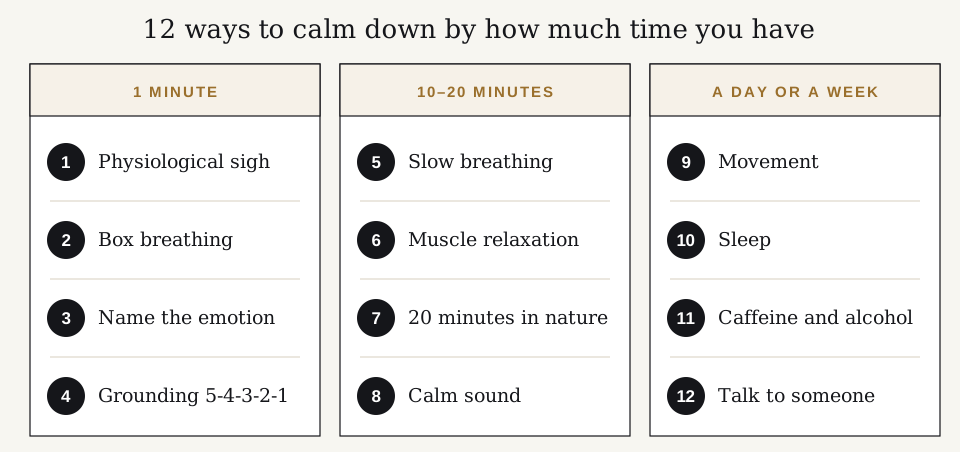
When everything inside you is racing, “just calm down” does not help. You can calm down, but not by willpower alone: you need an action that changes what is happening in your body and in your head. This article gives you 12 methods, arranged by how much time you have: one minute, ten or twenty minutes, or a whole day and week.
Each method says how to do it and what research says about it. Several of them you can try right now with the free MDU tools.
In short
Right now (1 minute): a long exhale, naming the emotion, grounding with your senses.
In 10–20 minutes: slow breathing, muscle relaxation, a walk in nature, calm sound.
For the longer term: movement, sleep, less caffeine and alcohol, talking to someone.
If anxiety lasts for months or interferes with daily life, self-help is not enough. See “When to seek help”.
What happens when we feel anxious
The American Psychological Association separates two states. Stress usually has an external trigger: a deadline, an argument, unexpected news. Anxiety is defined by persistent, excessive worry that does not go away even without a stressor. The symptoms overlap: trouble sleeping and concentrating, fatigue, muscle tension, irritability.
The body reacts fast: the heart speeds up, breathing becomes shallow, muscles tighten. Stanford psychiatrist David Spiegel describes how this turns into a snowball: you notice something is happening in your body, think “this must be really bad”, and become more anxious. That is why you can calm down from two directions: from the body to the mind (breathing, muscles, movement) and from the mind to the body (naming the emotion, redirecting attention).
This article is not medical advice and does not treat anxiety disorders. If symptoms are strong or long-lasting, see the last section.
12 methods by how much time you have
12 methods in three groups by how much time you have.
You have 1 minute
1. The physiological sigh
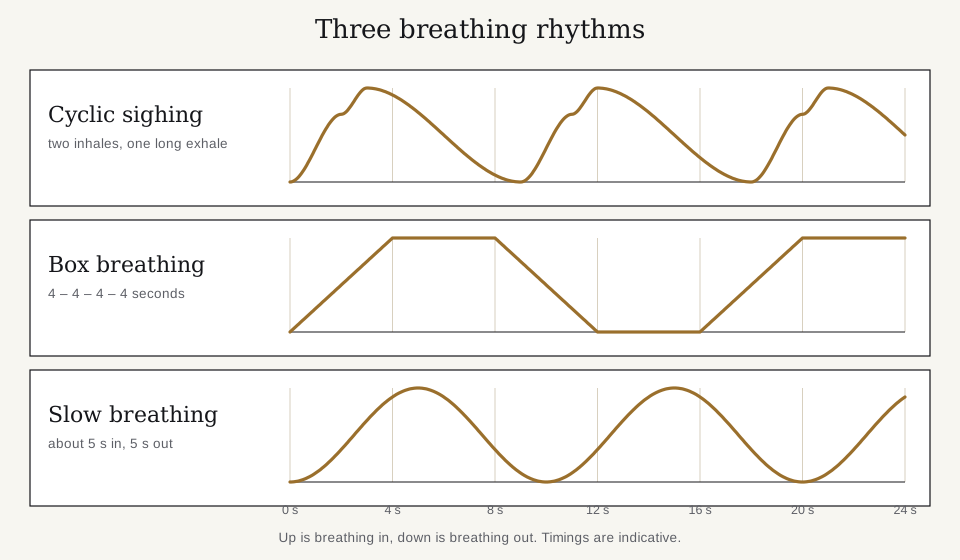
Breathe in through your nose. When your lungs feel full, take a second short “sip” of air to fill them completely. Then breathe out very slowly through your mouth until the air is gone. One to three of these sighs is enough to start slowing the body down.
It is the best-studied short breathing exercise. In a 2023 Stanford randomized trial, 111 healthy volunteers did one of three breathing exercises for 5 minutes a day for a month, while a control group practised mindfulness meditation. The exercise called “cyclic sighing”, with its long exhale, produced the largest increase in positive feelings and the largest drop in resting breathing rate. The participants were healthy, so the study does not show that the exercise treats anxiety disorders. Try it: the physiological sigh exercise.
2. Box breathing
Breathe in for 4 seconds, hold for 4, breathe out for 4, pause for 4. Repeat for 1–2 minutes. The rhythm gives your attention something to hold on to when your head is full of thoughts. In the same Stanford study, box breathing also reduced anxiety and negative mood, but it increased positive feelings less than the sigh did. Try it: the box breathing guide.
3. Name what you feel
Say to yourself, or write down, a precise word: not “bad”, but “fear”, “anger”, “shame”, “exhaustion”, “disappointment”. In a 2007 experiment by Matthew Lieberman’s team, when participants described negative images in words, the response of the amygdala and other limbic regions was weaker than during other tasks. This is called affect labeling. If you are short of words, the emotion wheel helps.
4. Grounding “5-4-3-2-1”
Notice 5 things you can see, 4 things you can feel (the fabric of your clothes, the chair, the floor), 3 things you can hear, 2 things you can smell and 1 you can taste. The technique moves attention from thoughts to sensations in the present moment. It is widely used in psychotherapy, but there are fewer controlled trials of it than of breathing or muscle relaxation, so treat it as a supporting technique.
You have 10–20 minutes
5. Slow breathing at about 6 breaths a minute
Breathe in for about 5 seconds, breathe out for about 5 seconds, and continue for 5–10 minutes. At roughly this rate the heartbeat and breathing synchronise, which is why it is often used in heart rate variability training. A 2024 meta-analysis (31 studies, 1,133 healthy participants) found reliable short-term effects on blood pressure, heart rate and heart rate variability, while the effect on negative emotions, especially perceived stress, was small and borderline significant. So expect the body to settle first, not an instant change of mood. Try it: the coherent breathing exercise with a guiding rhythm.
Three breathing rhythms. Timings are indicative: the chart shows the shape of each rhythm, not a study protocol.
6. Progressive muscle relaxation
Start with your feet. Tense a muscle group firmly for about 5 seconds, then release suddenly and notice the difference for 10–15 seconds. Work upward: calves, thighs, abdomen, hands, shoulders, face. The exercise takes 10–15 minutes. A 2026 meta-analysis of 31 randomized trials (2,277 patients) linked muscle relaxation to lower anxiety (SMD −1.11), although results varied a lot between studies (I² = 85%). A similar principle underlies the body scan meditation.
7. 20 minutes in nature
Go to a park, a forest or at least a green yard and keep your phone in your pocket. In a 2019 US study, participants who spent at least 20 minutes in nature had clearly lower salivary cortisol (a stress hormone): it fell 21.3% per hour, on top of the usual 11.7% daily drop.
8. Calm sound: noise and binaural beats
When surrounding noise gets in the way, a steady background can help: brown noise, pink noise, rain sounds or ocean waves. This is first of all a way to mask distractions, not a treatment.
For binaural beats for anxiety, research is mixed. A 2019 meta-analysis of 22 studies found a medium overall effect (g = 0.45) on memory, attention, anxiety and pain perception combined, but the authors note that the result depends on the frequency used, the length of listening and the timing. Try it with headphones and watch how you feel, not the promises.
You have a day or a week
9. Regular movement
In an overview of systematic reviews published in the British Journal of Sports Medicine in 2023, physical activity was effective in reducing mild-to-moderate symptoms of depression, anxiety and psychological distress compared with usual care (median effect size from −0.42 to −0.60). The World Health Organization also advises regular exercise as self-care, even if it is just a short walk. Any activity you can keep doing regularly works.
10. Sleep and a steady rhythm
Sleep problems are one of the symptoms of anxiety, and a sleepless night often makes anxiety stronger. Try to get up and go to bed at similar times, and do not watch the clock if you wake at night. If sleep problems persist, see the section “When to seek help”.
11. Less caffeine and alcohol
Alcohol may seem calming for a moment but, as the US National Alliance on Mental Illness (NAMI) writes, it can disrupt sleep and worsen mood. Caffeine, including energy drinks, can worsen anxiety by increasing restlessness and jitteriness. Mayo Clinic also notes that too much caffeine can cause anxiety, headache and a faster heart rate. If you feel anxious, count how much coffee and how many energy drinks you have in a day, and cut back for at least a week.
12. Talk to someone
Share what is happening with a close person or a professional. NAMI also advises finding support and sharing your thoughts and fears with others. You do not have to find a solution in the conversation: what matters is that the thoughts move from your head into words.
Why repetition matters
In the Stanford study above, the cyclic sighing group benefited more the more consecutive days they practised. So pick one method that suits you and repeat it daily for 5 minutes, not only in a moment of crisis. You will find timers in the breathing timer and the meditation timer.
The same methods fit different circumstances. How to combine them:
Before an important conversation or exam: 1–3 physiological sighs (method 1), then say to yourself what you feel (method 3). If you have 10 minutes, take a walk or do slow breathing (methods 5 and 7).
After an argument or bad news: slow your breathing first, name the emotion, and put decisions off until your body settles. Talk to someone later (method 12).
At night, when you cannot sleep: turn the clock away, breathe out slowly a few times (methods 1 and 5), try a body scan (method 6) and a steady background sound (method 8).
When your body shakes or your heart pounds: start with a long exhale (method 1) and grounding (method 4). If your chest feels tight or you are short of breath, call emergency services (112 in the EU).
When anxiety returns every day: choose a daily rhythm rather than one crisis exercise: movement, sleep, less caffeine and a 5-minute practice (methods 9–12).
What to avoid when you are trying to calm down
Alcohol as a “calmer”. It can worsen sleep and mood.
One more coffee. Caffeine can increase restlessness.
Trying to switch thoughts off by force. It works better to direct attention to the body or the breath.
Constant self-checking. If you check your pulse every minute or search for symptoms online, vigilance only grows.
When to seek help
See a doctor or a mental health professional if
anxiety or fear lasts for several months;
it interferes with work, study, sleep or relationships;
panic attacks keep happening;
you avoid situations that make you anxious.
The World Health Organization notes that anxiety disorders are the most common mental disorders in the world (about 470 million people in 2023), that there are highly effective treatments, but that only about one in four people with an anxiety disorder receives treatment. Psychological interventions (talk therapy) are an essential part of treatment, and some people are also prescribed medication.
Signs of anxiety (a pounding heart, shortness of breath, chest tightness) can resemble signs of other illnesses, so it is worth talking to a doctor first. If you feel acutely unwell, call your local emergency number (112 in the EU). In Lithuania, emotional support is available by phone on 116 123 (for adults, around the clock).
Frequently asked questions
What is the fastest way to calm down?
The fastest of the studied methods is a long exhale: the physiological sigh or box breathing. Do 1–3 sighs, then name what you feel.
How can I calm down at night when I cannot sleep?
Turn the clock away, breathe out slowly a few times and try a body scan or a steady background sound. If you wake often or sleep problems last for weeks, see the section “When to seek help”.
What is the difference between stress and anxiety?
Stress usually has an external trigger and passes when it is removed. Anxiety is persistent, excessive worry that remains even without a trigger (American Psychological Association).
Do breathing exercises really work?
In controlled studies, short breathing exercises improved mood and lowered resting breathing rate. They are a self-help tool, not a treatment for an anxiety disorder.
Do binaural beats help with anxiety?
A meta-analysis found a medium overall effect, but it depends on frequency, length and timing, and study results are mixed. Try it and watch how you feel.
How long should I practise?
In the Stanford study, participants did a breathing exercise for 5 minutes a day for 30 days, and in the cyclic sighing group the benefit grew with the number of consecutive days.
Lieberman, M. D., et al. (2007). Putting feelings into words: affect labeling disrupts amygdala activity in response to affective stimuli. Psychological Science, 18(5). https://pubmed.ncbi.nlm.nih.gov/17576282/
Hunter, M. R., et al. (2019). Urban nature experiences reduce stress in the context of daily life based on salivary biomarkers. Frontiers in Psychology. https://pmc.ncbi.nlm.nih.gov/articles/PMC6458297/
Garcia-Argibay, M., Santed, M. A., & Reales, J. M. (2019). Efficacy of binaural auditory beats in cognition, anxiety, and pain perception: a meta-analysis. Psychological Research, 83, 357–372. https://pubmed.ncbi.nlm.nih.gov/30073406/
Singh, B., et al. (2023). Effectiveness of physical activity interventions for improving depression, anxiety and distress: an overview of systematic reviews. British Journal of Sports Medicine, 57(18), 1203–1209. https://pubmed.ncbi.nlm.nih.gov/36796860/
Mind University – lietuviška žinių platforma, vienijanti geriausius mentorius, tyrėjus ir praktikus asmeninio augimo, sveikatos, istorijos ir dvasingumo srityse. Kursai, knygos ir seminarai, padedantys gyvenimą pakeisti iš esmės.






Comments (0)
No comments yet. Be the first!
Only logged-in users can comment. Register — and you'll be able to share your thoughts on this article.
Register