



Why can a social encounter become more frightening after it has ended, even when nothing visibly went wrong? Cognitive behavioral therapy offers one explanation: anxiety involves not only what happens between people, but also what someone predicts beforehand and concludes afterward. Social anxiety centers on the fear of being judged or humiliated. Calling it shyness can conceal this continuing inner activity.
A person may speak during a meeting, answer a question, or join a conversation while privately anticipating rejection. Later, a pause or an uncertain expression can become the focus of repeated examination. Outward participation does not necessarily reveal the distress involved, and leaving the room does not necessarily end it.
This makes social anxiety a question of awareness as well as behavior. The distinction concerns the difference between an encounter and the mental account built around it. The account can feel convincing without being a complete record, particularly when the person examining it already expects to find evidence against themselves.
What distinguishes social anxiety from shyness and introversion?
Shyness describes discomfort or inhibition in social contact. Introversion concerns a person's preference for less social stimulation or more time alone. Neither, by itself, means that someone expects humiliation or experiences a persistent struggle with being evaluated.
These experiences can overlap, but they are not interchangeable. Someone may prefer a quiet evening without fearing a gathering. Another person may want company intensely and still avoid it because being noticed feels threatening. The wish for connection and the fear of exposure can coexist.
As ema.live describes it, social anxiety involves “an intense fear of being judged and humiliated.” The emphasis belongs on the feared judgment, not on how much a person speaks. Quietness alone tells an observer little about the inner experience behind it.
Social anxiety can involve cognitive, emotional, physical, and behavioral difficulties. Reducing it to a personality label leaves out this range of experience, as well as its possible interference with relationships and everyday activities. A preference is not the same thing as feeling unable to do something one wants or needs to do.
Nor does every uncomfortable encounter indicate a disorder. Nervousness in a particular situation is not enough to establish a diagnosis. Persistence, distress, and interference matter, and a qualified professional can assess those dimensions without treating ordinary differences in temperament as illness.
The misunderstanding becomes especially consequential when advice assumes that the person simply needs to become more outgoing. More visible participation would not necessarily address the feared evaluation. It might leave the person performing sociability while continuing to feel under examination.
Tracing anticipation, avoidance, and the after-event replay
In a cognitive behavioral account, a feared social situation begins before the encounter itself. A prediction forms: speaking will expose inadequacy, uncertainty will invite ridicule, or a mistake will lead to rejection. These are expectations about what might happen, but they can organize attention as though the outcome were already settled.
During the encounter, attention may turn inward. Instead of following the conversation, the person watches their own performance and searches for signs of failure. A moment of uncertainty then has two competing demands attached to it: taking part in the exchange and checking whether taking part is going badly.
Avoidance fits into this pattern because it removes an immediate confrontation with the feared outcome. Yet avoiding a situation also leaves the prediction untested. Within the cognitive behavioral model, this is one reason the pattern can maintain itself: the absence of humiliation gets attributed to staying away rather than becoming an opportunity to reconsider the expectation.
Less visible forms of avoidance can occur inside participation. Someone might speak only when certain of the wording, avoid expressing disagreement, or rehearse a brief contribution repeatedly. These examples are not diagnostic signs on their own. Their meaning depends on whether they express a preference or are attempts to prevent an anticipated social catastrophe.
The encounter can then become material for post-event rumination. This is more than remembering what happened. The person repeatedly examines selected details, often with the aim of deciding whether they appeared foolish, intrusive, or inadequate. An ambiguous moment can acquire greater significance each time it is revisited.
Reassurance addresses a conclusion, but it may leave this process untouched. A friend's observation that the conversation seemed ordinary does not automatically change the habit of searching memory for a hidden mistake. The anxious review may even shift to whether the friend is being polite.
There is a meaningful difference between reflection and repetitive self-prosecution. Reflection can identify a specific action, acknowledge uncertainty, and reach a stopping point. Rumination keeps reopening the case without necessarily producing new information. In that framework, the difficulty is not excessive self-knowledge but an examination whose rules make acquittal hard to accept.
The prediction-and-replay observation practice
A modest observation practice can make this sequence more visible. It is not a diagnostic test or a substitute for treatment. Its purpose is to separate a prediction, an observable event, and a later interpretation, without requiring you to feel confident before taking part.
The first part happens before a manageable social moment. A brief exchange or a small contribution to a familiar conversation gives the practice a defined setting. The occasion need not be the one you fear most, and there is no requirement to provoke intense distress in order to learn something about your own expectations.
The prediction goes into a short written sentence. Specific wording matters: expecting another person to laugh at a question is more observable than expecting the whole encounter to be a disaster. If the fear concerns a private judgment that cannot be directly observed, the record can acknowledge that limit rather than pretending to read another person's mind.
A second sentence records what you feel inclined to do to prevent the feared outcome. You may notice an urge to remain silent, rewrite a message repeatedly, or abandon the exchange. This identifies the protective behavior without treating it as a character flaw.
The small experiment consists of changing one manageable element. In an ordinary, low-stakes exchange, you might ask the question you would otherwise withhold, or contribute a brief comment without rehearsing every word. The boundary matters: this is not an invitation to enter an unsafe situation, ignore mistreatment, or attempt a demanding exposure exercise alone.
During the interaction, the observation can stay simple. You participate as much as the situation allows and notice what the other person says or does. Perfect attention is not the task, and repeatedly checking whether you are observing correctly would only add another performance standard.
Immediately afterward, a brief factual record comes before evaluation. It might describe that the question was answered, that the conversation continued, or that someone disagreed with a point. Descriptions of actions belong here; claims about what everyone secretly thought do not.
The distinction between these stages is central to understanding social anxiety: an anticipated humiliation, an actual exchange, and a remembered verdict are related experiences, but they are not the same event. Keeping them separate makes room for uncertainty where anxiety may prefer a settled conclusion.
The next part concerns the replay. If the exchange returns to mind later, you can note what has been added since the initial record. A pause may now seem like disapproval, or a short answer may have become evidence of dislike. The relevant observation is that an interpretation has appeared, not that it must immediately be disproved.
A useful comparison places the original prediction beside the recorded outcome. The result may contradict the expectation, partly resemble it, or remain unclear. All three possibilities belong in the exercise. Calling an ambiguous result a success would be as inaccurate as automatically calling it a failure.
An awkward moment also deserves a proportionate description. Perhaps a sentence was unclear and needed repeating. That observation does not establish that the speaker is incapable of conversation. The practice distinguishes a particular difficulty from a global judgment about identity without insisting that every encounter went well.
The final part gives the review a boundary. A short record can end with what is known, what remains unknown, and whether there is a concrete action to take. If the mind returns to the same material without new evidence, that return can be recognized as repetition rather than another obligation to investigate.
This exercise does not promise relief, and insight alone does not end an entrenched pattern. If recording encounters becomes another demanding ritual, or the experiment feels overwhelming, it is reasonable to stop and discuss the difficulty with a professional. The practice is meant to observe the process, not create a new standard you must meet.
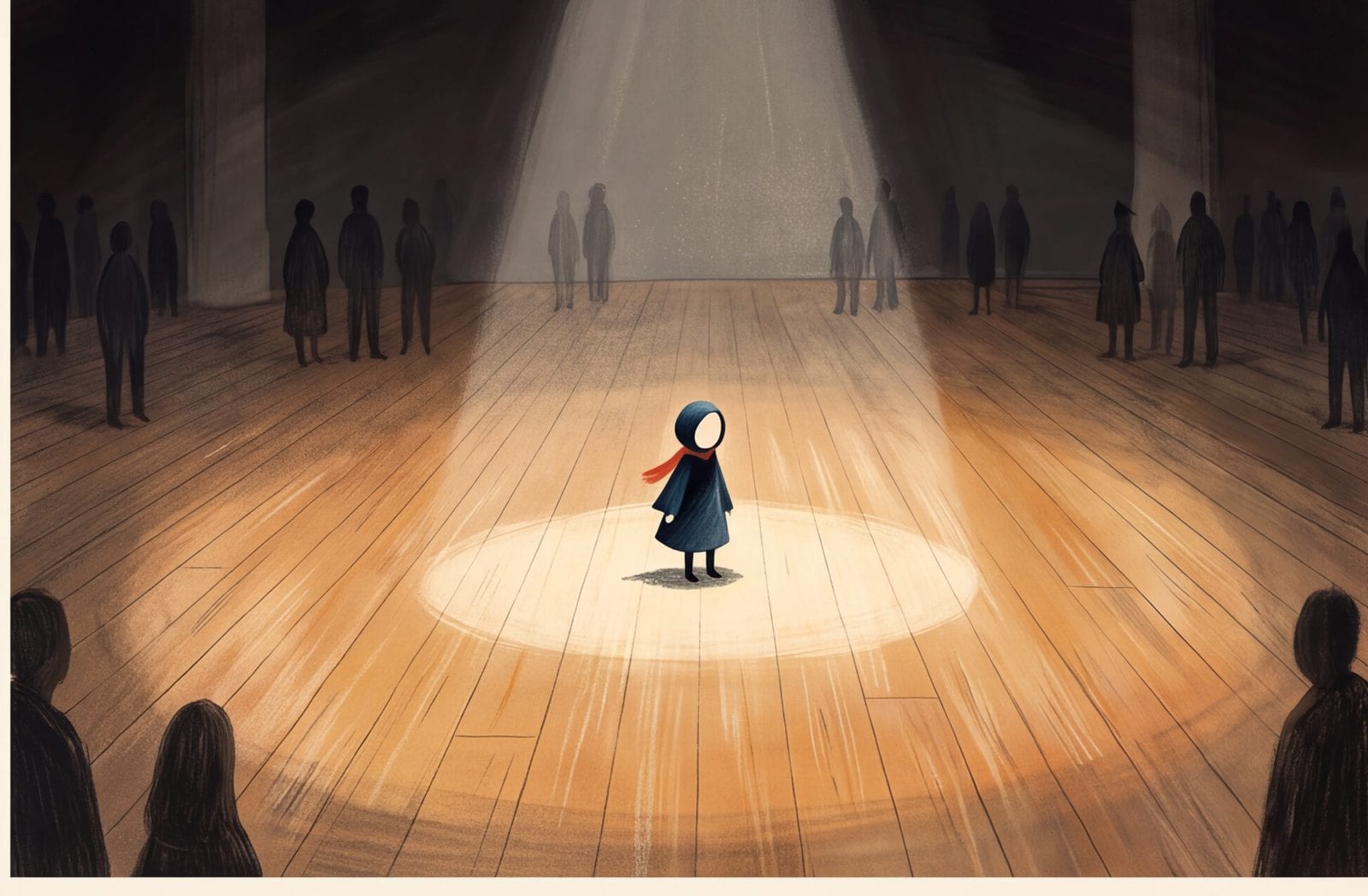
What might fear of judgment reveal about belonging?
A deeper interpretation begins where the behavioral description leaves a question open: what does being judged mean to this particular person? A mistake may carry more than the prospect of temporary embarrassment. In a psychodynamic reading, it might seem to threaten permission to belong, to speak, or to remain visible among others.
This is an interpretive possibility, not an established explanation for every case of social anxiety. It does not establish a hidden event in someone's past, and it does not mean that a person secretly chooses their distress. Its value depends on whether it describes the individual's experience without forcing that experience into a predetermined story.
Jung's analytical psychology offers a language for considering the relationship between a social identity and the parts of oneself that feel difficult to reveal. Used cautiously, this perspective can frame anxiety as a conflict around visibility. A person might feel permitted to appear competent but not uncertain, agreeable but not disappointed, useful but not in need.
These are possible inner rules, not universal features of the condition. Someone may recognize none of them. Another person may discover that the feared judgment is narrowly specific: being seen as demanding, foolish, weak, or insufficiently controlled. The content matters because apparently similar acts of avoidance can protect against different imagined consequences.
The image of an inner witness can describe the sense of carrying an audience into solitude. In this metaphor, the social encounter continues because an internal observer keeps assessing it. That observer is not a separate entity or a mystical presence. It is a way of giving language to evaluative activity that otherwise feels indistinguishable from truth.
This interpretation also complicates the instruction to be authentic. Revealing an ordinary preference may feel costly if someone expects acceptance to depend on concealing it. Encouraging disclosure without understanding the feared consequence can underestimate the person's dilemma. Authenticity is not necessarily experienced as freedom when visibility itself feels dangerous.
Accounts involving body memory need similar care. A bodily reaction can feel familiar before a person can explain it, but that familiarity does not prove a forgotten trauma or identify a particular cause. In a depth-oriented reading, bodily experience may invite curiosity about meaning; it does not authorize certainty about an unseen history.
Comments (0)
No comments yet. Be the first!
Only logged-in users can comment. Register — and you'll be able to share your thoughts on this article.
Register