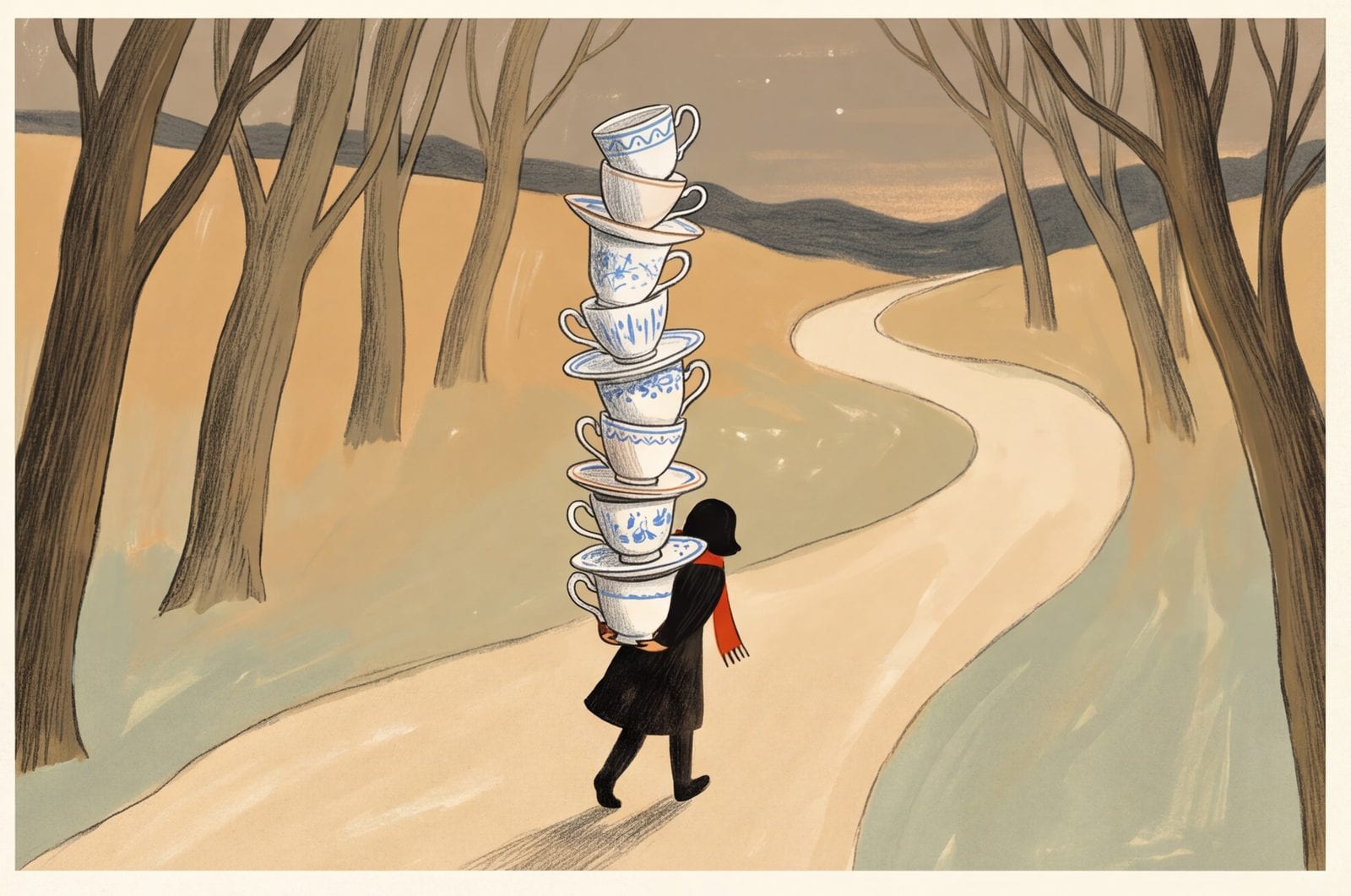
Why can refusing a request feel like doing something wrong, even when agreeing means neglecting yourself? People pleasing means repeatedly meeting other people’s needs at your own expense. Attachment theory offers one psychological frame for understanding that conflict; Carl Jung’s ideas about the persona offer a more interpretive way to consider the identity built around being agreeable.
You may recognize the contradiction before you have a name for it. Someone asks for a favor, you agree, and resentment arrives before the conversation has ended. Later, you criticize yourself for feeling resentful, as though the only acceptable options were wholehearted generosity or selfishness.
The difficulty is not always in knowing what you want. Sometimes you know perfectly well that you need rest, disagree with a decision, or do not want to take responsibility for another person’s problem. The difficulty lies in allowing that knowledge to matter when someone else might be disappointed.
When does kindness become self-abandonment?
Kindness and people pleasing can look identical from the outside. Both may involve listening, making accommodations, or offering time. The distinction lies partly in whether you experience a meaningful choice, including permission to decline without treating your refusal as evidence of personal failure.
A generous decision can involve inconvenience. Caring for someone does not require every exchange to be equal, and a difficult week can reasonably shift attention toward another person. The pattern becomes more concerning when your needs are routinely excluded from consideration, rather than consciously weighed alongside theirs.
As ema.live puts it, a people pleaser meets others’ needs “at their own expense.” The expense may be visible, such as an overloaded schedule, or less obvious, such as repeatedly concealing an opinion. You might preserve an agreeable conversation while losing the opportunity to be known accurately within it.
Guilt deserves particular attention because it can seem like an authoritative verdict. Yet feeling guilty and having harmed someone are not the same event. A refusal may violate an expectation you have learned to obey without violating a responsibility you have genuinely accepted.
That distinction requires context. Declining an optional favor differs from abandoning a commitment, and protecting your time does not erase another person’s legitimate needs. Awareness involves examining the actual obligation rather than automatically assuming either that every request must be met or that every demand is unreasonable.
There is also a quieter loss: uncertainty about your own preferences. If you habitually check what everyone else wants before consulting yourself, your answer may arrive late. Not knowing what you want in that moment need not mean you have no wishes; it may mean that attending to them has rarely been the first task.
How can attachment shape an automatic yes?
Attachment theory concerns the relationship between closeness, security, and expectations of other people. Applied cautiously, it offers a way to understand why disagreement might feel larger than the immediate situation. A small difference of opinion can carry the feared consequence of losing connection.
In this frame, early relationships may contribute to an expectation that acceptance depends on being accommodating. A child who experiences approval as conditional may learn to monitor another person’s mood before expressing a need. This is a possible developmental pathway, not a conclusion that can be drawn from a habit of apologizing.
The childhood question is therefore more precise than whether someone had a good or bad upbringing. It concerns what happened when they were inconvenient, angry, dependent, or different. There can be affection within a relationship and still be limited room for certain feelings.
For an adult carrying that expectation, a request may contain two separate tasks. One is the practical decision about whether to help. The other is the emotional task of preserving the relationship, which may feel urgent enough to override the practical decision before it has been considered.
The term fawn response describes appeasing another person in the face of perceived threat. It offers a possible trauma-related account of some people-pleasing behavior. It does not establish that everyone who avoids conflict has experienced trauma, nor does an agreeable manner identify a particular history.
Reading these ideas as explanations rather than diagnoses matters. Similar behavior can carry different meanings in different circumstances. Agreeing with someone who has power over your housing or livelihood is not equivalent to agreeing with a friend about dinner, even if both situations produce discomfort.
Attachment language also becomes misleading when it hardens into a personality label. A tendency to seek reassurance does not explain every decision, and no single attachment description captures an entire person. The useful question concerns what you expect will happen between you and another person if you stop accommodating them.
Simple advice about assertiveness often overlooks this expectation. A person may already know the words for declining while finding the imagined relational consequences intolerable. The obstacle is then not a missing phrase but the meaning attached to using it.
The recent-request observation practice
A modest observation practice begins with one recent, relatively low-stakes interaction. It does not require confronting anyone or making a new commitment. Its purpose is to examine a particular decision closely enough to distinguish the request, your reaction, and what you believed was at stake.
The starting point is a plain description of what happened. A friend wanted a call after a tiring day, for example, or someone asked you to take on an additional task. An imagined example is useful only if it stays specific; a real incident usually offers more detail than a general judgment that you always give too much.
The next part separates what the other person asked from what you silently added. A request for an evening conversation may become an internal obligation to remain available indefinitely. Someone’s disappointment may become, in your interpretation, proof that the relationship is in danger. Those additions are part of the experience, but they are not necessarily part of the request.
The description of a people pleaser on ema.live provides a fuller account of the pattern, including its possible childhood roots and connection with attachment. For personal observation, however, the label matters less than the details of this one exchange. Naming a pattern should not replace noticing how it operates.
Attention can then turn to the first response in your body. You may remember tension in your jaw, a sinking sensation, warmth in your face, or nothing distinctive. These observations do not prove trauma or reveal a hidden truth; they record what you experienced while deciding.
The feared consequence needs equally concrete language. You might have expected irritation, withdrawal, an argument, or a judgment that you were selfish. It is useful to distinguish something the other person has done before from something you anticipated without clear evidence in that situation.
Your own preference belongs in the record as well. Perhaps you wanted to help, but for less time. Perhaps you wanted to decline entirely. Mixed answers count: affection for another person and reluctance to meet a particular request can exist together.
The cost of agreeing can then be described without exaggeration. It may have meant missing rest, postponing your work, or hiding disagreement. There may also have been a genuine benefit, such as enjoying part of the conversation. An accurate account allows both rather than turning every act of accommodation into evidence against the relationship.
A final comparison concerns choice and fear. You can consider whether you would have made the same decision if you had felt confident that a respectful refusal would not threaten your connection. The answer is not a test score, and uncertainty is an acceptable result. The comparison simply gives the emotional pressure a more visible place in the decision.
In a future low-stakes exchange, a brief pause before answering can become the practical experiment. The pause might consist of checking your schedule or acknowledging that you need time to consider the request. It is not a disguised refusal; it creates an interval in which an answer can remain undecided.
The observation continues after that interval. You may notice an urge to explain at length, retract a limit, or offer something extra before the other person has reacted. You may also find that the other person accepts your answer without difficulty. Neither response should be forced into a predetermined story.
This practice has limits where disagreement carries a credible risk of retaliation or harm. In a coercive relationship, experimenting with refusal is not a neutral exercise, and professional support may be appropriate. Persistent distress or serious disruption to daily life also warrants attention from a qualified mental health professional, rather than reliance on private reflection alone.
What might Jung’s persona conceal?
Carl Jung used the concept of the persona to describe the social face through which a person meets the world. Within Jungian psychology, the persona is not simply a lie. Social roles make shared life possible, but difficulty can arise when a person identifies so completely with a role that other parts of experience become unacceptable.
Applied to people pleasing, this offers a possible interpretation of the identity of the endlessly understanding person. If being good has come to mean never disappointing anyone, anger and refusal can feel incompatible with who one is allowed to be. The pressure concerns identity as well as behavior.
Jung’s concept of the shadow provides a related lens for considering qualities that the conscious self rejects or fails to acknowledge. In this interpretation, the excluded material need not be cruel or destructive. It could include ordinary assertiveness, a wish to receive care, or the capacity to prefer one thing over another.
This is an interpretive framework, not a scientifically established explanation for a particular person’s motives. Feeling reluctant to help does not demonstrate a hidden shadow conflict. The value of the lens lies in the possibilities it makes thinkable, not in granting someone authority to announce what another person unconsciously wants.
Anger becomes particularly interesting within that framework. A person committed to being agreeable may regard anger as evidence of moral failure, even when it concerns an unwanted burden. The feeling may therefore be concealed, criticized, or explained away rather than considered as part of the situation.
It would still be too simple to declare that people pleasing is repressed anger. Resentment can follow repeated unwanted agreement, but that does not make anger the original cause of every accommodating act. Fear, affection, uncertainty, and habit may all be present, and their relative importance can change from one encounter to another.
A Jungian reading might also consider the wish to preserve an inner image. Someone may need to remain, in their own eyes, the reliable person who never asks for much. Receiving care could then feel as disruptive as refusing a request because both expose needs that the familiar identity leaves out.
This possibility does not turn kindness into manipulation. Wanting to be seen favorably is not, by itself, evidence of narcissism or a personality disorder. Nor is the label people pleaser sufficient grounds to classify someone as a warning sign in a relationship. What matters includes how they communicate, what happens to their unspoken expectations, and whether both people can acknowledge the consequences.
The same caution applies to intuition and bodily experience. A strong sensation may deserve attention without being treated as an infallible instruction. Through the Jungian lens, awareness involves making room for a disallowed part of experience; it does not require obeying every impulse that becomes noticeable.
The deeper possibility is not that an agreeable person must uncover a more authentic, angry self underneath. It is that a single approved identity may be too narrow to contain a whole person. Care and firmness, generosity and limitation, can belong to the same life without either side invalidating the other.
Observing what happens after a limit
The self-reinforcing part of people pleasing can become clearest after agreement. If saying yes immediately reduces tension, that relief may encourage the same response next time. The later cost arrives separately, sometimes hours or days after the moment when compliance seemed to resolve the problem.
This sequence can leave refusal largely untested. When you routinely agree before another person has the chance to respond to a limit, you receive little new information about how that relationship handles difference. The feared consequence remains an expectation rather than an event that has been observed.
Not every expectation is mistaken. Some people do respond poorly to limits, and recognition of that fact belongs alongside attention to your own pattern. The aim is not to assume that all discomfort comes from the past or that every relationship will become more accepting if you communicate carefully enough.
After setting a limit, guilt can be recorded alongside the actual response, rather than being allowed to erase everything else you know about the exchange.
A workable next entry in the observation practice is therefore small and factual: the request, the answer you gave, what you expected, and what happened afterward. Over time, such records can show where your predictions match experience and where they do not. The next request then becomes a specific situation to consider, rather than an immediate verdict on whether you are a good person.
Key Takeaways
- People pleasing is when meeting others’ needs repeatedly comes at your own expense, and the key difference from kindness is whether you can freely decline without treating that as failure.
- Attachment theory suggests that an automatic yes can come from fearing disconnection, while Jung’s ideas about the persona and shadow frame people pleasing as a social role that may hide anger, needs, or limits.
- A simple observation practice can help by tracking a recent request, your added assumptions, your bodily reaction, the feared consequence, and what actually happened after you set or considered a limit.
Frequently Asked Questions
When does kindness become people pleasing?
Kindness becomes more concerning when your needs are routinely excluded from consideration, rather than consciously weighed alongside someone else’s. The article says the difference also involves whether you feel you have a real choice, including permission to decline.
How can attachment theory help explain an automatic yes?
The article says attachment theory looks at closeness, security, and expectations of other people. In this frame, early relationships may teach someone that acceptance depends on being accommodating, so a request can feel like it risks the relationship.
What is the recent-request observation practice?
It is a small exercise that asks you to review one recent low-stakes request in detail: what happened, what you added to the request, what you felt in your body, what you feared would happen, what you wanted, and what actually happened afterward.
What does Jung’s idea of the persona add?
The article says the persona is the social face through which a person meets the world. Applied here, it can help explain how someone may identify so strongly with being agreeable that anger, refusal, or wanting care feels incompatible with who they are allowed to be.




Comments (0)
No comments yet. Be the first!
Only logged-in users can comment. Register — and you'll be able to share your thoughts on this article.
Register