



- Trataka is described in the Hatha Yoga Pradipika, a 15th-century text by Svātmārāma, as one of six cleansing practices (shatkarma) in chapter 2.
- Verse 2.31 of the Hatha Yoga Pradipika defines trataka as gazing steadily at a small mark, while calm, until the eyes fill with tears.
- The same text claims in verse 2.32 that trataka destroys eye diseases; a 2021 narrative review of shatkarma studies found no evidence supporting a role for trataka in eye disorders.
- In a randomised trial of 60 older adults in India (Talwadkar and colleagues, 2014), a month of trataka improved scores on attention and mental-flexibility tests compared with a waiting group.
- In a study of 30 healthy young men (Raghavendra and Singh, 2016), Stroop test performance was better after one trataka session than after a control session.
- The candle flame is the most common modern object for trataka; the classic text speaks only of a small mark, and a black dot or a symbol are also used.
What is trataka meditation?
Trataka is a concentration practice from hatha yoga in which you gaze steadily at one small point without moving your eyes, and then close them. In modern practice the point is usually a candle flame, which is why trataka is also called candle meditation or candle gazing.
It differs from most other meditation styles on this site in one way: the eyes are open and working. Breath counting, the body scan and loving-kindness meditation turn attention inwards with the eyes closed or lowered; trataka gives attention a single visual target, and only in the second stage turns inwards.
The practice has two parts. First the outer gaze: looking at the flame with soft, steady attention. Then the inner gaze: closing the eyes and watching the image of the flame that remains, until it fades.
Trataka in the Hatha Yoga Pradipika: what the text says
The classic source of trataka is the Hatha Yoga Pradipika, written by Svātmārāma in the 15th century. In its second chapter, trataka is one of the six shatkarmas, the cleansing practices of hatha yoga.
Verse 2.31, in Pancham Sinh's 1914 translation, gives the whole method in one line: "Being calm, one should gaze steadily at a small mark, till eyes are filled with tears. This is called Trataka by âchâryas." Âchâryas are teachers.
Verse 2.32 adds: "Trâtaka destroys the eye diseases and removes sloth, etc. It should be kept secret very carefully, like a box of jewellery." This is the claim of a 15th-century text, not a medical fact. The section on eyesight below explains what research says about it.
The text speaks of "a small mark", not a candle. A small object, a symbol, a black dot or a candle flame are all used today, and the flame has become the most common choice.
How to do trataka candle meditation step by step
To do trataka, place a candle at eye level about an arm's length away, sit still, gaze softly at the flame, then close your eyes and watch the after-image. The timer above guides a 6-minute session: 10 seconds to settle, then three cycles of 1 minute gazing and 1 minute with the eyes closed, with a soft bell at each change.
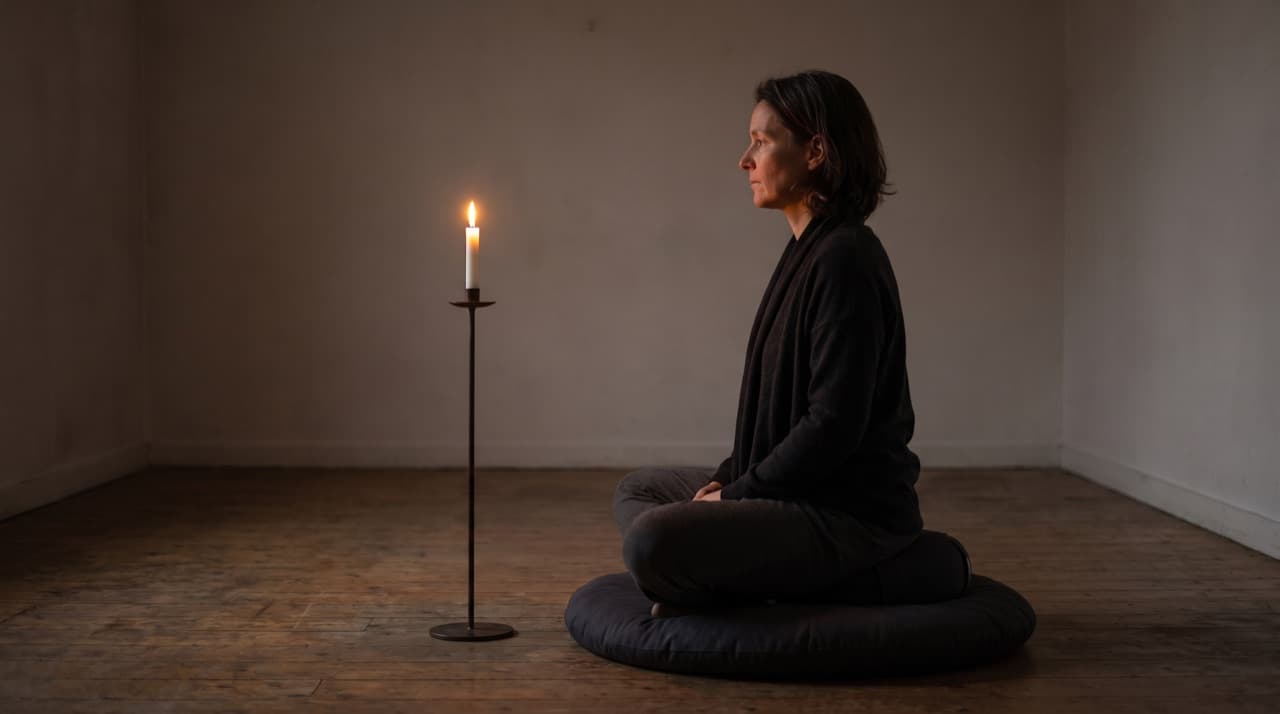
- Prepare the room. Dim the lights and close the windows so the flame does not flicker in a draught. Put the candle in a stable holder on a table, away from curtains and anything that can burn.
- Set the height and distance. The flame should be at eye level, so you look straight ahead without tilting the head, about an arm's length from your face.
- Sit. Use a chair or a cushion with your back upright and your shoulders loose. Take a few slow breaths.
- Gaze. Look at the flame. Keep the eyes soft and still. Try not to blink, but only as long as it stays comfortable.
- Return when you drift. When thoughts take you away, or the eyes start to wander, bring the gaze back to the flame without frustration.
- Close the eyes. At the bell, close your eyes; the screen goes fully black. You will usually see an after-image of the flame. Watch it calmly until it fades or drifts away. At the next bell, open the eyes and gaze again; the timer repeats this three times.
- Finish. At the final bell, sit a moment longer, open the eyes slowly, and blow out the candle.
If you have no candle, the timer shows a realistic looping video of a candle flame on a black background during each gazing minute, created with AI (Higgsfield). You can show it full screen and adjust its brightness and the size of the flame, and during each eyes-closed minute the screen goes fully black so no light disturbs the after-image. It is a convenient substitute; a real candle at a proper distance is closer to the traditional practice.
Candle, dot or screen: what to gaze at in trataka
A candle flame is the usual object for trataka today, but the original text only asks for "a small mark", so a black dot, a small symbol or another small object are equally valid. Each has practical pros and cons:
| Object | In practice | What to watch for |
|---|---|---|
| Candle flame | The most common modern choice; bright and easy to hold attention on, and leaves a clear after-image | Fire safety: stable holder, nothing flammable nearby, never leave it burning |
| Black dot on white paper | Closest to the "small mark" of the Hatha Yoga Pradipika; no flicker, no fire | Fix it at eye level so the head stays straight |
| Small symbol or object | Used in some schools; anything small and still | Choose something plain so the eyes do not wander over details |
| Flame on screen (this timer) | Always available, no fire; a realistic AI-made video of a candle flame, full screen if you like | Turn the brightness down in a dark room; the timer lets you adjust brightness and flame size |
Trataka benefits: what the studies found
Small trials have found better scores on attention and mental-flexibility tests after trataka, compared with waiting or a control session. The best-known is a randomised trial at SVYASA, a yoga university in Bengaluru (Talwadkar, Jagannathan and Raghuram, 2014, International Journal of Yoga). 60 older adults practised trataka for one month (26 days) or waited. The trataka group improved on a letter-cancellation attention test and on Trail Making Test B, a test of mental flexibility, both right after practice and at one month, and on digit span at one month.
A one-session study (Raghavendra and Singh, 2016) had 30 healthy men aged 18–31 do the Stroop test, which measures how well you can ignore a distracting word, after a trataka session and, on another day, after a control session. Their performance was better after trataka.
Newer trials follow the same pattern. The main studies are summarised here:
| Study | Who | Comparison | Finding |
|---|---|---|---|
| Talwadkar and colleagues, 2014 | 60 older adults, India | 1 month of trataka vs waiting list | Better attention and mental-flexibility test scores |
| Raghavendra and Singh, 2016 | 30 healthy men aged 18–31 | One trataka session vs a control session | Better Stroop test performance |
| Pandya, 2024 | 120 children before dental treatment | Trataka vs a relaxation group | Less anxiety |
| Yadav and colleagues, 2026 | 120 young adults | 20 min a day, 6 days a week for 8 weeks vs no intervention | Faster reaction time |
Read these results for what they are: small to medium samples, mostly published in Indian yoga journals, often run by yoga institutions, and compared with no treatment or relaxation rather than another concentration practice. A 2021 narrative review of shatkarma research (Swathi, Raghavendra and Saoji) summed it up: trataka was found to enhance cognition and bring a state of relaxation.
Does trataka improve eyesight?
No: there is no evidence that trataka improves eyesight or treats eye problems. The idea comes from verse 2.32 of the Hatha Yoga Pradipika, which says trataka "destroys the eye diseases". The 2021 narrative review of shatkarma studies found no evidence supporting trataka's role in eye disorders.
So treat trataka as a concentration and meditation practice, not as an eye exercise. If you have any eye condition, its care belongs with an eye doctor, and trataka is not a substitute.
Is trataka safe? Eyes, candle and practical safety
Trataka is a simple practice, but two kinds of care apply: do not force the eyes, and treat the candle as an open flame. No source we checked gives specific eye-safety guidance for candle gazing, so the rules below are plain common sense rather than medical advice.
The old text says to gaze "till eyes are filled with tears". The timer's cue is gentler: gaze without blinking for as long as it is comfortable. If your eyes sting, ache or feel strained, blink, close them, or end the session. Discomfort is a signal to stop, not something to push through.
- Stop if your eyes hurt, and do not try to outlast the urge to blink.
- Put the candle in a stable, non-tipping holder on a heat-proof surface.
- Keep it away from curtains, paper, hair and loose clothing.
- Never leave a burning candle unattended, and blow it out as soon as you finish.
- Keep candles out of reach of children and pets.
- If you feel dizzy, anxious or unwell, open your eyes, look around the room and stop.
As with any meditation, unpleasant experiences are possible. A 2020 review (Farias and colleagues, 83 studies) found that about 8% of participants reported one, most often anxiety. Shorten the session or stop if trataka makes you feel worse.
How long should you practise trataka?
Start with a few minutes in all, alternating gazing and sitting with the eyes closed; there is no proven ideal length. The timer runs three cycles of 1 minute gazing and 1 minute with the eyes closed, 6 minutes in total, which is a comfortable start for most people.
The studies used a range of schedules. The Talwadkar trial ran for 26 days over one month; the 2026 Yadav trial used 20 minutes a day, 6 days a week, for 8 weeks; the Raghavendra study tested a single session. None compared lengths, so they show what has been tried, not what is best.
If the one-minute gazes become easy, run the timer again for a second round or practise longer with your own candle, always staying within what the eyes find comfortable.
The after-image: what to do with the eyes closed
After you close your eyes, you will usually see a bright or coloured image of the flame for a while; in trataka this is the object of the second stage. Rest your attention on it as you did on the real flame. It may drift, change colour or fade; let it, and keep watching the space where it was.
When the image is gone, stay with the darkness behind the eyelids, or with the breath, until the next bell. There is nothing to achieve. The two stages together, gazing and then looking inwards, are the whole practice.
If you want a longer seated practice after trataka, the zazen and breath-counting pages each offer one.

Questions people ask
What is trataka?
Trataka is a yoga concentration practice of gazing steadily at a small point, usually a candle flame, and then closing the eyes to watch its after-image. It is described in the 15th-century Hatha Yoga Pradipika.
How do you do candle meditation?
Place a candle at eye level about an arm's length away, sit upright, gaze softly at the flame for a few minutes without forcing yourself not to blink, then close your eyes and watch the after-image until it fades.
How far should the candle be for trataka?
About an arm's length away, with the flame at eye level so you look straight ahead without tilting your head.
How long should I do trataka?
Start with a few minutes, for example three cycles of 1 minute gazing and 1 minute with the eyes closed, as on this timer. Studies used anything from a single session to 20 minutes a day; none showed an ideal length.
Does trataka improve eyesight?
No. The claim comes from the Hatha Yoga Pradipika, but a 2021 review of the research found no evidence supporting trataka's role in eye disorders.
What are the benefits of trataka?
Small trials in India found better attention and mental-flexibility test scores after a month of trataka in older adults, and better Stroop test performance after a single session in young men. The studies were small and mostly compared trataka with no practice.
Is it OK if my eyes water during trataka?
The old text says to gaze until the eyes fill with tears, but that is not required. Gaze only as long as it is comfortable, and stop if your eyes hurt.
Can I do trataka without a candle?
Yes. The original text only asks for a small mark, so a black dot or a small object work, and this timer shows a realistic video of a candle flame on screen.
What do you see when you close your eyes after candle gazing?
Usually an after-image of the flame, which slowly drifts and fades. In trataka you rest your attention on it as you did on the flame itself.
- Svātmārāma. Hatha Yoga Pradipika, 15th century, chapter 2, verses 2.31–2.32. Translated by Pancham Sinh, 1914 (sacred-texts.com).
- Talwadkar S., Jagannathan A., Raghuram N. Effect of trataka on cognitive functions in the elderly. International Journal of Yoga, 2014, 7 (2), 96–103.
- Raghavendra B. R., Singh P. Immediate effect of yogic visual concentration on cognitive performance. Journal of Traditional and Complementary Medicine, 2016, 6 (1), 34–36.
- Swathi P. S., Raghavendra B. R., Saoji A. A. Health and therapeutic benefits of Shatkarma: a narrative review of scientific studies. Journal of Ayurveda and Integrative Medicine, 2021, 12 (1), 206–212.
- Pandya P. R. International Journal of Yoga, 2024, 17 (3), 217–221.
- Yadav K., et al. International Journal of Yoga, 2026, 19 (2), 195–200.
- Farias M., Maraldi E., Wallenkampf K. C., Lucchetti G. Adverse events in meditation practices and meditation-based therapies: a systematic review. Acta Psychiatrica Scandinavica, 2020, 142 (5), 374–393.
- Wikipedia, "Hatha Yoga Pradipika" and "Trataka" (read 1 October 2026).
On this page the timer runs a 6-minute trataka session: a 10-second settling-in countdown, then three cycles of 1 minute gazing at the candle flame and 1 minute with the eyes closed, with a soft bell at each change and a cue on screen for each stage. The flame is a realistic looping video of a candle flame on a black background, created with AI (Higgsfield); you can show it full screen and adjust its brightness and flame size, and during each eyes-closed minute the screen goes fully black. You can gaze at a real candle instead.