Déjà vu: spiritual meaning, types and what the traditions teach
Déjà vu (French for “already seen”) is a sudden feeling that what is happening now has happened before. About two thirds of people experience it at least once. Spiritual traditions read déjà vu as a memory of a past life, a dream come true, the soul recognising someone or a sign that you are on your path, and mystics teach how to notice it and work with it.
Key facts
The term déjà vu was proposed in 1876 by the French philosopher Émile Boirac and developed in his book L'Avenir des sciences psychiques (1917).
About two thirds of people experience déjà vu at least once, more often the young and frequent travellers.
Related experiences: déjà vécu, déjà senti, déjà visité, déjà rêvé, jamais vu and presque vu.
Plato taught anamnesis: knowledge is the soul's recollection of what it saw before birth.
J. W. Dunne linked déjà vu to dreams of the future in An Experiment with Time (1927).
In reincarnation traditions, déjà vu is seen as a reflection of a past life.
Contents
What does déjà vu mean?
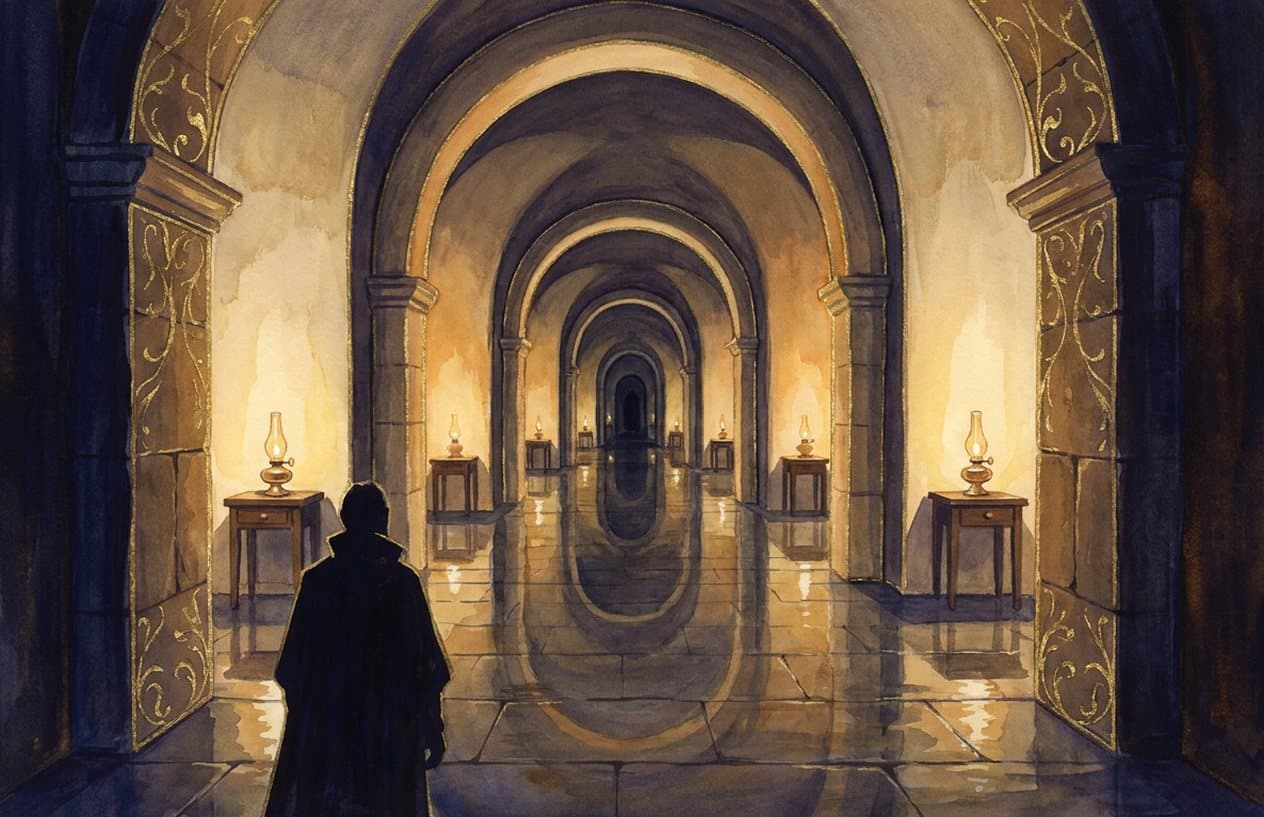
Déjà vu (French for "already seen") is a sudden, vivid feeling that what is happening now has happened before. A room you are entering for the first time feels familiar down to the details. A conversation sounds as if you have already heard every word. The feeling lasts a few seconds and vanishes as suddenly as it came, leaving a strange question behind: how do I know this?
Surveys suggest that around two thirds of people experience déjà vu at least once, most often the young, people who travel a lot and people who dream vividly. Neurologists link the feeling to activity in the temporal lobe. Yet in almost every culture people have taken déjà vu to be more than a quirk of the brain: a memory from another life, a dream coming true, the soul recognising someone, or a sign that you are exactly where you should be.
This page describes how spiritual traditions, mystics and esoteric teachers understand déjà vu, what related experiences there are, and how people work with them in practice.
Where does the word déjà vu come from?
The name was coined by the French philosopher and psychical researcher Émile Boirac. In 1876, while still a student, he described the feeling in a letter to the Revue philosophique, and later developed the idea in his book L'Avenir des sciences psychiques ("The Future of Psychic Sciences", 1917). Boirac was interested not only in déjà vu but in telepathy, clairvoyance and magnetism, so from the start the word lived among the mysterious phenomena of consciousness.
The experience itself is much older. Early in the fifth century, Saint Augustine wrote in On the Trinity about people who claimed to remember earlier lives, and suggested that such "memories" might be planted by other spirits. In the nineteenth century Charles Dickens, in David Copperfield, described the feeling that what we are saying and doing has been said and done before, in a remote time. Before Boirac it was called "paramnesia" or "false recognition".
Types of déjà vu and related experiences
The Jungian researcher Arthur Funkhouser proposed dividing déjà vu into three kinds, and more related experiences were described later. Esoteric writing still uses these names today.
Experience
Literally
What it feels like
Déjà vécu
"already lived"
A full, longer sense that the whole situation, with its sounds, smells and words, has been lived before. Often it even seems you know what comes next.
Déjà senti
"already felt"
What feels familiar is not the situation but a feeling or thought that suddenly seems to have been thought before.
Déjà visité
"already visited"
In a new place you know where the path, the room or the stairs are, though you have never been there.
Déjà rêvé
"already dreamed"
The situation is recognised as something dreamed earlier; sometimes the dream itself is remembered.
Jamais vu
"never seen"
The opposite: a familiar word, face or place suddenly seems completely strange.
Presque vu
"almost seen"
The sense that you are about to grasp or remember something important, but it slips away ("on the tip of the tongue").
The traditions pay special attention to déjà visité and déjà rêvé: the first is linked to past lives, the second to dreams that show the future.
Déjà vu in the spiritual traditions
There is no single spiritual meaning of déjà vu. Different schools explain the same feeling in different ways, and the explanations often complement each other.
Explanation
Who teaches it
What déjà vu means
A memory from a past life
Reincarnation traditions, Theosophists, followers of Edgar Cayce
The soul recognises a place or person it knew before.
The soul's recollection
Plato and the Platonists
The soul remembers what it knew before birth.
A dream come true
J. W. Dunne, dream researchers
You already saw a fragment of the future in a dream, and now it has happened.
Eternal recurrence
P. D. Ouspensky, readers of Nietzsche
Life repeats, and you recognise what you have lived before.
A sign on the path
Modern esotericism
You are in the right place at the right time, on your path.
Crossing timelines
Modern esotericism, the "Matrix" idea
Two versions of reality briefly touch, or the program of reality "glitches".
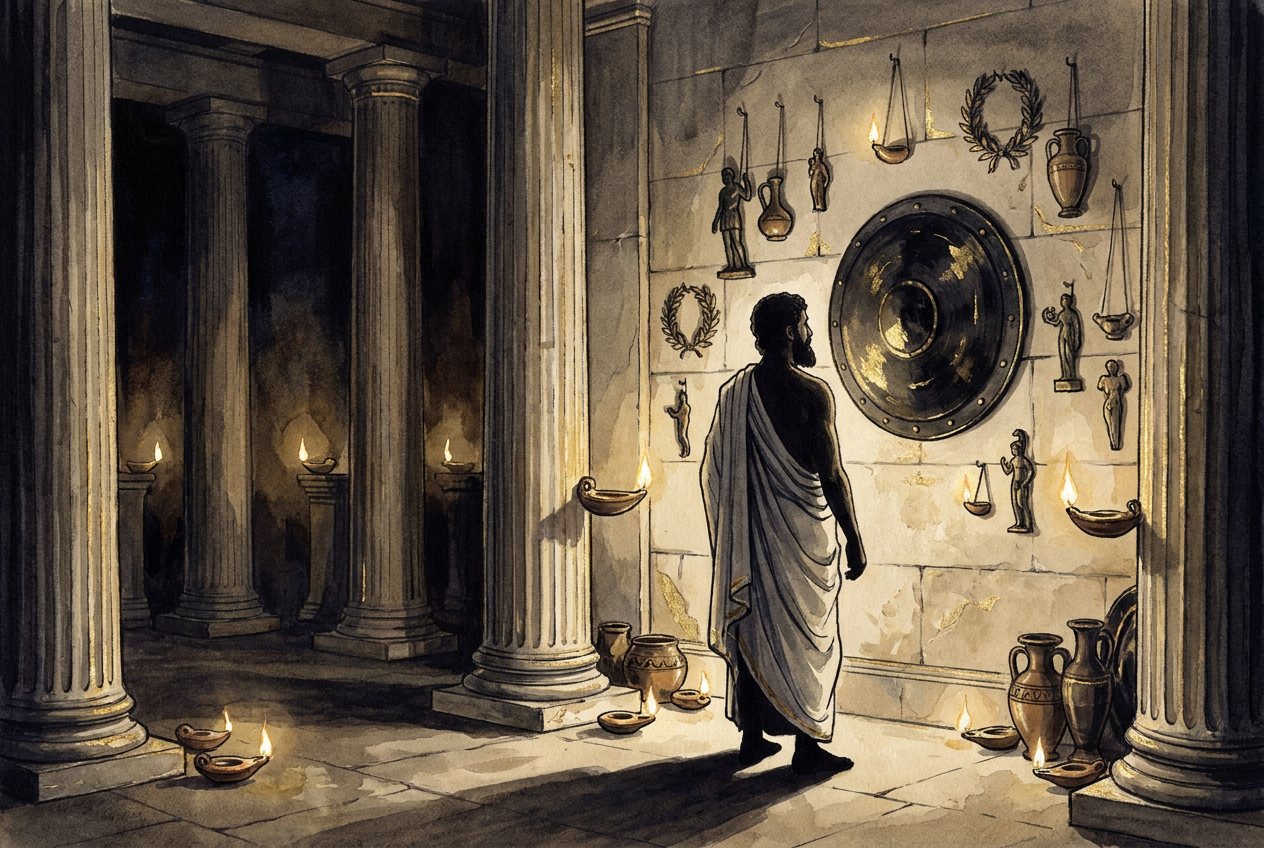
Legend says Pythagoras recognised in a temple the shield he had carried in an earlier life.
Déjà vu as a memory of a past life
The oldest and most popular spiritual explanation links déjà vu to the wheel of rebirth. If the soul is born more than once, it may carry not memories but their reflections: a sudden sense of recognition in a place where it once lived, or near someone it once loved or wronged. In the Indian traditions such traces are called saṃskāra, imprints left by every experience that travel together with karma.
In Buddhism the ability to recall former lives (pubbenivāsānussati) is counted among the highest powers of meditation. According to the Pali Canon, on the night of his awakening the Buddha recalled countless former lives in the first watch, and the Jataka tales describe hundreds of them. The tradition says that for ordinary people such memories open only for moments, and déjà vu is one of those moments.
Twentieth-century researchers of reincarnation tried to test the idea. Ian Stevenson, a psychiatrist at the University of Virginia, spent four decades collecting children's accounts of previous lives, and in Twenty Cases Suggestive of Reincarnation (1966) described children who recognised places and people unknown to them. Esoteric writing often explains déjà visité in just this way: the soul recognises a home it once lived in.
From the tradition
Greek tradition says Pythagoras remembered his earlier lives and claimed that during the Trojan War he had been the warrior Euphorbus. Once, entering the temple of Hera at Argos, he recognised among the offerings the shield of Euphorbus that he himself had once carried. Ovid tells the story in Pythagoras's own voice in Book XV of the Metamorphoses. For Pythagoras it was proof that the soul does not die but only changes bodies.
Recognising souls: déjà vu with people
A special kind of déjà vu arises not in a place but on meeting a person. A face seen for the first time looks familiar, a conversation flows as if continuing something begun long ago, and sometimes there is a strange sense of having been bound to this person before. Esoteric language calls this soul recognition.
Reincarnation traditions link this feeling to karmic bonds: people who lived, loved or fought together in earlier lives meet again to finish what was left unfinished. In his lectures on karmic relationships, Rudolf Steiner taught that the most important meetings in life are not accidental, and Edgar Cayce's "life readings" often describe family members, friends and enemies as souls who had met before.
Teachers suggest receiving such déjà vu calmly. A sense of recognition does not mean this person is necessarily your destiny or soulmate. It means there is something important to learn in this bond, and that may be closeness or a boundary.
Déjà vu, dreams and premonition
Some people not only recognise the situation during déjà vu but also remember having dreamed it. This is called déjà rêvé. It was studied seriously by the British aeronautical engineer and philosopher John William Dunne. In An Experiment with Time (1927) he described keeping a record of his dreams for years and later finding in them events that happened only days or weeks afterwards. Dunne argued that in dreams consciousness moves freely in time, so along with images of the past we also dream fragments of the future.
Dunne's book became a bestseller and influenced J. B. Priestley, T. S. Eliot and J. R. R. Tolkien. His method was simple: write dreams down the moment you wake, before they fade, and review the notes later. Many people who keep dream journals say that in moments of déjà vu they find matches in their notes.
In esoteric tradition déjà rêvé is seen as the beginning of intuition and clairvoyance. People who often experience this kind of déjà vu are said to have a more open bridge between the worlds of dreaming and waking.
What thinkers and teachers taught about déjà vu
Plato: knowledge is recollection
In the Meno and the Phaedo, Plato taught anamnesis: before birth the soul saw the true forms, and in life it only remembers them.
For Platonists, every sudden recognition is a flash of the soul's memory.
Carl Gustav Jung: the second personality
In his autobiography Memories, Dreams, Reflections (1962), Jung recalls seeing an old eighteenth-century carriage as a boy and feeling that he himself had lived in that century.
He linked this feeling to his "personality No. 2", which, in his words, belonged to another time.
P. D. Ouspensky: eternal recurrence
In the novel Strange Life of Ivan Osokin (1915), the hero relives his life knowing what will happen yet unable to change it.
In A New Model of the Universe (1931), Ouspensky wrote that lives repeat in a circle, and the feeling "this has happened before" is a trace of that repetition.
J. W. Dunne: time in dreams
An Experiment with Time (1927) described dreams in which future events are seen.
Dunne believed déjà vu is a forgotten dream of the future suddenly coming true.
Modern esotericism: timelines and "a glitch in the Matrix"
In the twenty-first century déjà vu acquired new, technological names. After the 1999 film The Matrix, in which the hero sees the same black cat pass twice and is told that déjà vu is "a glitch in the Matrix", the phrase entered everyday speech. People began to call déjà vu the moment when reality "stutters" and its program shows through.
Another popular idea borrows from physics. Hugh Everett's 1957 many-worlds interpretation holds that the universe contains countless parallel branches. Esotericism reads it like this: déjà vu is a moment when two timelines briefly touch and you sense a life you are living in another version. The fashion for "reality shifting", in which people deliberately try to move into a desired timeline, treats déjà vu as a sign that the shift has happened.
A third modern idea is the simplest: déjà vu is a sign that you are on your path. In this view the soul "saw" the key points of life before birth, and when you reach them, the sense of recognition confirms that you are heading the right way. Such déjà vu is often reported when starting a new job, meeting an important person or arriving in a place where you will later live.
What happens in a moment of déjà vu: the traditions' view
Esoteric teachers describe the moment of déjà vu as a brief shift of consciousness. The same stages recur in their accounts:
An ordinary moment. Everything is as usual: a conversation, a journey, an everyday task.
Sudden recognition. As if something inside says "I know this", sometimes with a sense of knowing what will happen a second later.
Time thickens. The moment seems to stand still; surroundings grow sharper and sounds clearer. Mystics call it "thin time", when past and present merge.
It fades. The feeling vanishes within seconds, often just as you try to catch it.
The question of meaning. What remains is the question of what it means. The traditions say this question, not the feeling itself, is the most valuable part of déjà vu.
How to work with déjà vu in practice
In spiritual schools déjà vu is not just an oddity to forget quickly. It is seen as an invitation to stop and look. These are the practices teachers mention most often.
A déjà vu journal
Each time you experience déjà vu, write down as soon as you can where you were, who was there, what you were doing, what you felt, and whether it seemed you knew what would happen next. After a few months, read the notes back. Many people notice recurring places, people or life themes that show where their energy is gathered.
A dream journal in Dunne's way
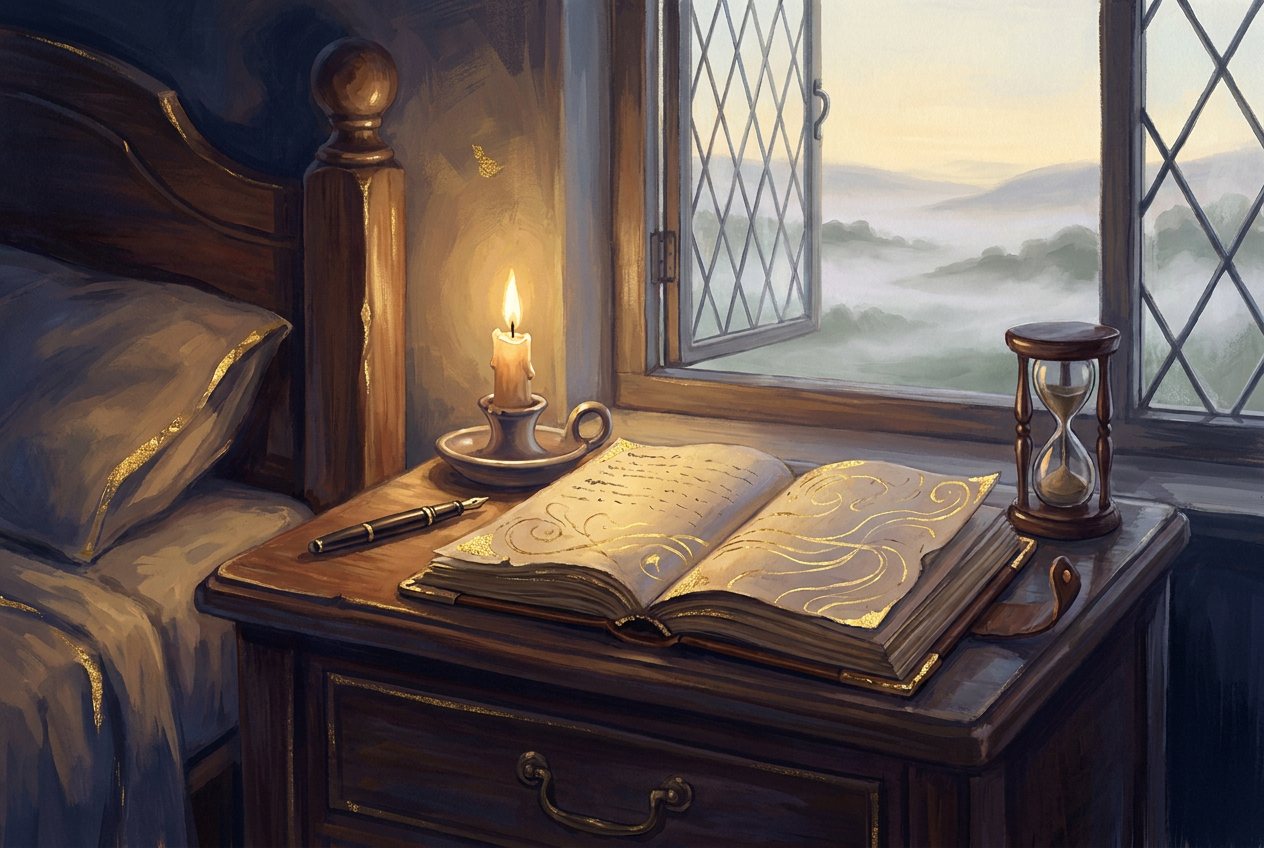
Keep a notebook by the bed and write down dreams the moment you wake, even if you remember only one image. Date each entry. When déjà vu comes, check whether a similar scene appears in your notes. You can look up dream symbols in the dream dictionary.
A dream journal is the oldest way of noticing when a dream and the present meet.
A conscious pause during déjà vu
When the feeling comes, do not try to analyse it. Stop, breathe in and feel your body: feet on the ground, hands, breath. Ask yourself: "Where am I right now? What matters here?" Many teachers say déjà vu opens a brief window of attention, and whoever notices it is fully present in that moment.
Past-life meditation
Esoteric schools practise a visualisation in which, deeply relaxed, you imagine a corridor or stairway leading to an earlier life. Places or people from déjà vu are often used as a starting point: you bring that image into the meditation and let it open. Those who enjoy this practice advise doing it calmly and not insisting on dramatic stories.
Questions to ask yourself after déjà vu
Where was I, and who was with me when it happened?
What feeling did I recognise: calm, unease, joy, longing?
Is this place or person connected with a decision I am making now?
Did I see a similar moment in a dream, or live it before?
What does this moment want me to notice about my present?
When déjà vu comes more often
Both the traditions and researchers notice that déjà vu is not spread at random. It is most often reported at these moments of life:
When travelling. New places, especially old towns, temples and wild nature, most often bring déjà visité.
At turning points. Before a move, a new relationship, a new job or an important decision. Esotericism sees this as confirmation of the path.
After periods of vivid dreaming. People who dream a lot and remember their dreams experience déjà rêvé more often.
On retreats and in spiritual practice. When the mind grows quiet, practitioners describe more frequent moments of "thin time".
In youth. Researchers note that déjà vu becomes rarer with age; mystics say that in youth the soul is still closer to its memories.
Is déjà vu a sign?
Most traditions answer in a similar way: déjà vu is an invitation to pay attention, not a command. It has no single correct translation. For one person it recalls a past life, for another a forgotten dream, for a third it confirms that a decision is right. Teachers suggest asking not "what does it predict?" but "what does this moment show me about my present?".
Rhythm matters too. An occasional déjà vu is an ordinary human experience. If it becomes very frequent or prolonged, or comes with other unusual sensations, it is worth talking to a doctor: in such cases the body comes first, and the spiritual questions can wait.
Self-knowledge guide Ema Sakalauskaitė writes about how psychology and neurology explain déjà vu, why it feels like a sign, and when it is worth seeing a doctor.
Frequently asked questions
What does déjà vu mean spiritually?
Spiritual traditions read déjà vu as a memory of a past life, a dream come true, the soul recognising someone, or a sign that you are in the right place on your path. There is no single correct reading, so teachers suggest asking what the moment shows you about your present.
Is déjà vu a memory of a past life?
Reincarnation traditions, Theosophists and followers of Edgar Cayce believe so: the soul may recognise a place or person it knew before. Déjà visité, the sense of knowing an unfamiliar place, is especially often read this way.
What is the difference between déjà vu and jamais vu?
Déjà vu is the feeling that a new situation has happened before; jamais vu is the opposite, when a familiar word, face or place suddenly seems completely strange.
Can déjà vu be a dream coming true?
That is how déjà rêvé is explained, when a situation is recognised as dreamed before. J. W. Dunne described in An Experiment with Time (1927) dreams in which he saw future events, and recommended keeping a dream journal.
How common is déjà vu?
About two thirds of people have experienced déjà vu at least once. It is reported more often in youth, while travelling, at turning points in life and after periods of vivid dreaming.
What should you do when you experience déjà vu?
The traditions suggest pausing, feeling your body and noticing the moment, then writing it down in a déjà vu journal. If déjà vu becomes very frequent or prolonged, it is worth talking to a doctor.
What does “a glitch in the Matrix” mean?
The phrase became popular after the 1999 film The Matrix, in which déjà vu is called a glitch in the program of reality. In modern esotericism déjà vu is also explained as two timelines touching.
Sources
É. Boirac, L'Avenir des sciences psychiques, Paris, 1917
Plato, Meno and Phaedo
Ovid, Metamorphoses, Book XV
Augustine, On the Trinity (De Trinitate), Book XII
Samyutta Nikaya and Majjhima Nikaya (the Buddha's recollection of former lives), Pali Canon
J. W. Dunne, An Experiment with Time, A. & C. Black, 1927
P. D. Ouspensky, A New Model of the Universe, 1931, and Strange Life of Ivan Osokin, 1915
C. G. Jung, Memories, Dreams, Reflections, 1962
I. Stevenson, Twenty Cases Suggestive of Reincarnation, University Press of Virginia, 1966
A. S. Brown, The Déjà Vu Experience, Psychology Press, 2004