Karma (Sanskrit karman, “action”) is, in the spiritual traditions, the law by which every intention, word and deed sows a seed that ripens into consequences in this life or another. The Indian schools divide it into accumulated, active and newly created karma; astrology and the destiny matrix read it from the date of birth; and the mystics teach how to dissolve it through practice.
Key facts
The word karma comes from the Sanskrit karman, “action”; in the traditions it covers both the act and its consequence.
Vedanta names three types of karma: sanchita (accumulated), prarabdha (already active in this life) and agami (being created now).
In Buddhism karma is first of all intention (cetanā), and the working of karmic results is one of four unconjecturable matters (AN 4.77).
The karma yoga of the Bhagavad Gita teaches acting without clinging to the fruits of action (2.47).
Vedic astrology reads karma in Saturn, the lunar nodes Rahu and Ketu and the tenth house; the destiny matrix in the karmic arcana and the karmic tail.
The popular “12 laws of karma” list is a modern esoteric scheme and does not appear in the ancient texts.
Contents
What does karma mean in spiritual traditions?
In the spiritual traditions, karma is much more than "what goes around comes around". It is a law that links intention, action and its fruit, and it does not stop at the edge of one lifetime. The sages of India compared karma to a seed: every action sows a seed in the soil of consciousness, and sooner or later it sprouts in circumstances that match its nature. Sometimes that happens quickly, sometimes years later, and the traditions hold that sometimes it only happens in another life.
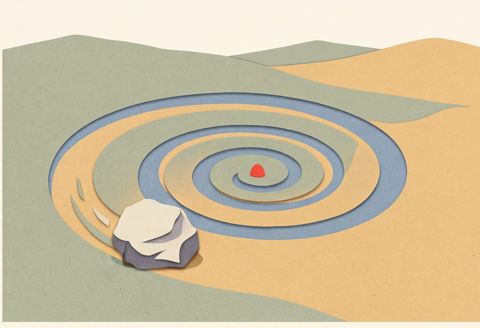
From a mystical point of view, karma is not a judge and not a punishment handed down from outside. It works more like a law of nature: a stone thrown into water sends out ripples, and every action sets a movement going that has to come to rest somewhere. That is why the traditions do not ask "why me?" but "what is this fruit teaching me, and what seed am I sowing now?". It is the second question that turns karma into a path rather than a sentence.
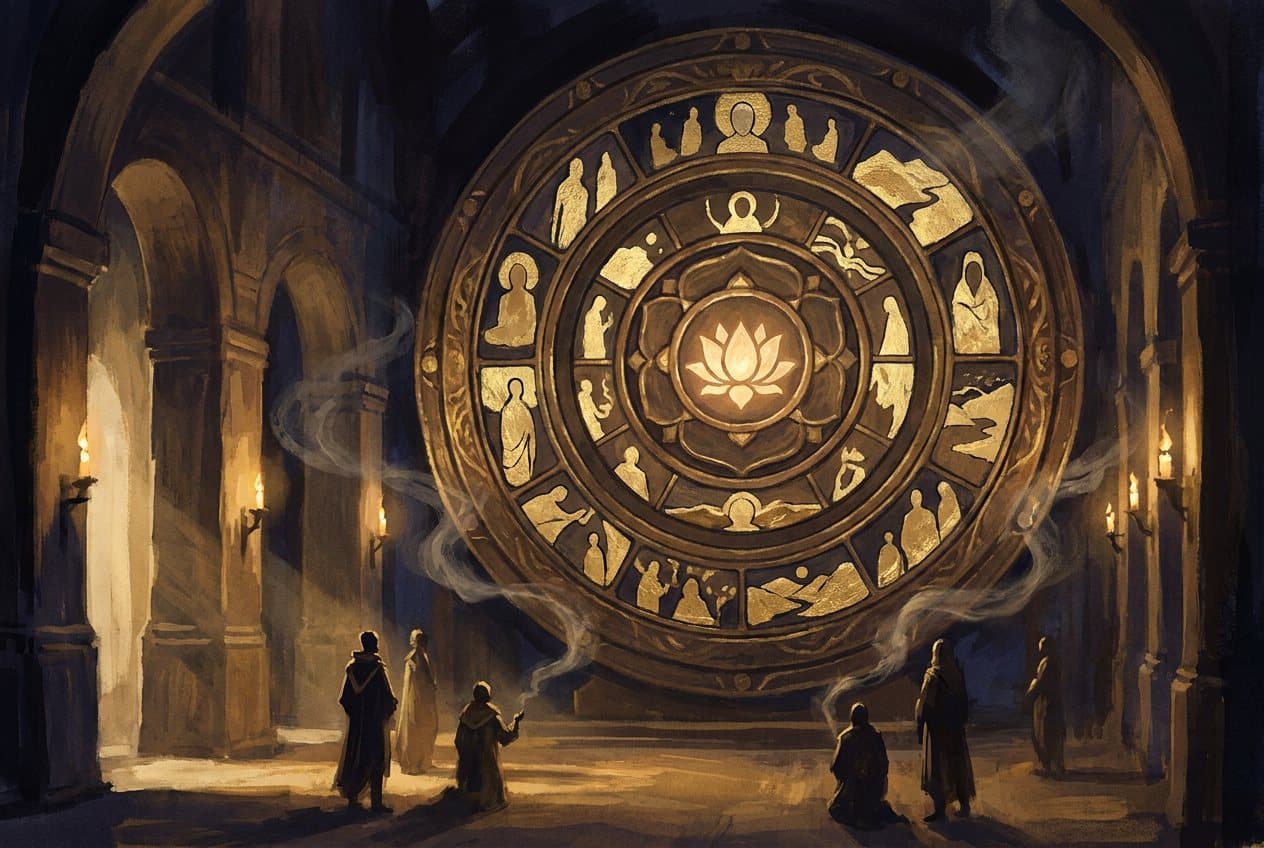
Karma is tied to three other ideas. Samsara is the wheel of birth and death that the soul travels while it still carries unresolved karma. Dharma is the right way of living that stops new knots from forming. Moksha (in Buddhism, nirvana) is liberation, the point at which karma no longer turns the wheel. Each of the great Indian schools understands this system a little differently, but all of them agree that karma is what the soul does with its freedom.
The three types of karma: sanchita, prarabdha and agami
Vedanta divides karma into three types. The classic explanation appears, for example, in the Tattva Bodha, a primer traditionally attributed to Shankara. The division helps explain why some things in life feel unavoidable while others are clearly yours to change.
Type
What it means
Can it change?
Sanchita karma (Sanskrit sañcita, "accumulated")
All the karma gathered over past lives that has not yet begun to bear fruit – a vast store of seeds waiting for their season.
Yes. The traditions say spiritual knowledge and practice burn it away.
Prarabdha karma (prārabdha, "begun")
The portion of sanchita that is already active in this life: your body, your family, where you were born, the main circumstances of your life.
Least of all. It has to be lived through, but how you respond to it is up to you.
Agami or kriyamana karma (āgāmi, "coming"; kriyamāṇa, "being done")
The karma you are creating right now through your intentions, words and actions. It will either join the store or ripen soon.
Completely. This is the realm of your freedom.
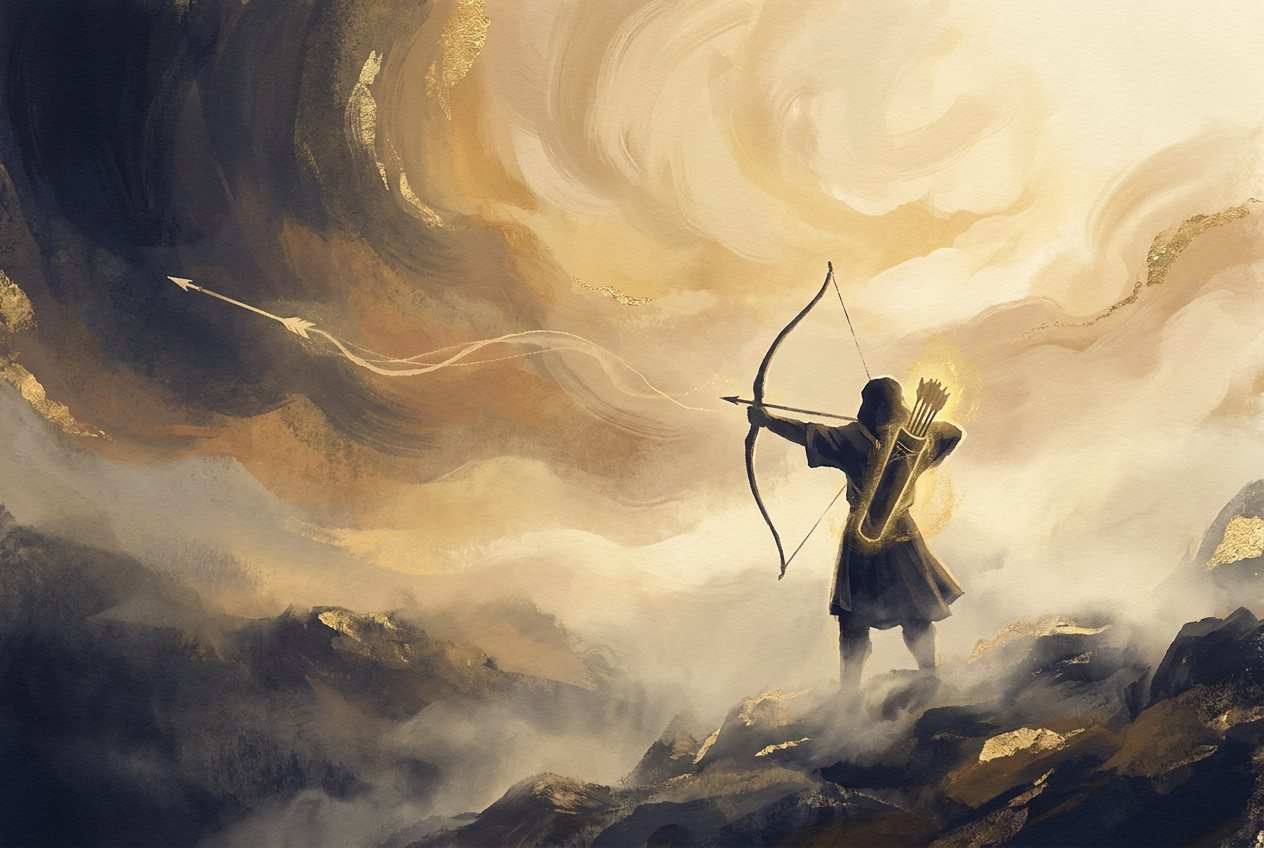
The archer analogy: the quiver is sanchita, the arrow already flying is prarabdha, the arrow on the string is agami karma.
Indian teachers often explain the three types with the image of an archer. The arrows lying in the quiver are sanchita karma: they need never be fired. The arrow that has already left the bow is prarabdha: you cannot call it back, and it will fly until it hits its mark. The arrow you are fitting to the string now is agami: only you decide whether to release it and where to aim.
From the tradition
Ramana Maharshi's disciples recalled how he explained prarabdha: once a person reaches realisation, the accumulated karma burns up and the coming karma has nothing left to stick to, but prarabdha keeps moving the body for a while, the way a fan keeps turning after it has been unplugged. The body lives out its course to the end, but the soul no longer takes it for a prison.
How karma works: from intention to fruit
The traditions describe the path of karma as a chain. Yoga and Buddhism explain it in similar terms: what matters is not only the outer act but the inner state it was born from.
Intention. In Buddhism karma is intention itself (Pali cetanā). The same act done out of love or out of greed sows different seeds.
Action. A thought, a word or a deed. The traditions count all three, so even a thought is not "innocent".
Imprint. Every action leaves an impression in the mind (saṃskāra), and many impressions form a tendency (vāsanā) that pulls you to act the same way again.
Ripening. Patanjali's Yoga Sutras (II.12–13) say that the store of karma is rooted in the causes of suffering and ripens as birth, length of life and experience.
Fruit and a new choice. When the fruit ripens, you choose again how to respond. Either karma keeps turning the wheel, or it starts to dissolve.
Buddhism adds an important note to this chain. In a discourse of the Anguttara Nikaya (AN 4.77), the Buddha names the precise working of karmic results as one of four "unconjecturable" matters (acinteyya): anyone who tries to work out exactly which deed produced each experience will be driven to madness. The tradition leaves the mystery in place on purpose. The law of karma can be understood, but it cannot be audited like a ledger.
What mystics and teachers taught about karma
Over three thousand years the idea of karma passed through many schools. Each added its own shade of meaning, and those differences explain why karma is talked about in so many ways today.
Bhagavad Gita: act without clinging to the fruit
Krishna teaches Arjuna that a person has a right to act but not to the fruits of action (2.47). This is the heart of karma yoga.
The Gita says the fire of knowledge reduces all karma to ashes (4.37), so the way out of the wheel runs through awareness, not through doing nothing.
Swami Vivekananda: "Karma Yoga"
In lectures given in New York in 1895–1896, Vivekananda taught that every task done unselfishly purifies the mind.
His point: we do not fix the world through our work; we perfect ourselves in it.
The Theosophists: karma as cosmic balance
Helena Blavatsky in The Key to Theosophy (1889) called karma the unerring law that restores disturbed balance.
Annie Besant's booklet Karma (1895) treated thoughts, desires and actions as three separate makers of karma.
Rudolf Steiner: karmic relationships
In his 1924 lecture cycle on karmic relationships, Steiner taught that people who meet in life are often connected through earlier incarnations.
He also spoke of the karma of groups and nations, not only of individuals.
Edgar Cayce: readings on past lives
The American psychic gave thousands of "life readings" in trance, linking present difficulties to earlier lives.
Gina Cerminara gathered these readings into a system of karma and reincarnation in Many Mansions (1950).
Jainism: karma as subtle matter
Jains understand karma almost literally, as fine particles that cling to the soul (jīva) and weigh it down.
That is why their path is so strict: non-violence (ahiṃsā), asceticism and care for every living being.
Karma and reincarnation: the soul carries its story
In many traditions karma is inseparable from the belief that the soul is born more than once. In the Indian schools this is samsara, the wheel of births and deaths that karma keeps turning. The soul does not bring memories into a new life; it brings tendencies, talents, fears and unfinished bonds. Together they make up the prarabdha a person starts living from birth.
The idea is not only an Eastern one. Pythagoras taught the transmigration of souls, and Plato told the Myth of Er in Book X of the Republic. Kabbalah speaks of gilgul neshamot, the cycling of souls, through which a soul returns to repair what it left unrepaired. In Tibetan Buddhism the Bardo Thödol, known in the West as the Tibetan Book of the Dead, describes the in-between state after death and before a new birth, where karmic tendencies decide where consciousness will turn.
From the tradition
In Plato's Myth of Er, the warrior Er is killed in battle and wakes on his funeral pyre twelve days later to tell what he saw. Before a new life, souls choose their own lot from many patterns laid before them, and their choice is shaped by what they lived through before. Before they choose, it is proclaimed: the blame belongs to the one who chooses; the god is blameless. Then the souls drink from the River of Forgetfulness and remember nothing.
Christianity has no concept of karma, but the line "whatsoever a man soweth, that shall he also reap" (Galatians 6:7) comes close. The difference is that Christianity has no wheel of rebirth, and in place of liberation from karma it speaks of grace and forgiveness.
Good karma and bad karma: what creates light
People talk about "good karma" and "bad karma" every day. Hinduism has the words puṇya (merit) and pāpa (wrongdoing, an act that weighs you down). Buddhism speaks of kusala and akusala, wholesome and unwholesome acts. Unwholesome acts grow from the three poisons of greed, hatred and delusion; wholesome ones grow from their opposites: generosity, love and clarity.
The Buddhist tradition names three main grounds of merit (puññakiriyavatthu):
Generosity (dāna): sharing things, time, attention and knowledge without expecting a return.
Ethical conduct (sīla): not harming living beings, not stealing, not lying, not clouding the mind.
Meditation (bhāvanā): training the mind to see clearly and stop sowing new knots.
Notably, the traditions themselves do not treat good karma as the final goal. A golden chain is as much a chain as an iron one, said Vivekananda. Good karma brings a favourable birth and happiness, but liberation begins when a person no longer acts for merit at all.
Personal, ancestral and collective karma
Esoteric schools speak of more than personal karma. Ancestral or family karma is what, from the traditions' point of view, the soul inherits along with its family: repeating fates, illnesses, marriage and money patterns that travel down the generations. Many teachers say a soul is not born into a particular family by chance: that is where it finds the lessons it came to learn.
The destiny matrix method has a dedicated part for this, the ancestral lines. They show what tasks a person receives through the father's and the mother's line. Collective karma is wider still: Steiner and the Theosophists spoke of the karma of nations, generations and even humanity, which plays out in historical events.
Karma by date of birth: astrology and the destiny matrix
Most people first want to know what karma they brought with them. The traditions answer through the moment of birth: if prarabdha shapes the circumstances of birth, it should show in the date of birth too.
Vedic astrology (jyotisha) reads the birth chart as a map of prarabdha. Saturn (Shani) is called the giver of karmic fruit: it brings what has been earned. The lunar nodes Rahu and Ketu form the karmic axis: Ketu shows what the soul brought from the past, Rahu where it is pulled in this life. The tenth house of the chart is called the house of karma (karma bhāva) and shows work and vocation.
The destiny matrix, Natalia Ladini's numerology method, reads karma from the date of birth through the 22 arcana. Two karmic points matter most:
The karmic arcana (point D) is the sum of the day, month and year. It shows the task the soul brought from the past. You can find it with the arcana by date of birth calculator.
The karmic tail is a three-number code at the bottom of the matrix, such as 15-5-8 or 21-4-10. It describes what the soul got wrong in the past and needs to put right in this life. There are 26 codes in all, each described on the karmic tail page.
Western numerology speaks of karmic debt numbers: 13, 14, 16 and 19. When they appear while calculating the life path, destiny or other core numbers, numerologists say the soul has brought an unfinished lesson: 13 about work and patience, 14 about balancing freedom and moderation, 16 about pride and humility, 19 about using power and accepting help.
Both systems read karma as a tendency, not a sentence. A strong Saturn or a heavy karmic tail does not mean life will be bad. It points to the area where a person will have to work hardest and where they can grow the most.
Karmic relationships: why some people feel familiar
In esoteric tradition, karmic relationships are bonds believed to continue from earlier lives. They often begin with great intensity: a sense that you have known the person for ages, sudden closeness, or the opposite, an unexplainable tension. Many teachers say souls agree before incarnating to meet again so they can finish what was left unfinished. Modern esoteric writing calls these soul contracts.
From the traditions' point of view, a karmic relationship does not have to last a lifetime. Its purpose is to learn what was left unlearned: to forgive, to draw a boundary, to repay a debt or to accept one. Once the lesson is learned the knot comes undone, and people can part without bitterness. In radionics and the energy-information model, such bonds are called karmic knots.
Signs of karma: how to recognise a karmic situation
Teachers and esoteric schools most often mention these signs that karma may be at work:
Repetition. The same situation returns with different people and different scenery until the lesson is learned.
A disproportionate reaction. Something others find minor shakes you to the core, as if it touched something older than this life.
A bond at first sight. A strong pull or aversion towards someone you barely know.
A sense of debt. You feel you must help someone, give something or carry something, though rationally you owe nothing.
Doors that will not open. Some paths stay closed for a long time however hard you try, then suddenly open once you have changed.
Synchronicities. Meaningful coincidences that seem to say you are in the right place, or that it is time to turn another way.
The traditions themselves advise reading these signs as questions to yourself rather than final answers. The same sign is an invitation to grow for one person and a mere coincidence for another.
How the traditions work with karma
All the traditions agree on one thing: karma cannot be "cleared" by a single ritual and then forgotten. It can be dissolved through daily practice that changes the intentions themselves. Here are the practices the traditions mention most often.
Karma yoga: work without clinging to the fruit
Do your work with your whole heart, but do not wait for praise, reward or a particular result. In the Indian tradition this is also called seva, selfless service. Such action creates no new karmic knots, because there is no ego waiting for the bill to be paid.
Loving-kindness meditation
The Buddhist practice of metta sends good wishes to yourself, to those close to you, to strangers and even to those you have a difficult bond with. The tradition considers it one of the most powerful ways to untie karmic knots, because it changes the very state that actions are born from.
The evening review
Rudolf Steiner recommended that his students review each day in reverse order every evening. It is an old practice that builds awareness of your own karma:
Lie down or sit quietly and close your eyes.
Start with the last event of the day and go back to the morning, as if watching a film from the end.
Look at yourself from the outside, like another person, without judging.
Notice where you acted from love and where from fear, anger or greed.
Give thanks for the day and fall asleep, leaving it in the past.
Ho'oponopono: a practice of forgiveness
A Hawaiian reconciliation tradition, adapted in modern form in 1976 by the traditional Hawaiian healer (kahuna lapaʻau) Morrnah Simeona. Later her student Ihaleakala Hew Len and the writer Joe Vitale popularised four phrases that you repeat both to yourself and to another: "I'm sorry. Please forgive me. Thank you. I love you." Practitioners believe this unties old bonds and releases patterns that keep repeating.
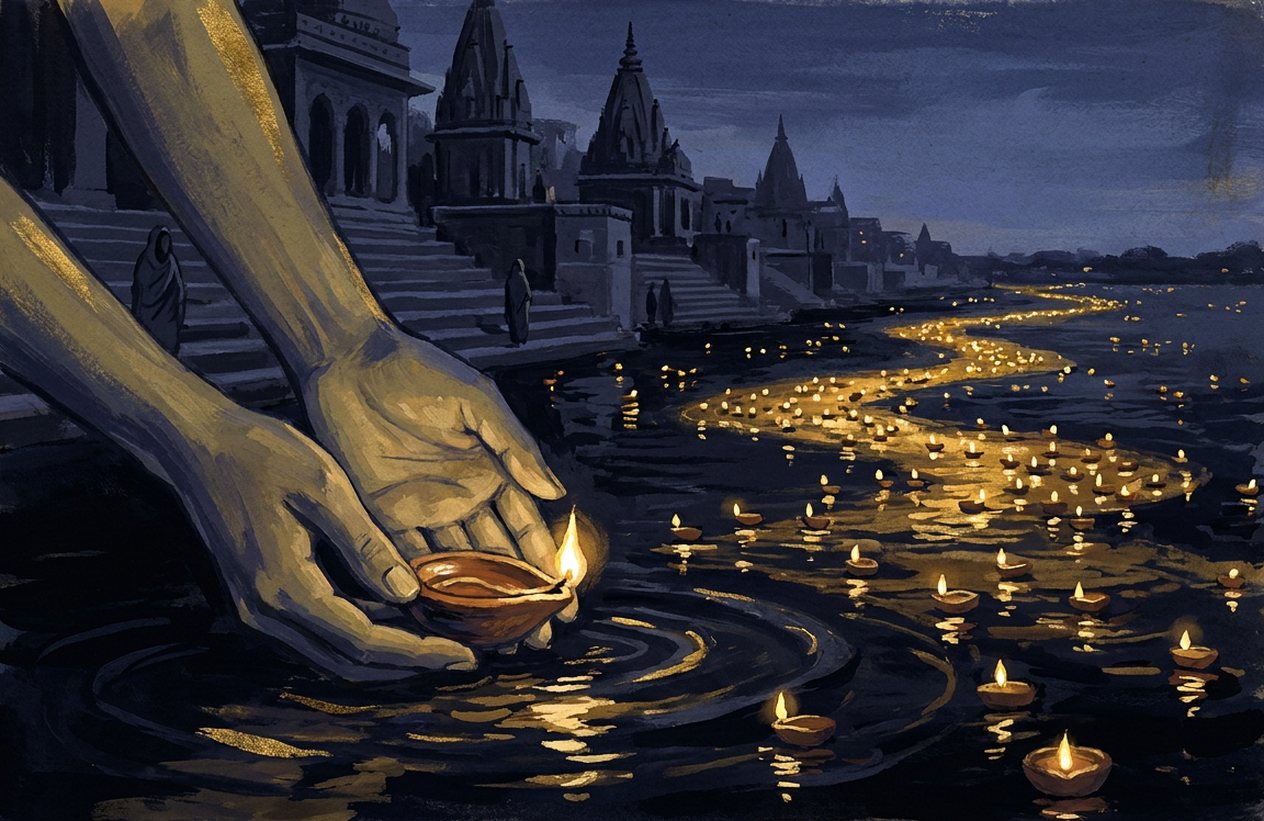
Letting go of what is no longer needed: in India, lit lamps are set on the river as a sign of release and gratitude.
Atonement and amends
The Hindu tradition has the concept of prāyaścitta, an act of atonement and repair. Its essence is not self-blame but making good what can be made good: apologising, returning, helping. Where the bond is with someone who has died or cannot be reached, the traditions suggest doing good to others in that person's name.
The 12 laws of karma
A list of "12 laws of karma" is widely shared online. It is a modern esoteric scheme that became popular in the early twenty-first century; no such list appears in the ancient Indian texts. Even so, it neatly sums up ideas the traditions repeat in many different words:
Law
Its essence
1. The great law
As you sow, so shall you reap: what you send into the world comes back.
2. The law of creation
Life does not just happen; you create it through your actions.
3. The law of humility
What you refuse to accept stays and repeats.
4. The law of growth
By changing yourself you change your surroundings.
5. The law of responsibility
You take responsibility for what happens in your life.
6. The law of connection
Everything is linked: past, present and future.
7. The law of focus
You cannot think of two things at once, so choose where your attention goes.
8. The law of giving and hospitality
Your behaviour should match what you believe.
9. The law of here and now
Replaying the past takes away the present.
10. The law of change
History repeats until you learn the lesson.
11. The law of patience and reward
The most valuable fruit ripens slowly.
12. The law of significance and inspiration
Every contribution, however small, matters to the whole.
Instant karma and other popular sayings
"Instant karma" is what people call it when the consequence arrives right after the act: someone who has just insulted another person slips, or loses what they took. The phrase took off after John Lennon's 1970 song "Instant Karma!". From the traditions' point of view, this is simply a seed that ripened fast; most karmic fruit ripens more slowly and less visibly.
"Karma's a boomerang", "karma will take care of it", "that's karmic debt": these everyday phrases shrink karma down to payback. The traditions see it more broadly, not as revenge but as a teacher who repeats the lesson until the student is ready to learn it.
What karma does not mean in the traditions
The great traditions distinguish karma from several common mistakes:
It is not fatalism. Karma does not say everything is fixed. Agami karma is the realm of freedom, so every choice made now changes the future.
It is not God's punishment. In Buddhism and many Indian schools, karma works as a law, without a judge handing out penalties.
It is not a reason to condemn others. Another person's suffering is not yours to judge. Buddhist texts even say that not all suffering comes from karma.
It is not a reason to endure harm. No tradition teaches you to stay where you are being hurt because "it is meant to be". Protecting yourself is both dharma and healthy karma.
When to seek help
If you explain violence, abuse or a threat to yourself as "your karma" and stay in an unsafe situation because of it, talk to someone you trust or contact a crisis line or local emergency services. In the US and Canada you can call or text 988; in the UK and Ireland, Samaritans are on 116 123. If a life is in danger, call your local emergency number.
Self-knowledge guide Ema Sakalauskaitė writes about how the word "karma" works in everyday life: when it helps you take responsibility, and when it turns into blaming yourself or others.
Frequently asked questions
What is karma in simple terms?
Karma is the spiritual law by which your intentions and actions sow seeds that sooner or later come back as consequences. In the traditions karma works across many lifetimes and is linked to reincarnation.
What are the three types of karma?
Sanchita karma is all the karma accumulated from past lives, prarabdha is the part already active in this life, and agami (kriyamana) is the karma you are creating now. Agami karma is the one you can change most.
How can I find my karma by date of birth?
Traditionally karma is read through Vedic astrology (Saturn, Rahu and Ketu, the tenth house) and the destiny matrix. In the destiny matrix, karma shows in the karmic arcana (point D) and the karmic tail, a three-number code calculated from your date of birth.
What is karmic debt?
In everyday speech it is a sense that you owe something from the past. In Western numerology the karmic debt numbers are 13, 14, 16 and 19; when they appear among your core numbers, numerologists say you have brought an unfinished lesson.
Can karma be cleared?
The traditions say karma cannot be erased by a single ritual, but it can be dissolved through karma yoga (work without clinging to results), generosity, meditation, atonement and forgiveness. Vedanta teaches that spiritual knowledge burns up accumulated karma.
What are karmic relationships?
In esoteric tradition these are bonds believed to continue from earlier lives. They often begin very intensely and carry a lesson both people need to learn; once it is learned, the relationship can end without bitterness.
Are the 12 laws of karma an ancient teaching?
No. The “12 laws of karma” list spread online in the twenty-first century and does not appear in the ancient Indian texts, although its ideas – responsibility, patience, attention to the present – match the traditions.