Samsara: the wheel of birth and death in the traditions
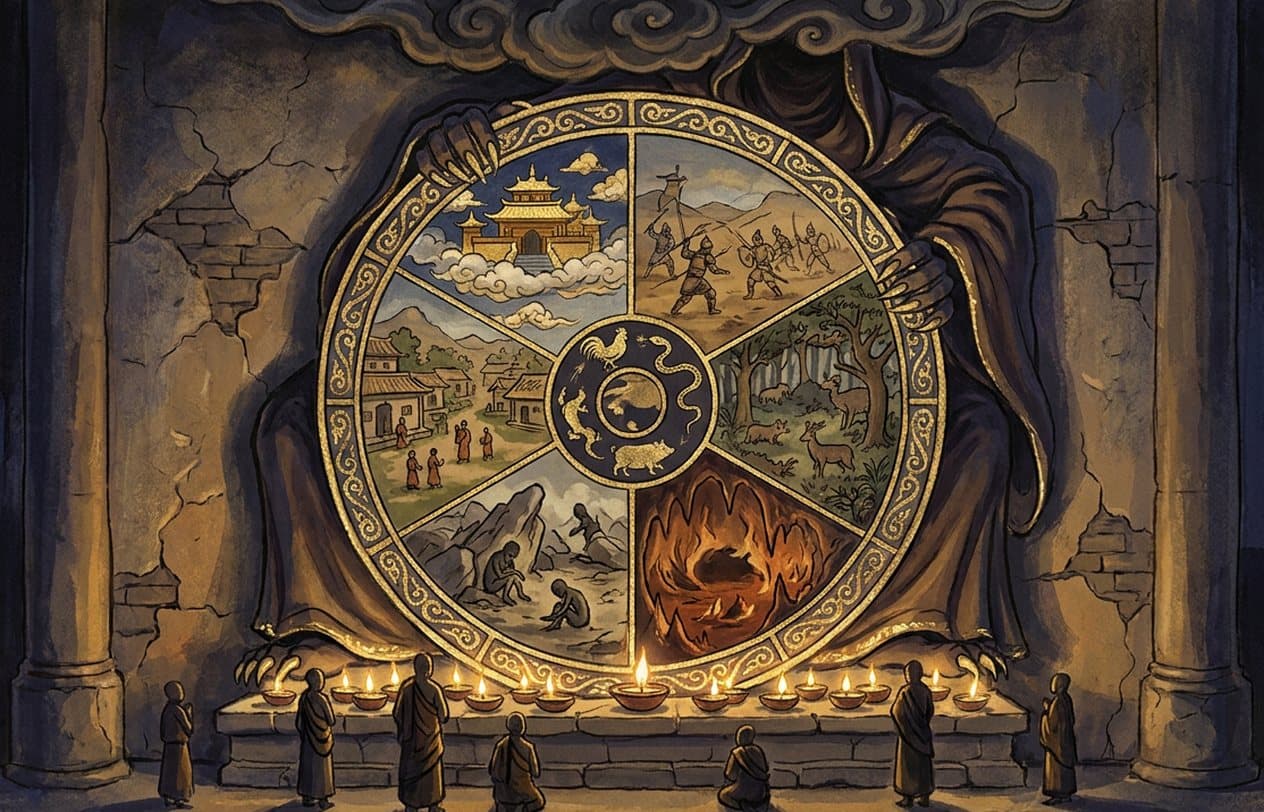
Samsara (Sanskrit saṃsāra, “flowing on, wandering in circles”) is, in the Indian traditions, the wheel of birth, death and rebirth that karma keeps turning. Hinduism, Buddhism and Jainism understand it differently, but all teach that the wheel can be left – for moksha or nirvana. The best-known image of samsara is the Tibetan wheel of life with its six realms.
Key facts
The word samsara comes from the Sanskrit saṃsāra; the root sṛ means “to flow”.
The idea of a cycle of rebirth appears clearly in the Upanishads (around the 8th–6th centuries BCE), for example the Chandogya Upanishad (5.10).
Samsara is turned by karma; leaving it is called moksha in Hinduism and nirvana in Buddhism.
The Tibetan wheel of life (bhavachakra) shows the three poisons, the six realms and the twelve links of dependent origination.
The oldest surviving image of the wheel of life is in Cave 17 at Ajanta in India.
In Tibetan tradition the in-between state between death and a new birth (bardo) lasts up to 49 days.
Contents
What does the word samsara mean?
The word "samsara" comes from the Sanskrit saṃsāra, built on the root sṛ, "to flow". Literally it means "flowing on together", an endless stream, a wandering in circles. In the Indian traditions it names the wheel of birth, death and rebirth that a soul or a stream of consciousness travels until it reaches liberation. People also speak of "the wheel of samsara", and in everyday speech the word sometimes simply means worldly life with all its cares.
What turns samsara is karma. As long as a person acts out of greed, anger and ignorance, those actions sow new seeds, and the seeds lead to a new birth. The traditions say samsara has no beginning that can be found: the Buddha called it a round whose start cannot be seen. But it does have an exit, and every great Indian spiritual school grew out of the search for it.
It matters that in the traditions samsara is not a place. It is a state: consciousness spinning between desire and fear, repeating life after life and even day after day. That is why teachers say you can notice samsara right now, in a mind that keeps running from one wish to the next.
Where does the idea of samsara come from?
The earliest Vedic hymns have no wheel of rebirth yet. The idea appears clearly in the Upanishads, around the eighth to sixth centuries BCE. The Chandogya Upanishad (5.10) says that people whose conduct has been pleasant will quickly enter a pleasant womb, and those whose conduct has been foul will enter a foul one. Here, for the first time, three things are clearly linked: deeds, a new birth and the idea of a cycle.
The Katha Upanishad tells of a young man, Nachiketa, who goes to Yama, the god of death, and asks what happens after we die. Yama first offers him wealth, power and long life if only he will stop asking. Nachiketa refuses, and Yama reveals that the true Self (ātman) is neither born nor dies, and whoever knows it leaves the round of death.
Three great traditions grew from this root, and each understands samsara differently:
Hinduism. The eternal soul (ātman) changes bodies the way a person changes clothes (Bhagavad Gita 2.22) until it realises its oneness with Brahman. Liberation is called moksha.
Buddhism. The Buddha did not teach an unchanging soul. What is reborn is not an "I" but a stream of causes and effects, like a flame passed from one candle to another. The way out is nirvana, literally "blowing out".
Jainism. The soul (jīva) wanders through 8.4 million forms of life, weighed down by particles of karma, until strict asceticism wipes it clean.
Sikhism calls the cycle āvāgavan, "coming and going", and sees liberation through remembering God's name and through grace.
The wheel of life: what samsara looks like
The best-known image of samsara is the Tibetan bhavachakra, the wheel of life or of becoming. According to the monastic discipline texts (Vinaya), the Buddha himself asked for it to be painted at the gate of a monastery, so that everyone entering would grasp the heart of the teaching. The oldest surviving example is in Cave 17 at Ajanta in India, and in Tibet the wheel is still painted at the entrance of every temple.
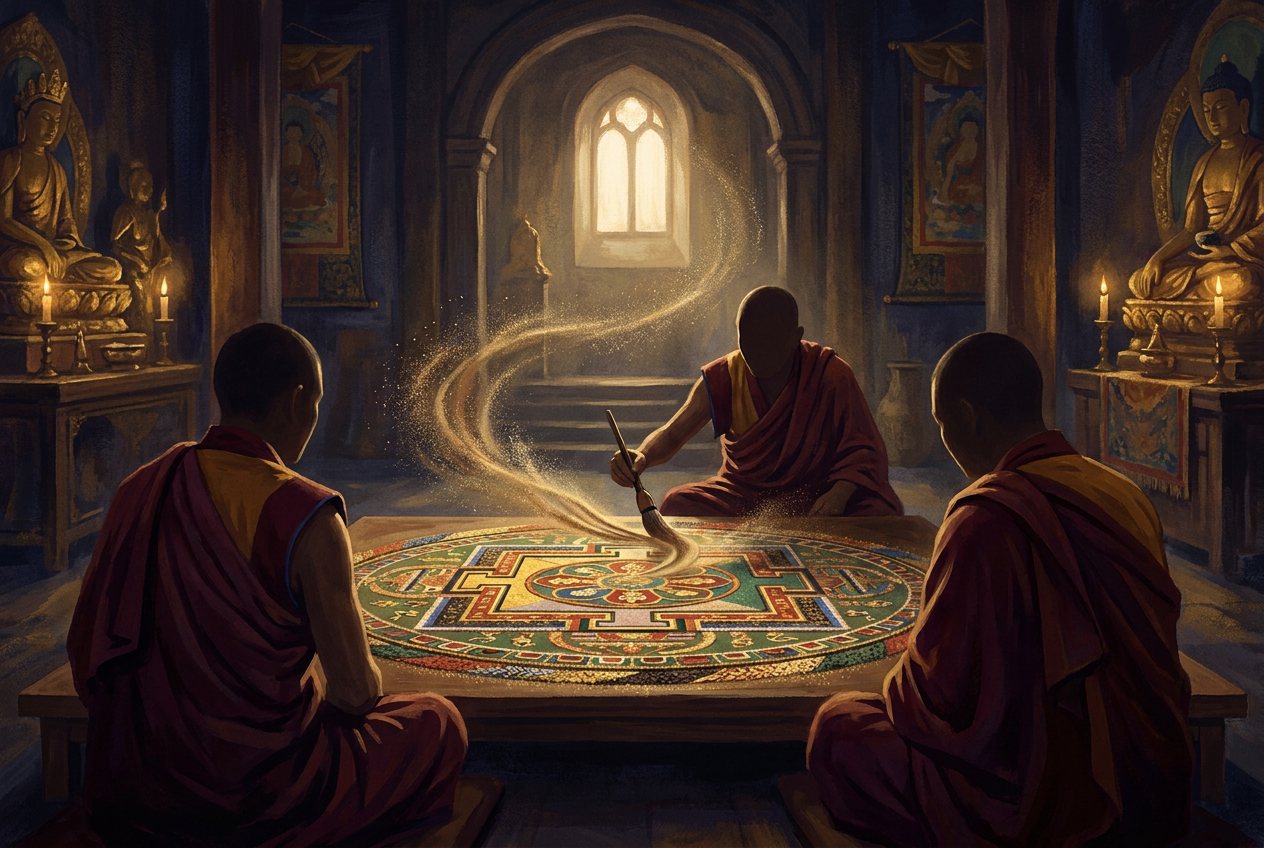
A sand mandala takes weeks to make and minutes to sweep away: the Tibetan monks' lesson in impermanence.
The wheel is read from the centre outwards. Each layer is a lesson of its own:
Part of the wheel
What is shown
What it means
Hub
A rooster, a snake and a pig chasing each other's tails
The three poisons – greed, hatred and ignorance – that drive the whole wheel.
Second ring
A light half with beings rising and a dark half with beings falling
Good and bad karma: some rise to higher realms, others fall.
Third ring
Six realms
The six realms of birth that karma leads to (see the table below).
Outer rim
Twelve pictures: a blind man, a potter, a monkey, a boat and more
The twelve links of dependent origination, through which ignorance becomes new birth and death.
The holder
A fearsome being gripping the wheel with claws and teeth
Yama, lord of death, or impermanence itself: everything on the wheel is in death's hands.
Outside the wheel
The Buddha pointing to the moon
The way out: nirvana lies beyond samsara, and a path to it exists.
The six realms of samsara
Tibetan Buddhism describes six realms in which consciousness can be born, each linked by the tradition to one dominant emotion. Teachers add that these realms can be recognised within a single day of a human life: sometimes we live in the realm of the gods, sometimes in that of the hungry ghosts.
Realm
Dominant state
How the tradition describes it
Gods (deva)
Pride, bliss
A long, pleasant life that lulls to sleep: when good karma runs out, the gods fall and suffer most of all.
Demigods (asura)
Jealousy, struggle
Powerful beings forever at war over what others have.
Humans
Desire and doubt
The only realm with enough suffering to want to leave and enough freedom to make it possible.
Animals
Ignorance
A life of instinct and fear, with no chance to understand one's situation.
Hungry ghosts (preta)
Greed
Beings with huge bellies and thin throats: however much they get, they are never satisfied.
Hells
Hatred
Realms of heat and cold created by anger; they too are not eternal, and beings leave them as well.
In the Tibetan tradition the popular mantra Om mani padme hum is linked to these six realms: each of its six syllables, it is believed, closes the way to one of them. That is why it is recited on behalf of all living beings, so that they may escape the wheel.
How samsara turns: the twelve links
Buddhism explains why the wheel never stops through the twelve links of dependent origination (pratītyasamutpāda). Each link arises because of the one before it, and the last sets the first going again. Teachers often condense them into five steps:
Ignorance. A person does not see that everything is impermanent and that there is no separate, unchanging "I". On the wheel it is a blind old man with a stick.
Senses and contact. From ignorance arise consciousness, body and six senses that meet the world.
Feeling. Every contact brings a pleasant, unpleasant or neutral feeling. On the wheel it is an arrow in the eye.
Craving and clinging. We want more of the pleasant and none of the unpleasant, and we hold on. The traditions say this is the easiest place to stop the wheel.
Becoming, birth and death. Clinging creates new becoming, which leads to new birth, old age and death. And the wheel begins to turn again.
What mystics and teachers taught about samsara
The Buddha: a round with no visible beginning
In the Pali Canon the Buddha says the tears shed over countless lives are more than the water in the four great oceans.
Yet he also taught that a human birth is rare: like a blind turtle surfacing once in a hundred years and putting its head through a yoke floating on the ocean (SN 56.48).
Bhagavad Gita: the soul changes bodies
As a person casts off worn-out clothes and puts on new ones, the soul leaves an old body and enters a new one (2.22).
The way out of the wheel is action without attachment, devotion and knowledge.
Nagarjuna: samsara and nirvana are not different
The second-century thinker wrote in his Verses on the Middle Way (25.19–20) that there is not the slightest difference between samsara and nirvana.
The Mahayana tradition reads this to mean that liberation is not somewhere else: it is the same world, seen without ignorance.
Tibetan teachers: the four thoughts
Before any deeper practice, Tibetan schools teach reflection on four "thoughts that turn the mind": precious human birth, impermanence and death, karma, and the suffering of samsara.
They are meant to awaken the wish to leave the wheel, not fear.
Can you escape samsara?
Every tradition answers yes, and there is a path. What differs is what the path is called and where it leads.
Hinduism offers four paths of yoga: jnana (knowledge), bhakti (devotion to God), karma (selfless action) and raja (meditation). All lead to moksha, when the soul realises its true nature.
Buddhism offers the Noble Eightfold Path: right view, intention, speech, action, livelihood, effort, mindfulness and concentration. It leads to nirvana, when the three poisons are extinguished.
Jainism teaches the three jewels – right faith, right knowledge and right conduct – together with strict non-violence.
From the tradition
A Tibetan sand mandala takes weeks to build: grain by grain, the monks lay coloured sand into an intricate map of a divine world. When the work is done, the mandala is swept away in minutes and the sand is poured into a river. It is a lesson about samsara: everything made passes away, and freedom begins when you stop clinging to it.
The ocean of samsara and the other shore
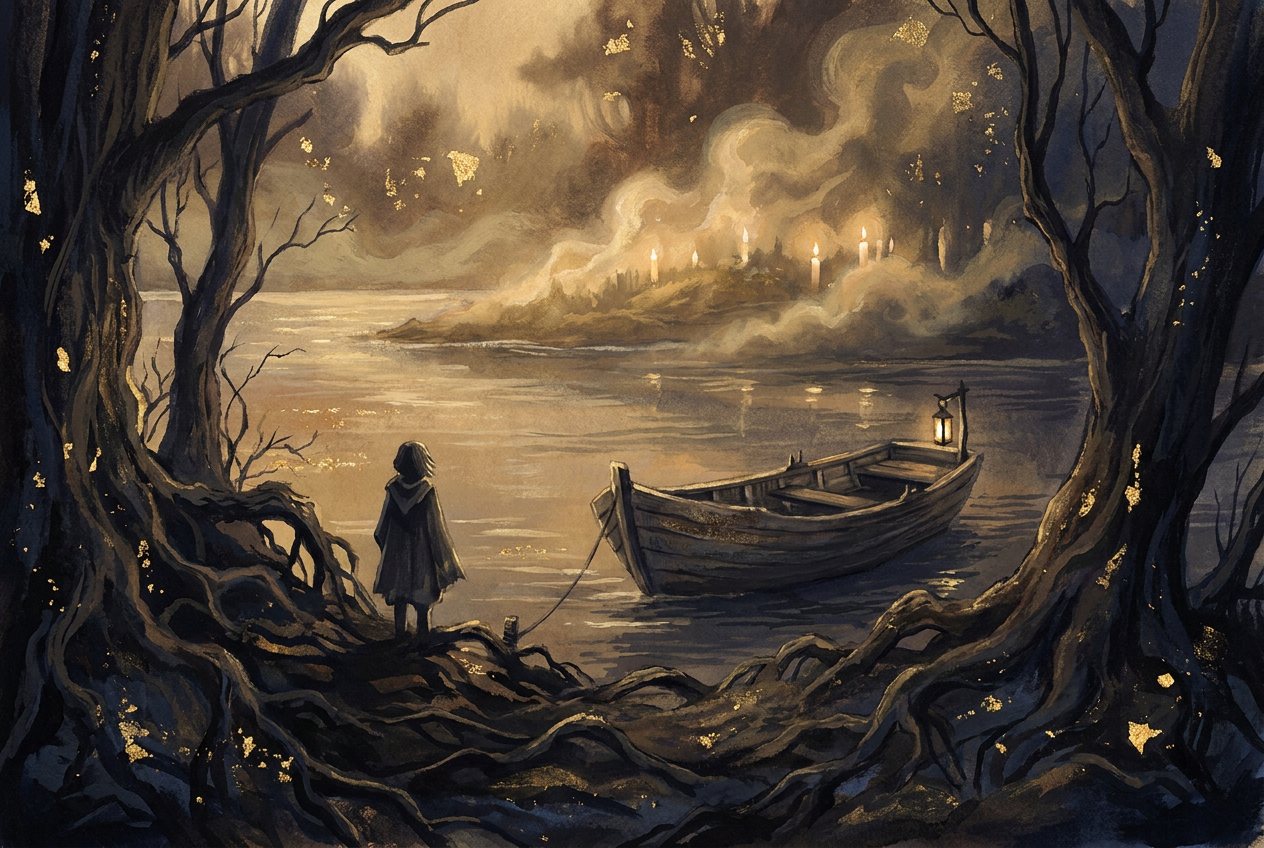
The traditions often picture samsara not only as a wheel but as water. Sanskrit speaks of bhavasāgara, "the ocean of becoming": restless, bottomless and without a visible shore, its waves being births and deaths. Hindu hymns call God the one who carries us across this ocean, and the Jain teachers are called tīrthaṅkara, "ford-makers": they found the place where the river can be crossed.
In Buddhism the image is even stronger. The perfections a bodhisattva cultivates are called pāramitā, literally "gone to the other shore". The best-known Buddhist mantra, which closes the Heart Sutra, runs gate gate pāragate pārasaṃgate bodhi svāhā: "gone, gone, gone beyond, gone completely beyond, awakening". It is the mantra of crossing samsara.
The Buddha himself compared his teaching to a raft (MN 22). A man separated from a safe shore by dangerous water binds a raft out of branches and crosses. But once across, he does not carry the raft on his head; he leaves it on the bank. In the same way the teaching is a means of crossing samsara, not one more thing to cling to.
Signs that a person is waking from samsara
The traditions have precise words for the moment when a person first sees the wheel and wants to leave it. Teachers describe these as natural stages of the path, not as an illness or a crisis.
Samvega (saṃvega). A spiritual shock: suddenly seeing how fast life runs and how emptily it can pass. Tradition says the young prince Siddhartha first felt it when he saw an old man, a sick man and a corpse.
Nibbida (nibbidā). A quiet disenchantment with what once attracted you: not hatred of the world, but the understanding that it cannot give lasting satisfaction.
Renunciation (nekkhamma). The wish to let go of what binds and to choose simplicity. For monks it means leaving home; for lay people, freedom from needless desires.
Confidence in the path (saddhā). An inner sense that a way out of the wheel exists and that it can be walked.
Tibetan teachers say these signs are not sad. They resemble waking from a long dream: strange at first, but with a new lightness, because you no longer have to run in circles.
Samsara after death: the in-between state
Tibetan Buddhism pays close attention to the time between death and a new birth, called the bardo. According to the Tibetan Book of the Dead (Bardo Thödol), after death consciousness first meets the clear light. If it recognises it, it is liberated at once. If not, it travels through ever denser visions that arise from its own karma until a new womb draws it in.
Traditionally this passage lasts up to 49 days. That is why in Tibet and other Buddhist countries texts are read and rites performed for 49 days after a death, to help the deceased recognise the light and avoid birth in a lower realm.
How the traditions practise understanding samsara
In the traditions samsara is not just a theory about other lives. You are invited to notice it now. These are the practices teachers mention most often.
Reflecting on the four thoughts
Each morning, spend a few minutes reflecting on four thoughts in turn: that this life is rare and precious; that it will end, and no one knows when; that every action has consequences; and that running from one desire to the next does not bring happiness. Tibetan teachers say these thoughts turn the mind from the wheel towards the path.
Meditation and mindfulness
Sitting quietly and watching the breath, you soon see how thoughts go round in circles: a wish, a worry, a memory, a plan, and a wish again. The traditions call this the small samsara. Whoever notices it stands outside the wheel for the first time.
A mantra for all beings
Reciting Om mani padme hum is one of the most common Tibetan practices. It is counted on prayer beads (108 beads) or sent out by turning prayer wheels, so that each turn, it is believed, spreads compassion to all six realms.
Watching impermanence
Choose one object, a flower or even your own body, and watch for a few days how it changes. In the vipassana tradition this is called insight into impermanence (anicca). It is considered the key that, in time, unlocks the wheel.
In Buddhism the teaching is compared to a ferry that carries you from the shore of samsara to the other shore.
Samsara in modern language and culture
Today "samsara" is often used more broadly than in the traditions. It names the vicious circle of everyday life: work, consumption, the same problems coming round again. Ron Fricke's wordless 2011 documentary Samsara showed rituals, factories and megacities around the world so the viewer could see humanity's wheel from the outside. The word has also become the name of perfumes, albums and yoga studios.
From the traditions' point of view this is not a mistake: samsara really does begin wherever a person repeats the same thing without awareness. Only the depth differs. In everyday speech samsara is routine; in the traditions it is the wheel of all lives, which can be left only by fully knowing one's own nature.
How samsara differs from related concepts
Concept
Essence
Link to samsara
Karma
The law of action and consequence
The engine that turns the wheel of samsara
Reincarnation
A soul being born in a new body
One stage of samsara, seen from a single life
Moksha and nirvana
Liberation
The end of samsara, the way out of the wheel
Maya
Illusion, appearance (Vedanta)
What makes samsara seem real to us
Dukkha
Suffering, unsatisfactoriness (Buddhism)
The nature of samsara: nothing on the wheel brings final satisfaction
Self-knowledge guide Ema Sakalauskaitė writes about how the Buddhist idea of suffering helps make sense of everyday dissatisfaction, and what to do with it.
Frequently asked questions
What is samsara in simple terms?
Samsara is the cycle of birth, death and rebirth that, according to the Indian traditions, consciousness travels while karma drives it. In everyday speech, samsara also means the vicious circle of daily life where the same things keep repeating.
What is the difference between samsara and nirvana?
Samsara is the state of the wheel, driven by greed, hatred and ignorance; nirvana is liberation, when these three poisons are extinguished. The Mahayana thinker Nagarjuna taught that they are not two places but the same world, seen with and without ignorance.
What are the six realms of samsara?
In Tibetan Buddhism they are the realms of gods, demigods, humans, animals, hungry ghosts and hells. Each is linked to one dominant state: pride, jealousy, desire, ignorance, greed and hatred.
What do the rooster, snake and pig at the centre of the wheel mean?
They are the three poisons that drive samsara: the rooster is greed and passion, the snake is hatred, the pig is ignorance. They chase each other's tails because each one feeds the next.
How do you escape samsara?
Hinduism offers the yogas of knowledge, devotion, selfless action and meditation; Buddhism offers the Noble Eightfold Path; Jainism offers right faith, knowledge and conduct. All lead to the same goal: liberation from the wheel.
How is samsara different from reincarnation?
Reincarnation is a single event of a soul entering a new body, while samsara is the whole wheel made up of countless such births and deaths. Buddhism speaks not of a soul moving on but of the continuity of a stream of causes and effects.
Sources
Chandogya Upanishad, 5.10, and Katha Upanishad
Bhagavad Gita, 2.22
Samyutta Nikaya 15.3 (Assu Sutta) and 56.48, Pali Canon
Majjhima Nikaya 22 (Alagaddupama Sutta)
Nagarjuna, Mūlamadhyamakakārikā (Verses on the Middle Way), 25.19–20
Patrul Rinpoche, The Words of My Perfect Teacher (Kunzang Lama'i Shelung), 19th century
W. Y. Evans-Wentz (ed.), The Tibetan Book of the Dead, Oxford University Press, 1927
S. F. Teiser, Reinventing the Wheel: Paintings of Rebirth in Medieval Buddhist Temples, University of Washington Press, 2006
W. D. O'Flaherty (ed.), Karma and Rebirth in Classical Indian Traditions, University of California Press, 1980