Enlightenment: awakening in Buddhism, Zen and mysticism
Enlightenment (Sanskrit and Pali bodhi, “awakening”) is, in the spiritual traditions, a direct seeing of the nature of reality that frees a person from suffering and the wheel of samsara. Buddhism calls it bodhi and nirvana, Zen calls it satori and kensho, Hinduism moksha, Christian mysticism illumination and union with God, and Sufism fana.
Key facts
The word “bodhi” comes from the Sanskrit root budh, “to wake up”, so Buddha means “the Awakened One”.
In the Pali Canon (MN 36) the Buddha relates that on the night of his awakening he gained three kinds of knowledge over three watches.
The Mahabodhi Temple at Bodh Gaya, the place of the awakening, has been a UNESCO World Heritage Site since 2002.
The ten ox-herding pictures, Zen's map of the path to awakening, were drawn by the Chinese master Kuoan Shiyuan in the 12th century.
Ramana Maharshi had his awakening in 1896, at the age of sixteen, in Madurai.
In Japan the day of the Buddha's enlightenment, Rōhatsu, is celebrated on 8 December.
Contents
What does the word enlightenment mean?
The English word “enlightenment” translates the Sanskrit and Pali word bodhi. Its root, budh, means “to wake up, to become aware”, so bodhi literally means “awakening”, and the Buddha is “the Awakened One”. Many teachers today prefer the word “awakening” for exactly this reason. Both images hold true, though: the traditions speak of waking from a long dream and of a light that suddenly reveals what was always right here.
In the traditions, enlightenment is not a piece of information you can read in a book. It is a direct seeing of the nature of reality: what the “self” really is, why we suffer, and how that suffering ends. In Buddhism this seeing extinguishes the three poisons of greed, hatred and ignorance, and with them it stops the wheel of samsara. Hinduism calls it moksha or self-knowledge, classical yoga calls it kaivalya, Zen calls it satori and kensho, Christian mysticism speaks of illumination and union with God, and Sufism of fana, the passing away of the self in God.
It helps to keep two meanings apart. In European history, “the Enlightenment” (the 18th century) means the age of reason and science; Immanuel Kant defined it in 1784 as humanity's emergence from its self-incurred immaturity. The spiritual traditions are talking about something quite different: not about reason, but about an awakening beyond thought.
How the Buddha became enlightened under the Bodhi tree
Siddhartha Gautama was born into a royal family at Lumbini, in present-day Nepal. The traditional story tells that after seeing an old man, a sick man, a corpse and a wandering ascetic, he left the palace and spent six years searching for a way out of suffering. He studied with two renowned meditation teachers and reached deep states of absorption, but realised that they came to an end. He then starved his body for years until he looked like a skeleton, and saw that this was not the way either. Accepting a bowl of milk rice from a young woman named Sujata, he chose the middle way between indulgence and self-torment.
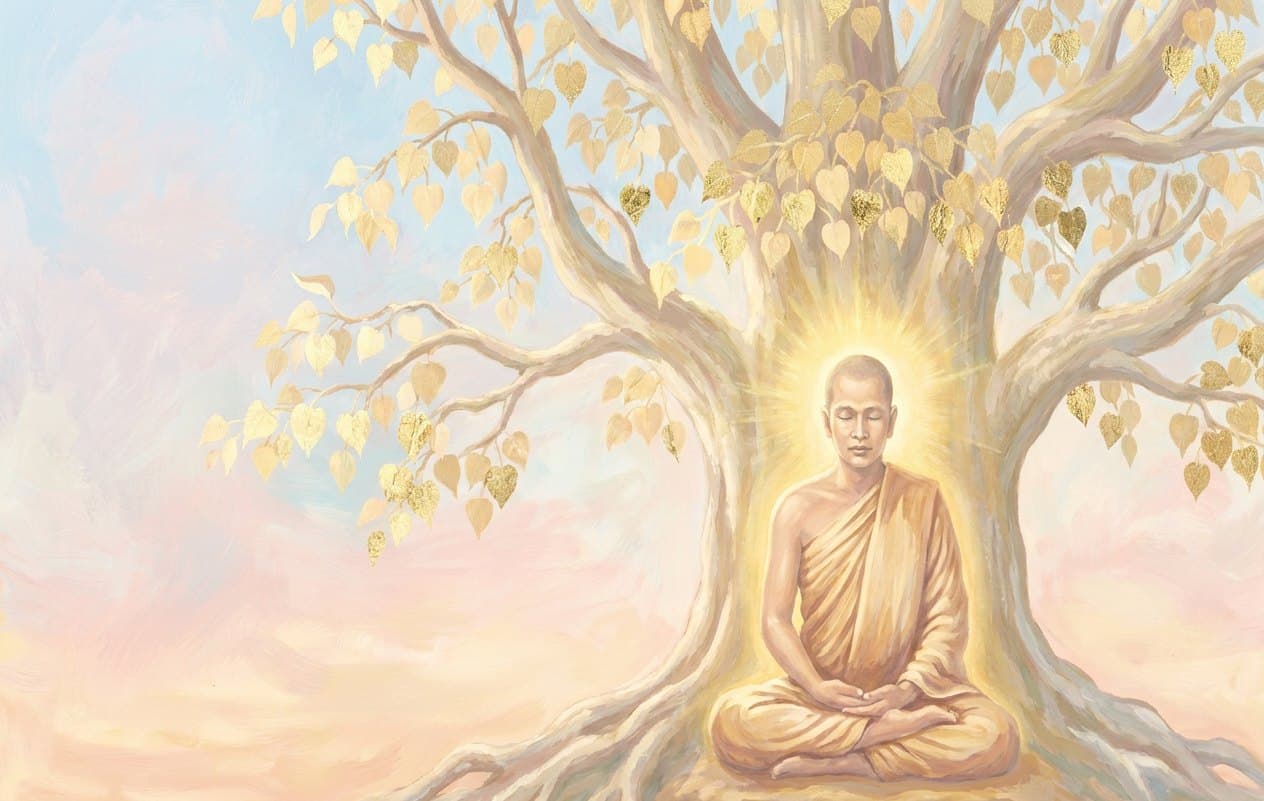
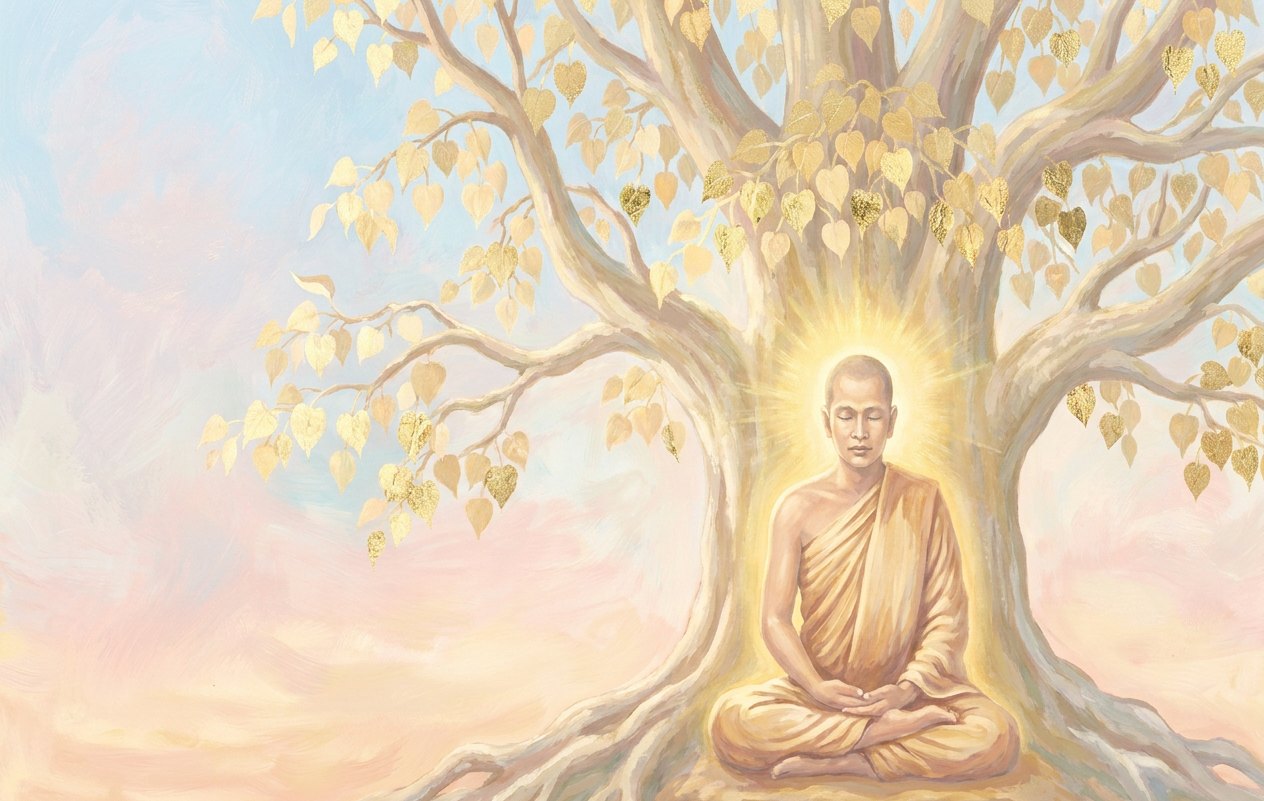
By the Neranjara river, at the place now called Bodh Gaya, he sat down under a fig tree (Ficus religiosa) and vowed not to rise until he had awakened. In the Pali Canon (MN 36) the Buddha himself describes how during that night he gained three kinds of knowledge:
The first watch of the night. He recollected his past lives: names, families, sorrows and joys, birth after birth.
The second watch. He saw how all beings die and are reborn according to their karma: wholesome actions lead to brighter worlds, unwholesome ones to darker worlds.
The third watch. He realised the four noble truths and saw how the mind's defilements are destroyed. The tradition places the moment of awakening at dawn, as the morning star rose.
Before that, the story goes, he was assailed by Mara, the god of desire and death, who sent his daughters, his armies and his doubts. Siddhartha did not argue. He simply touched the earth with his right hand, calling on it to bear witness. This gesture, the bhūmisparśa mudrā, is still one of the most common poses of Buddha statues across Asia.
The Dhammapada (verses 153–154) records the words the Buddha is said to have spoken on awakening: through many births he had wandered, seeking the builder of the house; now the house-builder is seen and will build no more, for the rafters are broken and the ridge-pole shattered. The house-builder is craving, and the house is the endless round of new births.
According to tradition, Siddhartha awakened at dawn as the morning star rose; ever since, the Bodhi tree has been the sign of enlightenment.
The Mahabodhi Temple at Bodh Gaya has been a UNESCO World Heritage Site since 2002, and the Bodhi tree that grows beside it descends from a cutting of the original. In Japan, the day of the Buddha's enlightenment, Rōhatsu, is celebrated on 8 December, and Zen monasteries mark the week before it with an intensive retreat in which monks sleep very little. In Theravada countries the Buddha's birth, enlightenment and passing are remembered together at Vesak, on the full moon of May.
Enlightenment across the traditions
Each of the great traditions has its own word for enlightenment, its own path towards it and its own picture of what remains afterwards. The table shows where they meet and where they part.
Tradition
Name
What is revealed
Main path
Theravada Buddhism
Bodhi, nibbāna
Impermanence, suffering and not-self in all phenomena; the extinction of craving
The noble eightfold path, vipassana
Mahayana Buddhism
Complete awakening, Buddha nature
Emptiness (śūnyatā) and compassion for all beings
The bodhisattva path and the six perfections
Zen
Satori, kensho
Seeing one's true nature here and now
Zazen, koans, the teacher–student bond
Tibetan Buddhism
Rigpa, buddhahood
The pure, luminous nature of mind
Dzogchen, mahamudra, guru yoga
Advaita Vedanta
Moksha, ātma-jñāna
Atman is Brahman: the individual Self and the absolute are one
Hearing, reflection, self-enquiry
Yoga (Patanjali)
Kaivalya, samadhi
Pure consciousness (purusha) standing apart from nature (prakriti)
The eight limbs of yoga
Christian mysticism
Illumination, union
The nearness of God in the ground of the soul
Prayer, contemplation, humility
Sufism
Fana and baqa
The self passes away in God, then lives on in Him
Dhikr (remembrance of the divine names), the sheikh
Unlike Vedanta, Buddhism does not teach an eternal soul that comes to know itself. The Buddha spoke of anatta, not-self: the awakened person sees that there never was any unchanging “I”. Vedanta says the opposite: the true Self exists and is everything. Yet both agree that after awakening, the small, anxious “me” that always wants something no longer runs a person's life.
The four stages of awakening in Theravada
Early Buddhism describes enlightenment not as a single flash but as a path with four clear stages. At each, certain fetters (saṃyojana) are cut, ten in all.
Stage
What is cut
What remains
Sotāpanna, “stream-enterer”
Belief in a separate self, doubt about the path, clinging to rites and rituals
No more than seven births until full liberation
Sakadāgāmī, “once-returner”
Sensual desire and ill will are greatly weakened
One more birth in the human world
Anāgāmī, “non-returner”
Sensual desire and ill will entirely
Rebirth in the pure abodes and awakening there
Arahant, “worthy one”
Craving for form and formless states, conceit, restlessness, ignorance
Nothing: the wheel has stopped, there will be no further birth
The Mahayana traditions widened the goal. Their ideal is not only to leave the wheel oneself but to become a bodhisattva: a being who vows to awaken for the sake of all living beings and does not enter final peace while others still suffer. This aspiration is called bodhicitta, “the mind of awakening”.
The ten ox-herding pictures: a map of awakening
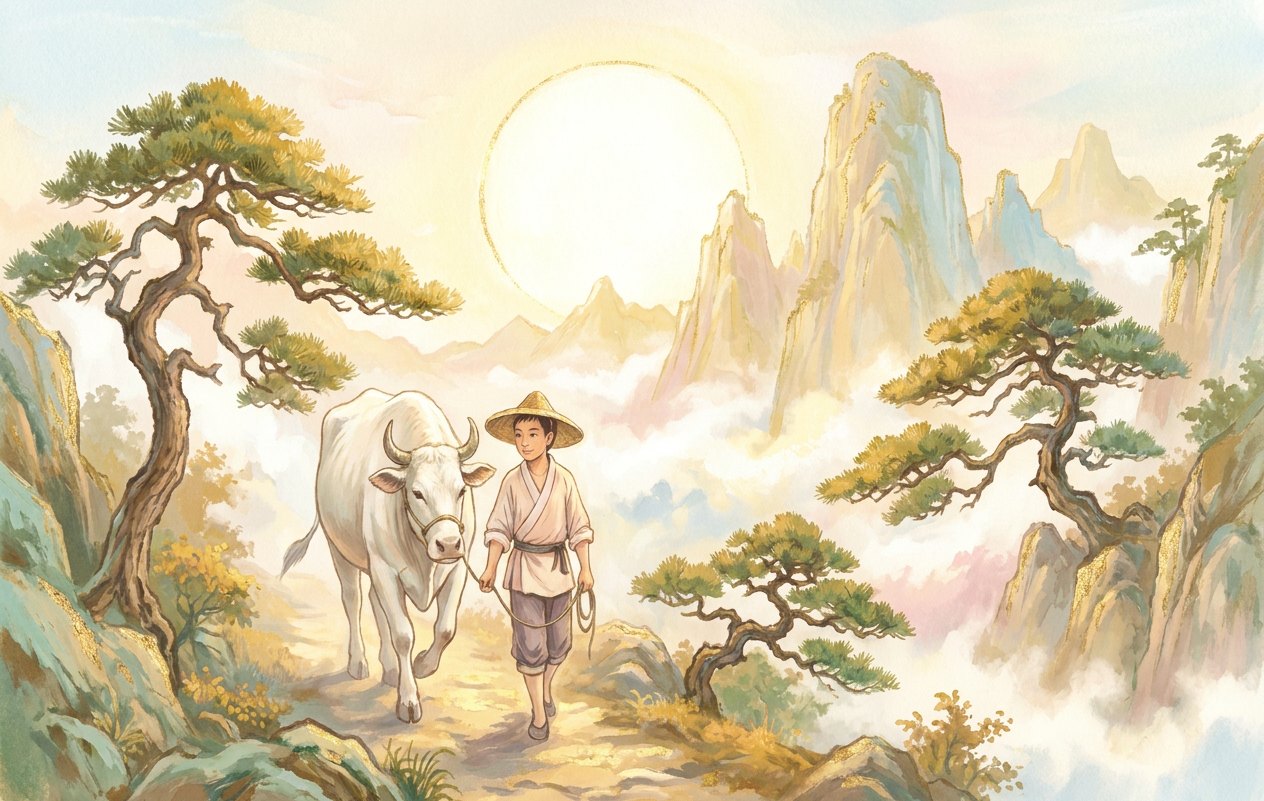
Zen has one of the most beautiful maps of the path to enlightenment. In the 12th century the Chinese master Kuoan Shiyuan (Kakuan in Japanese) drew ten pictures of a herdsman searching for an ox, and accompanied each one with a short poem. The ox stands for the true nature of mind; the herdsman is the person who seeks it.
1–3. Searching for the ox, finding its tracks, glimpsing it. A person feels that something is missing, reads, listens to teachers, finds the traces and at last, for one moment, sees what they were looking for.
4–5. Catching and taming the ox. The first insight slips away, so it has to be held: these are the long years of practice, when old habits keep pulling back.
6. Riding the ox home. The struggle is over; the herdsman rides the ox and plays his flute. Practice becomes natural.
7–8. The ox forgotten, then both forgotten. Neither the seeker nor the sought remains. The eighth picture is an empty circle.
9–10. Returning to the source, and entering the market with open hands. The rivers flow, the flowers are red. The awakened one returns among people, ordinary and cheerful, and helps others.
The ten ox-herding pictures: the herdsman searches for the ox, his own true nature, and finally returns among people.
The most important lesson of the pictures is the last one. Enlightenment here does not end in an empty circle or in rising above the world. It ends in the marketplace: a person comes back to ordinary life, but no longer as its prisoner.
Sudden or gradual? Huineng's poem
In Chinese Chan (Zen) of the 7th and 8th centuries a famous debate arose over whether awakening comes suddenly or step by step. The Platform Sutra of the Sixth Patriarch tells how the Fifth Patriarch, Hongren, asked his students to write a verse showing their understanding. The senior monk Shenxiu wrote that the body is the Bodhi tree and the mind a bright mirror stand, which must be wiped constantly so that no dust can settle on it.
Huineng, an illiterate kitchen worker, asked someone to write down his reply: Bodhi originally has no tree, the bright mirror has no stand; fundamentally there is not a single thing, so where could dust alight? Hongren secretly handed Huineng the patriarch's robe and bowl. From then on, the Southern school of Zen has taught sudden awakening: the nature of mind is already pure and needs not to be cleaned but to be seen.
A story from the tradition
The first koan of the collection The Gateless Gate (Wumenguan, 1228) goes like this: a monk asked Master Zhaozhou whether a dog has Buddha nature. Zhaozhou answered, “Mu”, meaning “no”. The compiler, Wumen, wrote that one should live with this single word day and night, as if one had swallowed a red-hot iron ball that can be neither swallowed nor spat out. When the question finally breaks open, says Wumen, you walk hand in hand with all the patriarchs and see with their eyes.
In Japanese Zen this current continued in the Rinzai line, with its koans, and in the Soto line founded by Dōgen (1200–1253). Dōgen taught that practice and enlightenment are not two: sitting in zazen is already the expression of Buddha nature. His essay “Genjōkōan” (1233) contains his best-known lines: to study the Buddha way is to study the self, to study the self is to forget the self, and to forget the self is to be actualised by the ten thousand things.
What the teachers taught about enlightenment
Ramana Maharshi: “Who am I?”
In 1896, sixteen-year-old Venkataraman in Madurai was gripped by a sudden fear of death; he lay down, acted out dying, and realised that the true Self does not die. Soon afterwards he left for the holy hill of Arunachala, where he lived until his death in 1950.
His path is self-enquiry (ātma-vichāra): for every thought that arises, ask “to whom has it arisen?” and follow the sense of “I” back to its source.
Shankara: Atman is Brahman
The 8th-century Indian teacher who shaped Advaita Vedanta taught that the world seen as countless separate things is maya, while reality is one.
Enlightenment is not an achievement but the undoing of a mistake: like a rope mistaken for a snake at dusk, it was always a rope.
Meister Eckhart: the eye with which I see God
The German Dominican (c. 1260–1328) preached about the birth of God in the ground of the soul and about Gelassenheit, letting go, releasing everything one calls one's own.
His most famous words: the eye with which I see God is the same eye with which God sees me.
Teresa of Ávila and the Sufis
In The Interior Castle (1577), Teresa described seven mansions of the soul; in the seventh the spiritual marriage, union with God, takes place.
The Sufis speak of fana, the passing away of the self in God, and baqa, abiding in Him afterwards. The mystic al-Hallaj, who cried “Ana al-Haqq”, “I am the Truth”, was executed in Baghdad in 922.
Samadhi, satori and enlightenment: what is the difference?
These words are often used interchangeably, though in the traditions they mean different things. In Patanjali's Yoga Sutras, samadhi is the eighth limb of yoga, a state of deep absorption in which the observer and the object observed merge. It can be with an object (samprajñāta) or without one (asamprajñāta), and its highest form leads to kaivalya, liberation.
In Zen, satori is a sudden flash of awakening, while kensho means “seeing one's nature”. Zen masters stress that the first kensho is only a beginning: after it comes a long time of “riding the ox home”. Hakuin (1686–1769) counted several great satori and countless small ones in his own life. Final enlightenment in Buddhism, by contrast, means there is no going back: craving and ignorance are extinguished for good.
Term
Tradition
Essence
Samadhi
Yoga, Buddhism
A state of deep absorption; it can pass
Satori, kensho
Zen
Seeing one's true nature; the first is the start of the path
Nirvana
Buddhism
The extinction of craving and the end of samsara
Moksha
Hinduism
Liberation from the cycle of birth, knowledge of the Self
Illumination
Christian mysticism
The second stage after purgation, before union
How the traditions describe an enlightened person
Interestingly, the traditions rarely describe the enlightened as miracle workers. Far more often they describe a simple, calm and very alive human being. A Zen saying puts it this way: before enlightenment, chop wood, carry water; after enlightenment, chop wood, carry water. What changes is not the activity but who is doing it.
Peace without a reason. The texts speak of a peace that does not depend on circumstances: it stays in success and in failure.
Compassion. The Buddhist tradition says that true wisdom and compassion are like the two wings of a bird: neither flies without the other.
Simplicity. Ramana Maharshi wore only a loincloth all his life and said that silence was his highest teaching.
The search is over. In the last ox-herding picture the person no longer looks for anything, and so is free to give.
In Hinduism such a person is called a jivanmukta, “one liberated while still alive”. They go on living in the body until their past karma is spent, just as a potter's wheel keeps turning for a while after the potter has stopped pushing it.
Practices that lead towards enlightenment
All the traditions agree that enlightenment cannot be manufactured, but the ground can be prepared for it. These are the practices teachers mention most often.
Zazen: just sitting
The Soto Zen practice of shikantaza means “just sitting”: back upright, eyes half open, not trying to attain anything and not pushing thoughts away. Dōgen said that such sitting is already the expression of enlightenment, not a means of reaching it.
Vipassana: seeing things as they are
Theravada insight meditation trains attention to follow the breath, bodily sensations, feelings and thoughts until three marks are clearly seen: everything passes, nothing can finally satisfy, and there is nothing that could be called an unchanging “I”.
Self-enquiry
Ramana Maharshi's method: when a thought arises, do not follow it, but ask “to whom has it arisen?” The answer is “to me”, and then comes “who am I?” Attention is turned back to the very sense of “I” until, as Ramana said, it dissolves in its source.
The koan
In Rinzai Zen a student receives a koan, such as “Mu” or “What was your original face before your parents were born?”, and carries it everywhere until the mind, unable to solve it with logic, stops grasping and opens.
Cultivating compassion
In the Mahayana, enlightenment without compassion is considered incomplete. Loving-kindness (mettā) meditation, offering good wishes to yourself, to those close to you, to strangers, to difficult people and to all beings, softens the heart and loosens the sense of separateness.
Contemplative prayer
Christian mystics repeated a short prayer or a single word while resting quietly in God's presence. The 14th-century English work The Cloud of Unknowing advised taking one short word, such as “God” or “love”, and using it to bring attention back from thoughts into silence again and again.
In Christian mysticism, illumination is the second stage of the path after purgation, when the soul first clearly senses the light of God.
What the traditions warn about along the way
The traditions do not only teach the way; they also warn about its traps. Zen teachers use the word makyō, “demonic realms”, for the visions, lights and unusual sensations that can arise in long meditation. Their advice: do not take them for enlightenment and do not be frightened by them; just keep sitting. The Tibetan teacher Chögyam Trungpa left modern seekers the term “spiritual materialism”, for when a spiritual experience becomes one more trophy for the ego.
In her book Mysticism (1911), Evelyn Underhill described five stages of the mystic way: awakening, purgation, illumination, the dark night of the soul and union. As she observed, light is often followed by darkness, when everything seems lost. St John of the Cross saw this darkness not as failure but as a necessary stage of the path.
Enlightenment and related concepts
Term
Essence
Link to enlightenment
Samsara
The cycle of birth and death
What enlightenment frees one from
Karma
The law of action and consequence
The enlightened no longer create binding karma
Ego death
The dissolving of the sense of a separate self
Often described as the threshold of awakening
Nonduality
Not-two: subject and object are not separate
What the awakened directly see
Spiritual awakening
The first turn towards the spiritual path
A beginning, not the end: the first ox-herding pictures
Self-knowledge guide Ema Sakalauskaitė writes about how psychology sees the idea of enlightenment: when it helps you live more calmly, and when it becomes one more goal that wears you out.
Frequently asked questions
What is enlightenment in simple terms?
According to the spiritual traditions, enlightenment is waking up from illusion: a direct seeing of what the “self” and the world really are. A person who has realised it is no longer driven by greed, anger and fear, and in Buddhism enlightenment also means liberation from the cycle of birth and death.
How did the Buddha become enlightened?
The tradition tells that after six years of searching, Siddhartha Gautama sat under a fig tree at Bodh Gaya and vowed not to rise until he had awakened. Over three watches of the night he recalled his past lives, saw how beings are reborn according to karma, and realised the four noble truths. At dawn, as the morning star rose, he awakened.
What is the difference between enlightenment and nirvana?
Enlightenment (bodhi) is the awakening, the direct seeing of reality, while nirvana is its fruit: the extinction of craving, hatred and ignorance and the end of samsara. In everyday speech the two words are often used as synonyms.
What are satori and kensho?
They are Zen terms. Kensho means “seeing one's nature”, while satori refers to the experience of awakening in general. Zen masters teach that the first kensho is only the beginning of the path, after which the insight must be matured for a long time.
What are the stages of enlightenment?
Theravada Buddhism describes four stages: the stream-enterer, the once-returner, the non-returner and the arahant. Zen pictures the path in the ten ox-herding pictures, and Christian mysticism as purgation, illumination and union.
Can enlightenment happen suddenly?
The Southern school of Zen, which goes back to the Sixth Patriarch Huineng, teaches sudden awakening: the nature of mind is already pure and only needs to be seen. Other schools emphasise a gradual path. Many teachers say that a sudden awakening usually comes after long practice.
How can I move towards enlightenment day to day?
The traditions suggest daily meditation (zazen, vipassana), self-enquiry by asking “who am I?”, loving-kindness practice, contemplative prayer and an ethical life. None of these manufactures enlightenment; they prepare the ground for it.