Manifestation: meaning, techniques and how to start
Manifestation (from the Latin manifestare, “to make clear”) is the spiritual practice of turning an inner wish into reality: stating it clearly, living it as if it had already come true, and acting from that state. Modern manifestation grew out of the nineteenth-century New Thought movement, and its roots can be found in the yogic sankalpa and in the Buddhist teaching that mind goes before all things.
Key facts
The word comes from the Latin manifestare, “to make clear, to show”.
Modern manifestation grew out of the nineteenth-century American New Thought movement (P. P. Quimby, W. W. Atkinson, W. D. Wattles).
The term “law of attraction” was popularised by W. W. Atkinson's 1906 book and turned into a global phenomenon by The Secret (2006).
Neville Goddard taught “living in the end”: imagining the wish fulfilled, especially in a state akin to sleep.
The 369 method is popularly linked to Nikola Tesla, though Tesla never described such a method.
Almost all the classic authors stress that manifestation does not work without action.
Contents
What does manifestation mean?
The word "manifestation" comes from the Latin manifestare, "to make clear, to show". In spiritual language, to manifest means turning an inner wish into outer reality: stating clearly what you want, living it in thought and feeling as if it had already happened, and letting life bring it to you. "Manifesting" is now one of the most searched spiritual words in the world.
At its core is an old idea: that the mind and consciousness shape reality. You can find it in Eastern traditions and in Western esotericism alike. Modern manifestation is the legacy of the nineteenth-century American New Thought movement, popularised in the twentieth century by books on success and in the twenty-first by the film The Secret and by social media.
Practitioners distinguish three things: intention (a clear wish), state (the feeling of already having it) and release (trust, without demanding proof every day). Almost every technique works with one of these three parts.
Where did the idea of manifestation come from?
The idea that the mind creates the world is far older than the word "manifestation". The Buddhist Dhammapada opens by saying that mind goes before all things: whoever speaks and acts with a pure mind is followed by happiness like a shadow that never leaves. The yoga tradition has sankalpa, a solemn intention spoken in deep relaxation so that it takes root in the deepest layers of consciousness. And the Bible says: "What things soever ye desire, when ye pray, believe that ye receive them, and ye shall have them" (Mark 11:24).
Modern manifestation took shape over about a century and a half. These are its main milestones:
When
Who
What they added
Mid-19th century
Phineas P. Quimby
Founder of New Thought: taught that belief and thought shape a person's condition.
1903
James Allen, As a Man Thinketh
A person is what they think; circumstances mirror the inner world.
1906
William Walker Atkinson, Thought Vibration or the Law of Attraction in the Thought World
Popularised the "law of attraction": like thoughts draw like events.
1908
The Kybalion
The Hermetic principle "The All is Mind": the universe is mental.
1910
Wallace D. Wattles, The Science of Getting Rich
A clear picture, faith and gratitude as a "science" of prosperity.
1925
Florence Scovel Shinn, The Game of Life and How to Play It
Words and affirmations as the rules of the game.
1937
Napoleon Hill, Think and Grow Rich
Burning desire, definiteness of purpose and daily repetition.
1940s–1970s
Neville Goddard
"Living in the end": imagining the wish fulfilled and feeling it.
From the 1980s
Esther and Jerry Hicks (Abraham-Hicks)
The emotional scale and aligning your "vibration" with the wish.
2006
Rhonda Byrne, The Secret
The film and book that turned the law of attraction into a global phenomenon.
For the law of attraction and what researchers say about it, see the ema.live glossary. This page describes the practice itself, as the tradition and its teachers present it.
How manifestation works, according to the teachers
Different schools use different words, but they describe the process in a similar way. Teachers usually set it out in five steps:
Clarity. Knowing exactly what you want and why. Hill called it "definiteness of purpose": a vague wish brings a vague result.
Image. Seeing the wish as already fulfilled. Neville Goddard taught imagining a short scene that would only happen once the wish came true, such as a friend congratulating you.
Feeling. Feeling that scene in the body: calm, joy, gratitude. Teachers say the feeling, not the words, is the real "order".
Release. Stopping the constant checking. Doubt and waiting, practitioners say, signal lack.
Inspired action. Doing what naturally arises from the new state. Almost every teacher, from Wattles to Hill, stresses that manifestation without action does not work.
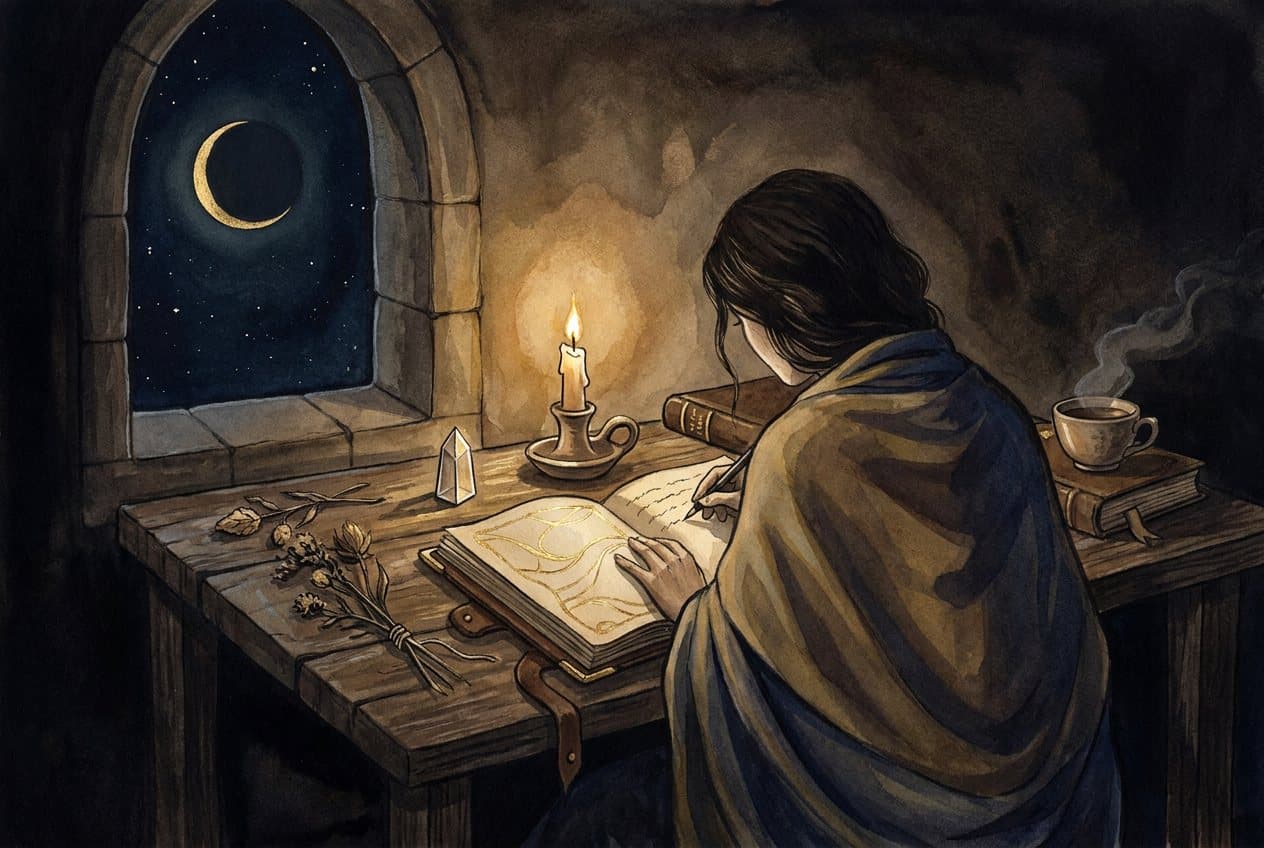
Intention and receiving: many practices begin with a quiet moment of feeling the wish as already fulfilled.
How to phrase a wish for manifestation
Teachers agree that half the work is phrasing the wish well. A vague or conflicted wish, they say, brings a vague result. These are the rules mentioned most often:
Present tense. Not "I will have a home" but "I live in my own home". Practitioners say the future tense keeps the wish in the future.
Positive form. Not "I am no longer in debt" but "my finances are in order and free". The mind, it is said, does not hear the negation.
Detail and feeling. The more detail and the stronger the feeling, the easier it is to live the wish as real.
Your own wish. Check that the wish is really yours, not your parents', your partner's or social media's.
"This or something better." Florence Scovel Shinn suggested ending every wish with "this or something better, under grace in a perfect way", to leave life room to surprise you.
Manifestation techniques, step by step
The most popular techniques are simple, which is why they spread. Each works mainly with one of the three parts: intention, state or release.
The 369 method
Write your wish 3 times in the morning, 6 times during the day and 9 times in the evening, and repeat this for 21 or 33 days. The method is popularly linked to Nikola Tesla and his fascination with the numbers 3, 6 and 9, though Tesla never described such a method; it spread on social media around 2020. Practitioners say the numbers matter less than returning to the same intention every day.
The 55×5 method
Write one short affirmation in the present tense ("I live in my own home by the sea") 55 times a day for five days in a row. The aim is to rewrite your inner dialogue through intense repetition and give the mind no room to drift back to doubt.
Scripting
Write a journal entry or a letter to a friend from a future in which the wish has already come true: what you are doing, how you feel, who is around you. Write in the present or past tense, with detail. The technique was popularised by the Abraham-Hicks teachings, and its roots go back to Neville's "living in the end".
Neville's method: the state akin to sleep
In the evening, lying in bed when your body is relaxed but you are not yet asleep, imagine one short scene from the fulfilled wish and replay it until you fall asleep. Neville called this the "state akin to sleep" and taught that this is when imagination most easily reaches the subconscious. The same logic is found in the yogic sankalpa.
Vision board
On a large sheet or board, pin photographs and pictures that show the life you want: a home, travel, relationships, health, work. Hang it where you will see it every day. Some practitioners make their board at the new moon and refresh it once a year.
A vision board: images you see every day keep reminding you where your attention is pointed.
Affirmations
Short positive sentences in the present tense, repeated aloud or silently. Early in the twentieth century the French pharmacist Émile Coué had his patients repeat daily: "Every day, in every way, I am getting better and better." Louise Hay later made affirmations popular. A good affirmation is short, personal, in the present tense and free of negatives.
Gratitude journal
Each day, write down three or five things you are grateful for, and at least one you give thanks for in advance, as if it had already happened. Wattles considered gratitude the most important part of the whole practice: in his view, a grateful mind stays in constant touch with abundance.
A teacher's story
In his lectures Neville Goddard often told how, during the Second World War, he was drafted into the army and wanted to go home to New York, though he had no real prospect of discharge. Every night before sleep he imagined himself lying in his own apartment in Manhattan. A few days later, he said, his request for discharge was unexpectedly approved. He told the story as an example of his teaching of "living in the end".
Manifesting love, money and work
Most people try manifestation in three areas. For each, teachers suggest a slightly different approach.
Love and relationships
Most teachers suggest manifesting not a specific person but the quality of a relationship: how you feel with a partner, what values you share, what your days together look like. Neville Goddard was an exception and believed you could imagine a specific person too, but even he spoke of changing your own state, not bending another's will. A common practice is to write a list of the qualities of a future partner and first develop them in yourself.
Money and abundance
Wattles and Hill taught that manifesting money starts with a clear amount, a deadline and a plan. Modern practitioners add an "abundance journal": each day they write down everything they have received, however small, and give thanks for it, so that attention shifts from lack to what is already there. Another practice is setting aside a small sum as a sign that there is already enough.
Work and calling
Here manifestation usually combines with practical steps: describing your ideal day, analysing your wheel of life or ikigai, and taking consistent action. Teachers stress that a clearly seen goal helps you notice opportunities you missed before.
Signs that manifestation is starting to work
Practitioners often describe similar signs that a wish is on its way:
Synchronicities. You unexpectedly meet people, books or chances connected with the wish.
Repeating numbers. In esoteric tradition, 111, 333 or 1111 are taken as signs that thought and reality are aligned.
Calm instead of waiting. The wish no longer feels urgent, as if it were already yours.
Inspired impulses. You suddenly feel like calling someone, going somewhere or trying something you never did before.
Resistance. Some teachers say old fears surface just before fulfilment, and that this is a sign change is coming, not that the practice is failing.
Manifestation and the lunar cycle
In modern esotericism manifestation is often paired with the rhythm of the Moon. The logic is simple: as the Moon grows from new to full, so does the intention.
New moon. The time for new intentions. People write 3 to 10 wishes in the present tense, often within 48 hours of the new moon. Find the next date in the new moon calendar.
Waxing moon. The time for action: taking steps towards the wish.
Full moon. The time for gratitude and release. Some practitioners list what they want to let go of (fears, old beliefs) and burn the page. Find the dates in the full moon calendar.
Waning moon. A time for clearing and rest, when it is said to be easiest to let go of what is in the way.
Sound lovers add frequencies to the practice: in the solfeggio scale, 528 Hz is called the "miracle" or "love" frequency, so it is often played during intention meditations. You can try it with the 528 Hz generator.
What teachers taught about manifestation
Neville Goddard: imagination creates reality
He taught to "assume the feeling of the wish fulfilled" and to live as if it had already happened.
His central idea: the outer world reflects your inner state, so it is the state you change, not the circumstances.
Wallace Wattles: a clear picture and gratitude
The Science of Getting Rich (1910) held that a clear picture of what you want, faith and gratitude work like a law.
At the same time he insisted on doing, every day, everything that can be done that day.
Napoleon Hill: burning desire
Think and Grow Rich (1937) advised writing down your goal, a deadline and a plan, and reading them aloud twice a day.
Hill stressed "burning desire" and persistence, not mere wishing.
The yoga tradition: sankalpa
In Swami Satyananda's Yoga Nidra (1976), sankalpa is a short resolve repeated at the start and end of practice.
The tradition says an intention spoken in deep relaxation is "sown" where, sooner or later, it unfolds.
How to begin: a simple 21-day practice
If you are trying manifestation for the first time, teachers advise starting with one wish and a simple routine. This practice combines the most important techniques:
Choose one wish. Write it as one sentence in the present tense and check that it is really yours.
Morning: intention. Write the sentence 3 times and think of one step towards it you can take today.
Daytime: action. Take that step, however small.
Evening: gratitude. Write three things you are grateful for and one you give thanks for in advance.
Before sleep: the image. For a few minutes, imagine one scene from the fulfilled wish and fall asleep with that feeling.
After 21 days: review. Read back through your notes and notice what has changed in you and around you.
So that your wishes are not random, it helps first to see which areas of life matter most to you right now. The wheel of life does exactly that: it shows where the gap is largest and where your first intention is best directed.
What to avoid when practising manifestation
The teachers themselves warn against several mistakes that turn the practice into disappointment:
Wishing on someone else's behalf. The traditions say you can manifest your own life, not another person's will. A practice of "make him love me" usually turns into attachment.
Blaming yourself. If something did not come true, it does not mean you "thought wrong". Illness, misfortune and loss are not a punishment for the wrong thoughts.
Replacing action with wishing. Nearly all the classic authors stress action. A vision board does not replace work, and an affirmation does not replace a conversation.
Giving up treatment or help. Manifestation can be a source of calm and direction, but it does not replace a doctor, treatment or professional help.
Suppressing "bad" feelings. Sadness, anger or fear are not a "low vibration" to be hidden. Many teachers suggest first sitting with the feeling and only then returning to the intention.
How manifestation differs from related concepts
Concept
Essence
Link to manifestation
Law of attraction
The idea that like thoughts draw like events
The theoretical basis of manifestation in New Thought
Affirmation
A short positive sentence repeated daily
One of the manifestation techniques
Visualisation
Creating the desired image in the mind
The main tool of Neville's and many other methods
Sankalpa
A solemn intention in the yoga tradition
An Eastern relative of manifestation
Prayer
A request addressed to God or a higher power
The difference: prayer asks, manifestation "assumes" the wish as already present
Self-knowledge guide Ema Sakalauskaitė writes about what research shows on visualising wishes, why manifesting seems to work, and when it turns into self-blame.
Frequently asked questions
What is manifestation in simple terms?
Manifestation is a practice in which you state a wish clearly, live it every day in thought and feeling as if it had already come true, and act from that state. Practitioners believe this helps the wish become reality.
How do you manifest correctly?
Teachers suggest five steps: know exactly what you want, see it as already done, feel that feeling in your body, stop constantly checking for results, and take the actions that naturally arise from the new state.
What is the 369 method?
You write your wish 3 times in the morning, 6 times during the day and 9 times in the evening, and repeat this for 21 or 33 days. It spread on social media around 2020 and is popularly linked to Nikola Tesla.
What is the 55x5 method?
You write one short affirmation in the present tense 55 times a day for five days in a row. The intense repetition is meant to rewrite your inner dialogue.
When is the best time to manifest by the Moon?
In modern esotericism, new intentions are written at the new moon, the waxing moon is for action, the full moon for gratitude and release, and the waning moon for clearing and rest.
How is manifestation different from prayer?
Prayer is usually a request addressed to God or a higher power, while manifestation “assumes” the wish as already present and works with a person's own state. Many practitioners combine the two.
Can manifestation replace medical treatment?
No. Manifestation can be a source of calm and direction, but it does not replace a doctor, treatment or professional help. Illness or misfortune is not a punishment for “bad thoughts”.
Sources
Dhammapada, verses 1–2
Swami Satyananda Saraswati, Yoga Nidra, Bihar School of Yoga, 1976
J. Allen, As a Man Thinketh, 1903
W. W. Atkinson, Thought Vibration or the Law of Attraction in the Thought World, 1906
The Kybalion, Yogi Publication Society, 1908
W. D. Wattles, The Science of Getting Rich, 1910
F. Scovel Shinn, The Game of Life and How to Play It, 1925
N. Hill, Think and Grow Rich, 1937
N. Goddard, Feeling Is the Secret, 1944, and The Power of Awareness, 1952
É. Coué, Self Mastery Through Conscious Autosuggestion, 1920