



The life path number is the core number of classical, so-called Pythagorean, numerology. It is derived from the one thing a person cannot change: the date of birth. In numerology it is read as the general direction of a life, the inborn tendencies and the lessons a person meets more often than others. There are twelve possible values: nine single digits from 1 to 9 and three master numbers, 11, 22 and 33.
This article gives the exact calculation rule and three worked examples, including the case where the two popular methods disagree. It then describes all twelve numbers: strengths, challenges, relationships and work. Finally, it explains how the life path number differs from the destiny matrix arcana, because both are calculated from the same date but by different rules, and answers the most common questions.
- The life path number is the sum of the digits of your date of birth reduced to a single digit; 11, 22 and 33 are kept as they are.
- The most accurate method reduces the month, the day and the year separately, then adds the three results and reduces once more.
- The nine numbers 1 to 9 form a cycle from beginning to completion; 11, 22 and 33 are read as a higher octave of 2, 4 and 6.
- The destiny matrix arcana comes from the same date but on a scale of 1 to 22, so it is a different number from a different system.
What the life path number is
Encyclopaedia Britannica defines numerology as the use of numbers to interpret a person's character or to divine the future, and traces its theoretical basis to the Pythagorean idea that all things can be expressed in numbers. Modern Western numerology took its present shape in the early twentieth century: the American writer L. Dow Balliett described a system that assigns the numbers 1 to 9 to letters and dates in her 1908 book "The Philosophy of Numbers", and her student Juno Jordan organised it in "Numerology: The Romance in Your Name" (1965) into the form that almost every book and calculator repeats today.
Numerology describes a person through several core numbers. Some come from the letters of the name (expression, soul urge and personality numbers), others from the date of birth. The life path number is considered the most important, because a name can be changed and a date cannot. Hans Decoz, one of the most frequently cited contemporary numerologists, calls it the most important number in the chart: it describes not what will happen to a person but the road they walk and the qualities that road will require.
This is a descriptive system, not a science. The mathematician Underwood Dudley shows at length in "Numerology, or What Pythagoras Wrought" that the meanings of the numbers are a convention handed from book to book, not a finding from research. Read your number as a mirror for questions about yourself, not as a forecast.
How to calculate your life path number
The basic operation is digit summing, also called reduction: a number is reduced when its digits are added together (14 becomes 1 + 4 = 5), and this is repeated until a single digit remains. The only exception is the master numbers 11, 22 and 33: if one of them appears at the end of the calculation, it is kept.
The rule, step by step
- Write the date of birth in three parts: month, day, year.
- Reduce the month to a single digit (11 stays 11, because it is a master number; November is the only such month).
- Reduce the day to a single digit (11 and 22 stay unreduced).
- Reduce the year: add all four digits, then add again until a single digit or 11, 22, 33 remains.
- Add the three results and reduce once more. If the final sum is 11, 22 or 33, that is your life path number; otherwise reduce to a single digit.
Example: 23 June 1992
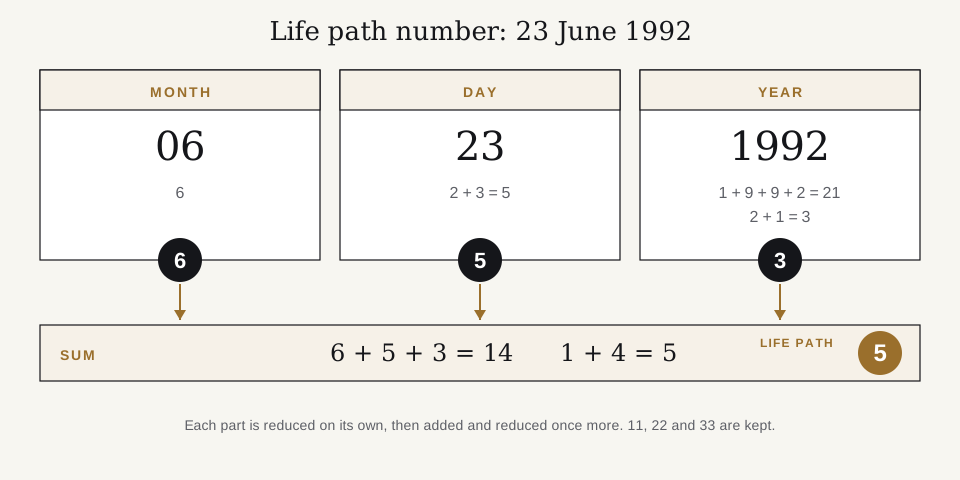
The month, 6, stays 6. The day, 23, becomes 2 + 3 = 5. The year, 1992, becomes 1 + 9 + 9 + 2 = 21, and 21 becomes 2 + 1 = 3. Adding up: 6 + 5 + 3 = 14, and 14 becomes 1 + 4 = 5. The life path number is 5. We used the same date in our article on how numerology and the destiny matrix differ, so you can compare there what the other system makes of it.
Two methods and why they sometimes disagree
Online you will also find a simpler method: add every digit of the date in one row and reduce the total. For most dates both methods give the same answer (23.06.1992: 2 + 3 + 0 + 6 + 1 + 9 + 9 + 2 = 32, 3 + 2 = 5). The difference appears when a master number gets involved. Decoz and most authors of the classical school keep to the method where each part of the date is reduced separately, because in numerology those three parts correspond to three life cycles, and the final sum is meant to join them.
| Date of birth | Reducing separately (month + day + year) | Adding all digits | Result |
|---|---|---|---|
| 23 June 1992 | 6 + 5 + 3 = 14 → 5 | 32 → 5 | Same: 5 |
| 29 November 1984 | 11 + 11 + 22 = 44 → 8 | 35 → 8 | Same: 8 |
| 6 September 1980 | 9 + 6 + 9 = 24 → 6 | 33 → kept as 33 | Differs: 6 or 33 |
| 2 November 2007 | 11 + 2 + 9 = 22 → kept as 22 | 13 → 4 | Differs: 22 or 4 |
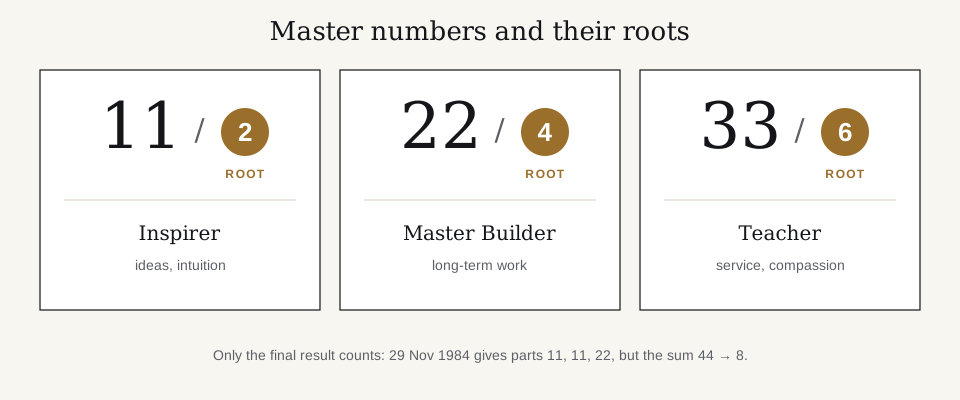
The second row shows an important detail: on 29 November 1984 all three parts are master numbers, but the final sum, 44, is not, so the life path is 8, not 11 and not 22. Only the number that appears in the last step counts as a master number. If two calculators give you different answers, they are almost always using different methods from this table.
What the numbers 1 to 9 mean
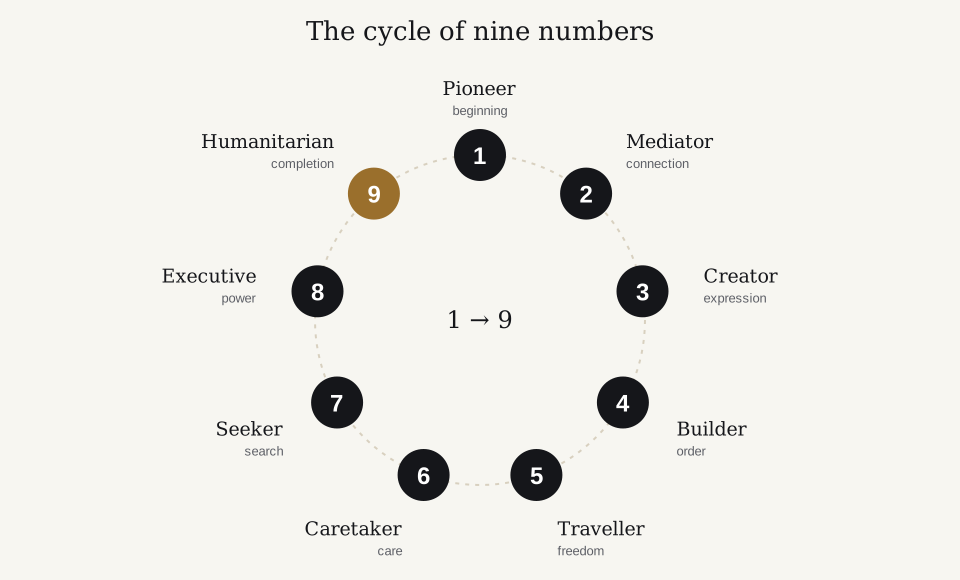
In numerology the nine numbers are understood as one cycle: 1 begins, 9 completes, and the numbers between mark the stages from independence through cooperation, expression, order, freedom, responsibility and inner search to power and summing up. Below is each number as the classical school presents it. No number is better than another: each has a strength and the reverse side of that strength.
1. The Pioneer
Essence: independence, initiative, will. Strengths: courage to start, ability to lead, originality. Challenges: stubbornness, impatience with slower people, a habit of doing everything alone. Relationships: the partner needs room, and the 1 needs to learn to ask rather than announce. Work: founding a business, leadership, self-employment, pioneering projects.
2. The Mediator
Essence: cooperation, sensitivity, balance. Strengths: diplomacy, the ability to listen and reconcile, patience. Challenges: oversensitivity to criticism, indecision, hiding one's own wishes for the sake of peace. Relationships: 2 is the number of partnership; "we" matters more than "I", and the risk is dissolving into the other person. Work: negotiation, mediation, counselling, teamwork, the helping professions.
3. The Creator
Essence: expression, words, joy. Strengths: eloquence, humour, imagination, the ability to inspire. Challenges: scattering, superficiality, unfinished projects. Relationships: lightness and play, but routine and hard conversations come harder. Work: writing, the stage, design, teaching, communication.
4. The Builder
Essence: order, work, reliability. Strengths: endurance, system, the ability to finish what others started. Challenges: rigidity, fear of change, work instead of life. Relationships: loyalty and stability; the partner may miss spontaneity. Work: engineering, construction, finance, administration, anything that needs structure.
5. The Traveller
Essence: freedom, change, experience. Strengths: adaptability, curiosity, quick reactions, ease with all kinds of people. Challenges: restlessness, fear of commitment, excess (food, entertainment, stimulation). Relationships: movement and novelty are essential; monotony is the hardest test for a 5. Work: sales, travel, journalism, marketing, any job without two identical days.
6. The Caretaker
Essence: responsibility, home, care. Strengths: warmth, sense of duty, feeling for beauty, the ability to create community. Challenges: control "for their own good", self-sacrifice to the point of exhaustion, perfectionism. Relationships: family and home are central; the task is to keep care from turning into custody. Work: medicine, education, social work, interiors, food, anything tied to people's wellbeing.
7. The Seeker
Essence: analysis, inner life, the search for truth. Strengths: deep thinking, intuition, self-sufficiency, the ability to see beneath the surface. Challenges: detachment, scepticism, solitude turning into isolation. Relationships: a 7 needs time alone; closeness comes slowly but runs deep. Work: science, research, philosophy, technology, spiritual practice.
8. The Executive
Essence: power, matter, results. Strengths: ambition, organisation, the ability to manage resources and people. Challenges: workaholism, status for its own sake, control. Relationships: the partner must be an equal; the 8 has to learn that a relationship is not run like a company. Work: business, management, law, finance, building large structures.
9. The Humanitarian
Essence: completion, compassion, the wide view. Strengths: generosity, idealism, the ability to forgive and let go, artistry. Challenges: disappointment in people, difficulty caring for oneself, holding on to the past. Relationships: a 9 loves widely, so the person closest sometimes gets too little. Work: charity, art, teaching, healing, work whose meaning is wider than one person.
The master numbers 11, 22 and 33
In numerology 11, 22 and 33 are read as a higher octave of 2, 4 and 6, which is why they are often written with their root: 11/2, 22/4, 33/6. Decoz stresses that they are master numbers not because the digits repeat but because those digits are 1, 2 and 3: the first three numbers of the cycle, doubled. Other double numbers (44, 55) are not master numbers in the classical school. A person with a master number, numerologists say, lives all their life between the root and the higher tone: until the first is learned, the second is felt as tension.
11. The Inspirer (11/2)
The sensitivity and intuition of the 2 raised to the level of ideas. Strengths: insight, the ability to inspire, vision. Challenges: nervous tension, self-criticism, fear of not living up to expectations. In relationships the task is to find someone who respects the sensitivity without exploiting it. Work where an idea is passed on to others: teaching, art, counselling, spiritual work.
22. The Master Builder (22/4)
The diligence and system of the 4 aimed at large, long-term work. Strengths: practical vision, the ability to gather people and deliver. Challenges: burnout, self-doubt when the scale is frightening, a tendency to carry everything alone. In relationships a partner who sees the long road is needed. Work: building organisations, infrastructure, projects that outlast the person.
33. The Teacher (33/6)
The care of the 6 extended beyond the family. Strengths: compassion, the ability to heal and teach, sincere service. Challenges: sacrifice without limits, placing others' needs above one's own to the point of illness, excessive responsibility for everyone. Work: education, medicine, helping people. The 33 is the rarest, because the final sum rarely produces it; some numerologists treat it as theoretical and read it as a 6.
Comments (0)
No comments yet. Be the first!
Only logged-in users can comment. Register — and you'll be able to share your thoughts on this article.
Register