

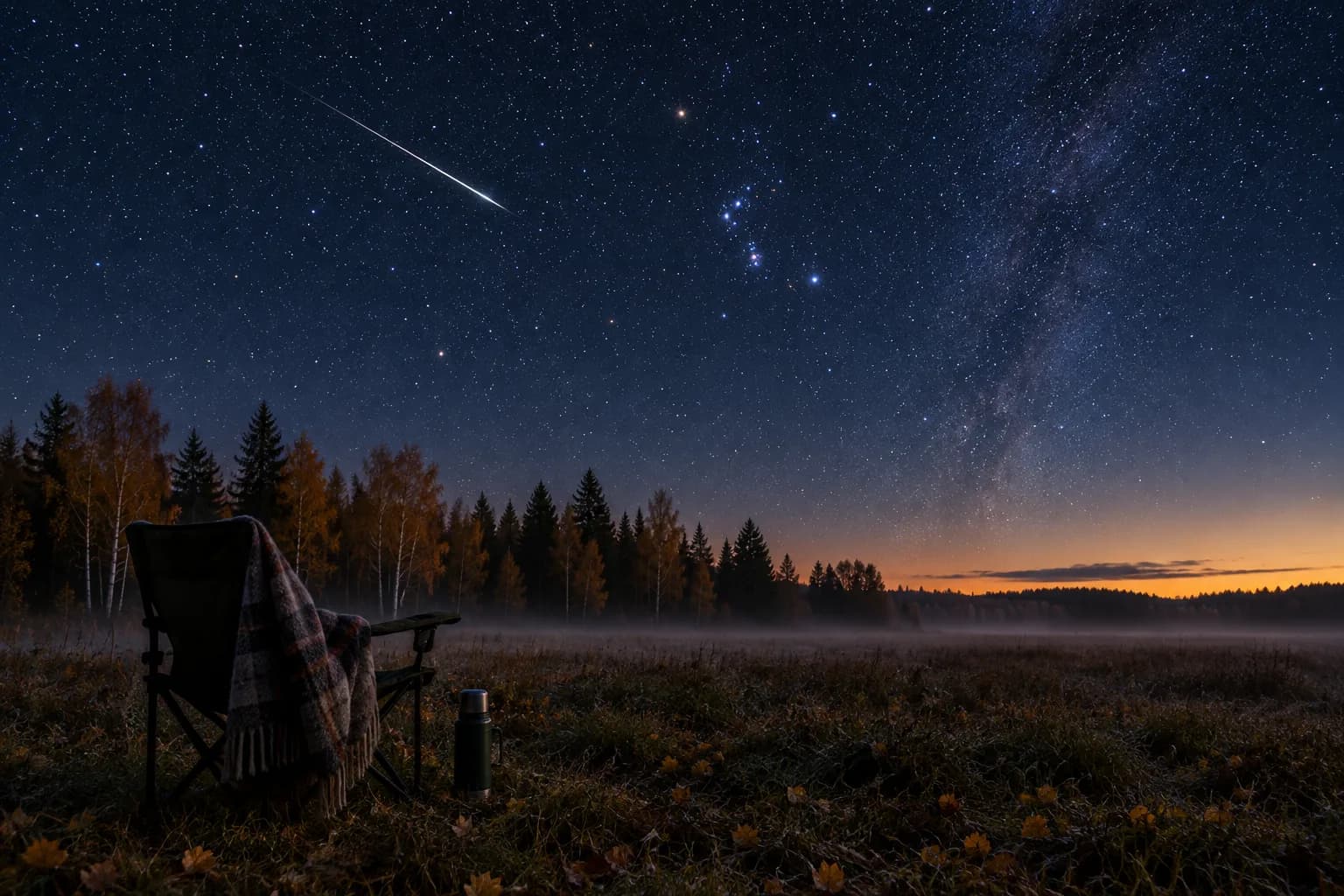

Every October, Earth ploughs through the dust left behind by Halley's Comet, and the result is the Orionid meteor shower. In 2026 the International Meteor Organization (IMO) puts the maximum on 21 October, when the Sun's ecliptic longitude reaches 208°. By our calculation that moment falls at about 09:20 UTC, which is 10:20 BST in London and 05:20 EDT in New York. On both sides of the Atlantic, then, the night to set an alarm for is the night of 20–21 October, with 21–22 October a close second.
The complication this year is a waxing gibbous Moon, about 73% lit on the peak night. The good news is that it sets at 01:33 in London and 02:07 in New York, hours before the Orionid radiant climbs highest. The last three or four hours of darkness before dawn will be moonless, and those are exactly the hours when Orionids are most plentiful. Below you will find a night-by-night table for 18–25 October for the UK and the US East Coast, realistic hourly counts for a dark site and for a town, where to look, how to catch one on a phone, and what else is up there. Our permanent Orionid meteor shower page carries the year-by-year tables and the radiant curve for your own city.
- When: the best night is 20–21 October; 21–22 October is nearly as good. The shower is active from 2 October to 7 November.
- What time: roughly 02:00 to 05:45 local time, after moonset and before twilight, in both London and New York.
- How many: our model gives about 10 meteors an hour from a dark rural site (11–12 in New York, where the radiant climbs higher) and 2–3 from a town.
- Where to look: high in the south-east, not straight at Orion; the meteors cross the whole sky.
What the Orionids are, and the Halley connection
A meteor is not a falling star but a grain of dust hitting the upper atmosphere fast enough to burn up roughly 80–120 km above the ground. The Orionid grains were shed by Comet 1P/Halley. Each time the comet swings past the Sun it loses some ice and dust, which spread out along its orbit, and Earth's own orbit crosses that stream twice a year.
The first crossing, in May, gives us the Eta Aquariids; the second, in October, gives us the Orionids. Same comet, same dust, two different points on the orbit. NASA notes that Halley itself was last seen by casual observers in 1986 and will not return to the inner Solar System until 2061, so this annual shower is the nearest most of us will get to the comet for decades.
Fast and bright
Orionids strike the atmosphere at about 66 km/s (41 miles per second), among the fastest of any annual shower, because Earth meets the stream almost head-on. That speed makes them short and bright, and the faster ones can leave a glowing train that hangs in the sky for a second or more. NASA also mentions the occasional fireball.
How strong is the shower
The IMO's 2026 calendar gives a zenithal hourly rate (ZHR) of "20+". ZHR is the theoretical count for a perfect observer under a pristine sky with the radiant overhead. From 2006 to 2009 the shower surprised everyone with ZHRs of roughly 40–70; between 2012 and 2020 the average peak ran at about 20–30. The maximum is broad, often a plateau over several nights, which is why the nights either side of the peak are still worth your time.
Orionids 2026, night by night: London and New York
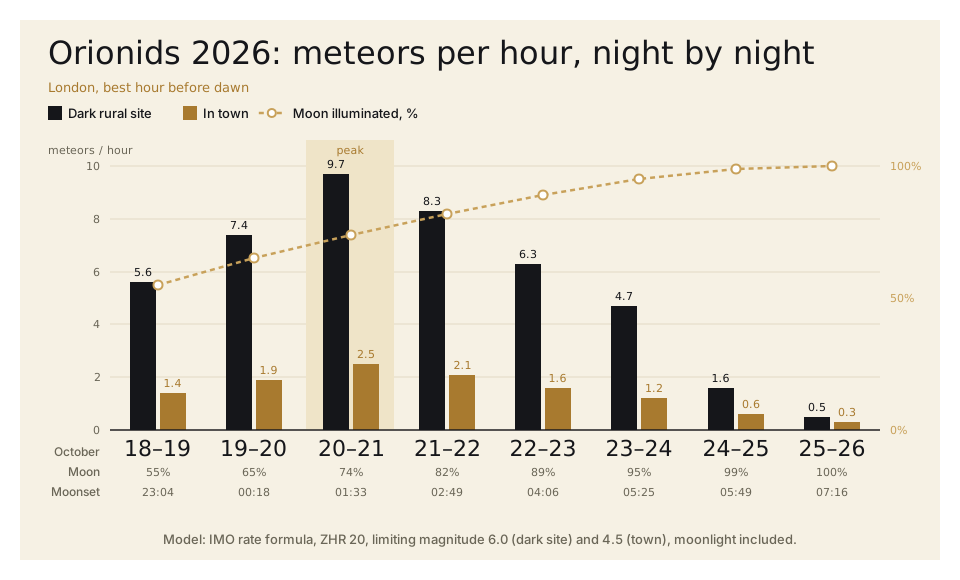
The table uses the same model as our Orionids page: the IMO rate formula, which turns the ZHR into what a real person sees using the radiant's altitude, the faintest star the sky shows (limiting magnitude 6.0 for a dark site, 4.5 for a town) and moonlight. Counts are for the best hour of each night under a clear sky. Times are local: BST and EDT. British clocks go back an hour in the early hours of 25 October; American clocks not until 1 November.
| Night of | Moon lit | Moonset London | Moonset New York | Dark site, per hour (London / NY) | Town, per hour |
|---|---|---|---|---|---|
| 18–19 Oct | 55% | 23:04 | 23:58 | 6 / 7 | 1–2 |
| 19–20 Oct | 65% | 00:18 | 01:02 | 7 / 9 | 2 |
| 20–21 Oct | 74% | 01:33 | 02:07 | 10 / 11–12 | 2–3 |
| 21–22 Oct | 82% | 02:49 | 03:12 | 8 / 9 | 2 |
| 22–23 Oct | 89% | 04:06 | 04:19 | 6 / 7 | 1–2 |
| 23–24 Oct | 95% | 05:25 | 05:28 | up to 5, last half hour only | 1 |
| 24–25 Oct | 99% | 05:49 | 06:40 | 1–2, Moon up all night | under 1 |
| 25–26 Oct | 100% | 07:16 | 07:56 | under 1, full Moon | 0 |
Treat the numbers as an honest estimate rather than a promise. The Orionids vary from year to year, and nobody spots every faint meteor. The pattern, though, is robust: a dark site shows roughly four times as many meteors as a suburban garden, and the nights after 23 October are washed out by the Moon.
Why not in the evening
The radiant sits in Orion's raised club, just north of the red star Betelgeuse, near the border with Gemini. It clears the horizon around 22:00 in London and 22:20 in New York, and it is highest just before dawn: about 54° up at 05:20 in London and 65° at 05:20 in New York. While it is low, most of the shower's meteors are below your horizon. On the peak night in London the model gives about 3 meteors an hour from a dark site at 01:00, 8 at 03:00 and nearly 10 at 05:00. New York does a little better at every hour because, at 41° north, Orion climbs higher.
Why the Moon matters less than it looks
First quarter was on 18 October and full Moon is on 26 October (04:12 UTC). Each night the Moon sets about 75 minutes later than the night before. On the peak night it is gone by 01:33 in London and 02:07 in New York, and on 21–22 October by 02:49 and 03:12. The prime pre-dawn hours stay dark until about 23 October, after which the shower is effectively over for casual observers. You can follow the Moon night by night in our October 2026 Moon calendar, and the Moon phases page explains the cycle.
Where to look and how to prepare
Direction
The meteors fly out of Orion but show up anywhere in the sky. After midnight Orion is in the east and south-east; by 05:00 it is in the south. NASA's advice is to look 45–90° away from the radiant, where trails look longer, rather than straight at it, where they appear foreshortened. In practice, lie back with your feet towards the south-east and look about two-thirds of the way up the sky. That puts the largest patch of sky in your field of view.
Give your eyes time
Dark adaptation takes 20–30 minutes, and one glance at a bright phone screen resets it. Switch the phone to a red filter or minimum brightness, or simply leave it in your pocket. Plan for at least an hour: at 10 meteors an hour you will get bursts and quiet spells, including 15 minutes with nothing at all.
Dress for it
Late-October nights run around 3–8 °C in southern England and 5–10 °C in New York, and lying still makes them feel colder. Bring a reclining chair or a foam mat, a sleeping bag or heavy blanket, a hat and a flask. Dew will soak anything left on the grass by dawn.
Finding a dark sky
The 2016 world atlas of artificial sky brightness (Falchi and colleagues, Science Advances) found that more than 99% of people in the US and Europe live under light-polluted skies and that the Milky Way is hidden from nearly 80% of North Americans. That directly sets how many Orionids you see: under a town sky only the brightest get through.
In the UK, the darkest skies within reach of most people are in national parks and designated dark-sky places: Exmoor, the South Downs, the Brecon Beacons (Bannau Brycheiniog), Northumberland and Kielder, the North York Moors and the Yorkshire Dales. In the north-eastern US, think of the Catskills, the Pine Barrens of New Jersey, or the long drive to Cherry Springs State Park in Pennsylvania. Because the Orionids are a south-eastern-sky affair, the key is that your south-east is free of a city glow. From London or New York, that often means heading somewhere with the city to your north or west.
If you cannot get away, pick the darkest corner of your garden or a park, put a building between you and the nearest streetlight, and keep expectations modest: perhaps 2–3 an hour, but every one of them bright.
Comments (0)
No comments yet. Be the first!
Only logged-in users can comment. Register — and you'll be able to share your thoughts on this article.
Register