

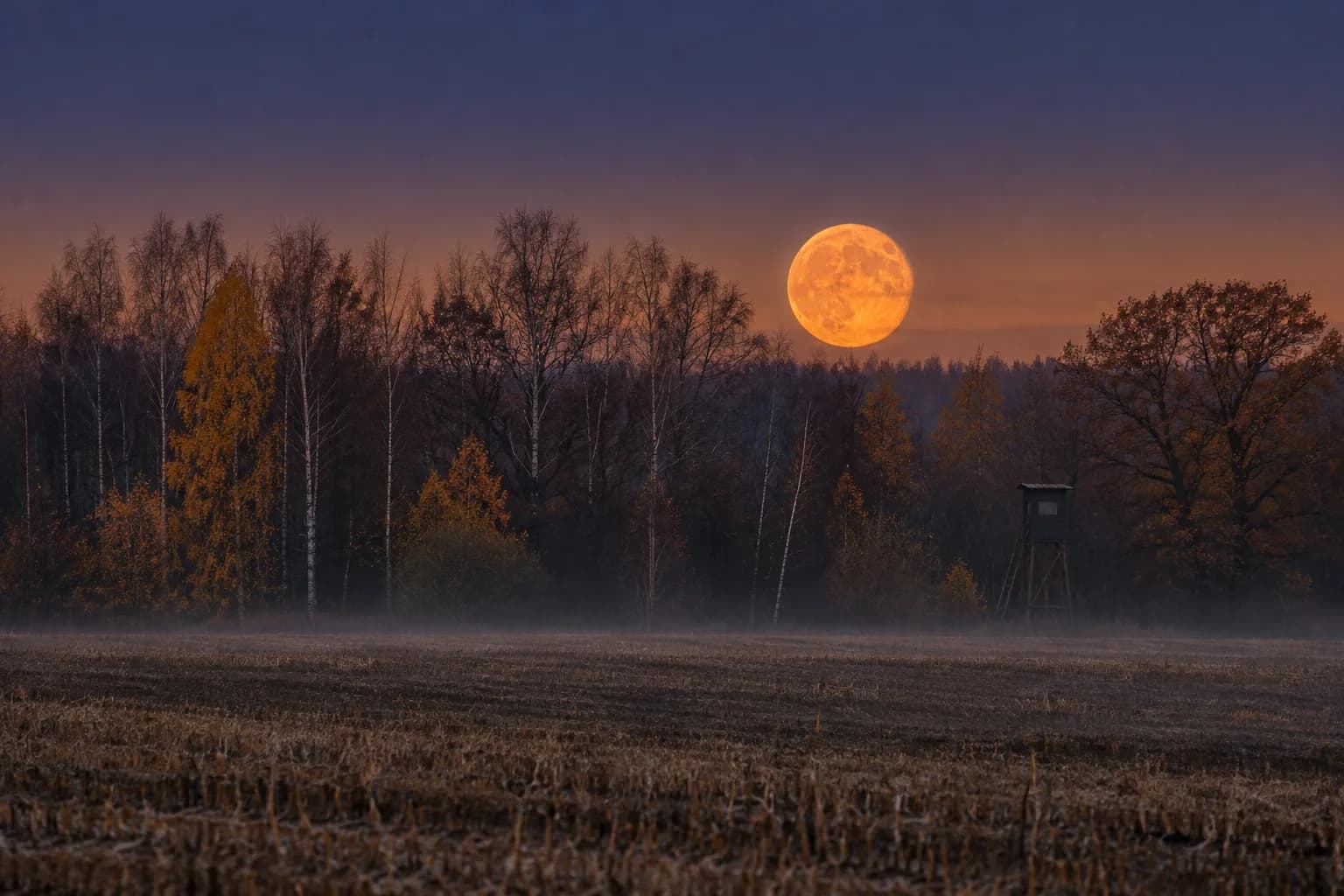

If you were hoping for a full moon over the jack-o'-lanterns this year, the timing is off by five days. October's full moon, the Hunter's Moon, is exact at 04:11 UTC on Monday 26 October 2026. In London that is 04:11 GMT, a few hours after the clocks go back. In New York it is 00:11 EDT, eleven minutes after midnight between Sunday and Monday. By Halloween night the Moon is a waning gibbous a little over half lit, and it does not rise until about 9 pm in London and 11 pm in New York.
So the night to look up is not 31 October but Sunday 25 and Monday 26 October, when an almost perfectly round Moon comes up in the east around sunset. Everything below was computed with the code behind the Mind University moon calendars: exact times and moonrise for the UK, the US and other cities, the Moon's distance, what our calendars say about that week, the sleep research, and phone photography tips.
- When: 04:11 UTC on 26 October 2026, which is 04:11 GMT in the UK and 00:11 EDT on the US East Coast (the night of Sunday 25 October).
- Halloween: no full moon on 31 October 2026. The next Halloween full moon visible in the UK and US comes on 31 October 2039.
- Not a supermoon: 368,859 km away, closer than average, but the supermoons of the season are 24 November and 24 December.
- Sleep: the research is mixed. Small lab studies found shorter sleep around the full moon, larger datasets did not, and a field study links later bedtimes to moonlit evenings before the full moon.
When is the full moon in October 2026?
A full moon is an instant, the moment the Moon stands opposite the Sun in the sky. This one falls at 04:11 UTC on 26 October. Because it happens in the small hours by European clocks and right around midnight in the eastern US, which evening counts as "the full moon" depends on where you live:
| City | Full moon, local time | Moonrise 25 Oct | Moonrise 26 Oct | Sunset 26 Oct |
|---|---|---|---|---|
| London | 26 Oct, 04:11 GMT | 16:01 | 16:21 | 16:46 |
| New York | 26 Oct, 00:11 EDT | 17:26 | 17:58 | 18:01 |
| Vilnius | 26 Oct, 06:11 EET | 16:10 | 16:24 | 16:57 |
| Moscow | 26 Oct, 07:11 MSK | 16:17 | 16:29 | 17:05 |
| Almaty | 26 Oct, 09:11 (UTC+5) | 16:06 | 16:34 | 16:53 |
Moonrise is for a flat horizon, good to about two minutes; trees and buildings delay it by 10 to 20 minutes. Other US time zones are simply earlier: the exact full moon is at 23:11 CDT, 22:11 MDT and 21:11 PDT on Sunday 25 October, so for everyone in North America Sunday evening is the full-moon night. In the UK the Moon sets at 07:16 on Monday morning, so at the exact moment (04:11) it is still well up in the western sky. For the day in detail, see the Moon on 26 October, and for the whole year our full moon calendar.
The clock change in the middle
British Summer Time ends at 02:00 on Sunday 25 October, when clocks go back to 01:00, and the rest of the EU changes at the same instant. The US keeps daylight saving time for one more week, until 02:00 on Sunday 1 November. For that week London is four hours ahead of New York, not five, and a calendar printed with summer time is an hour wrong for the UK. Check against UTC: 04:11 (some sources round to 04:12).
Why is it called the Hunter's Moon?
In the almanac tradition each full moon has a name, and the autumn pair is defined by the equinox. The Harvest Moon is the full moon closest to the September equinox. In 2026 the equinox fell at 00:05 UTC on 23 September. The candidates were 28 August, 26 days earlier, and 26 September at 16:49 UTC, 3.7 days later, so September's full moon was the Harvest Moon. The Hunter's Moon is the next one after it: 26 October. About one year in three the Harvest Moon falls in early October and the Hunter's Moon slides into November, but 2026 is not one of those years.
The name comes from the season: fields cut, leaves down, game easier to see, and a bright early-evening moon for hunting before winter. The astronomy is the same as for the Harvest Moon. On autumn evenings the ecliptic, the path the Moon follows, meets the eastern horizon at a shallow angle, so the full moon rises at almost the same time several evenings in a row instead of the average 50 minutes later. In London, moonrise moves from 16:01 to 16:21 to 16:47 across 25, 26 and 27 October, a lag of only 20 and 26 minutes. That gives three evenings with a nearly full Moon on the horizon at dusk.
At the moment of the full moon the Moon sits inside the constellation of Aries. Astrology sites call it a "full moon in Taurus": the tropical zodiac is counted from the March equinox point, which has drifted about one sign against the stars through precession.
Is the Hunter's Moon 2026 a supermoon?
No. At the instant of full moon the centres of Earth and Moon are 368,859 km apart. That is closer than the average of about 384,400 km: the disc is 32.4 arcminutes across against 30.6 at the near-apogee full moon of 28 August, about 6% wider and invisible to the eye. Perigee, the closest point of this orbit, comes at 18:04 UTC on 28 October (364,397 km), two and a half days after the full moon.
"Supermoon" is not a formal term. Richard Nolle's common definition is a full moon within 90% of the way from the orbit's farthest to its closest point. Using this stretch of the orbit (perigee 356,641 km on 24 December, apogee 406,597 km on 7 January 2027), the cut-off is about 361,600 km. October misses it, while November and December pass it easily. The full moon of 24 December will be the closest of all 2026 full moons.
The next full moons
| Date | UTC / UK | US Eastern | Name | Distance | Supermoon |
|---|---|---|---|---|---|
| 26 Oct 2026 | 04:11 | 00:11 EDT (26 Oct) | Hunter's Moon | 368,859 km | No |
| 24 Nov 2026 | 14:53 | 09:53 EST | Beaver Moon | 360,754 km | Yes |
| 24 Dec 2026 | 01:28 | 20:28 EST (23 Dec) | Cold Moon | 356,729 km | Yes, closest of the year |
| 22 Jan 2027 | 12:17 | 07:17 EST | Wolf Moon | 357,635 km | Yes |
The December full moon lights the longest nights of the year. Every phase is on the moon phases page.
October 2026 moon phases, day by day
October runs through a full cycle. Last quarter was 3 October at 13:25 UTC, the new moon 10 October at 15:50, first quarter comes on 18 October at 16:12 and the full moon on 26 October at 04:11. The lit share of the disc climbs from 1% on 11 October to 99% on the 25th and is still 66% on Halloween. The October moon calendar has every day with its phase, illumination and calendar ratings.
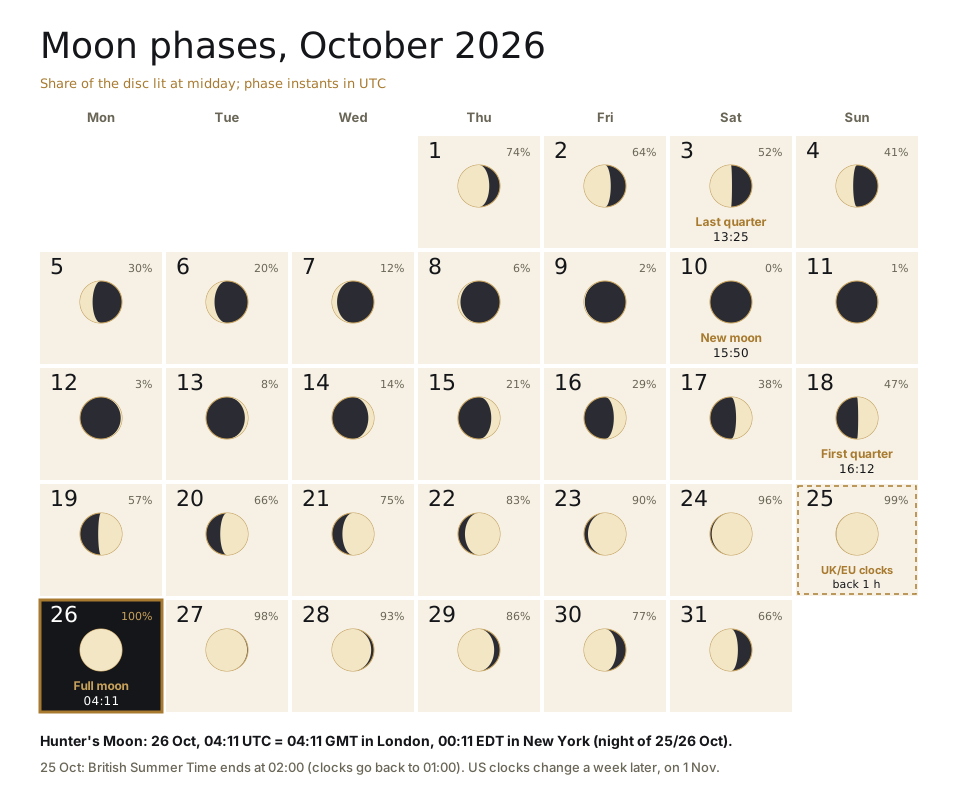
The bright second half of the month has one cost. The Orionid meteor shower peaks around 21 October with the Moon 75% lit. The radiant in Orion climbs high only after midnight, and on the morning of 22 October the Moon sets at 02:49 in London and 03:13 in New York, so the dark hours between moonset and dawn are the ones to try. What else is up tonight is on our sky page.
What the moon calendars say for 24–28 October
Mind University runs several moon calendars from one engine: the phase, the lunar day (counted from the instant of the new moon), the Moon's tropical sign and, for fishing, rise, set and transit times for your city. They are traditions, not science, and each page says so. Full moon week:
| Date | Moon | Haircut | Garden | Fishing |
|---|---|---|---|---|
| Sat 24 Oct | 96%, lunar day 14 | Favourable for cutting and colouring, manicure neutral | Moon in Aries, fruit day: fruiting crops and garden care | Good |
| Sun 25 Oct | 99%, lunar day 15 | Unfavourable for all: a traditional "difficult" day | Rest day, no sowing | Best |
| Mon 26 Oct | Full moon, lunar day 16 | Neutral: the tradition is divided | No sowing; favourable for harvest and care | Best |
| Tue 27 Oct | 98% waning, lunar day 17 | Cutting neutral; manicure and hair removal favourable | Moon in Taurus, root day: roots and planting | Best |
| Wed 28 Oct | 93%, lunar day 18 | Manicure and hair removal favourable | Moon in Gemini, flower day: bulbs, flowers, care | Good |
Haircut calendar
The lunar haircut calendar follows tradition: a waxing moon for cutting and colouring, a waning moon for manicures and hair removal, and the new moon and "difficult" lunar days 9, 15, 23 and 29 for nothing. This week that makes Saturday 24 October the pick for a cut, while Sunday 25th, lunar day 15, is marked unfavourable. On the full moon day itself the calendar stays neutral, because the sources of the tradition disagree.
Planting calendar
The lunar planting calendar says not to sow on the full moon day but marks it as good for harvesting and garden care. For garlic, late October's classic job, it picks Tuesday 27th, a root day with the Moon in "fertile" Taurus; for flower bulbs, Wednesday 28th.
Fishing calendar
The fishing calendar is built on John Alden Knight's solunar tables, in which the best days fall around the new and full moon, so 25–27 October all get the top rating. In London on the 26th the minor period around moonset (07:16) falls within an hour of sunrise and the one around moonrise (16:21) falls at dusk. In New York the same pairing comes at 07:56 and 17:58. The calendar flags those dawn and dusk periods, where the anglers' tradition and the low-light feeding of many fish agree. There is no overhead transit in London on the 26th at all: the lunar day is 24 hours 50 minutes long and skips a date about once a month.
Does the full moon affect sleep? What the research says
Studies that found an effect
In 2013 chronobiologists in Basel (Cajochen and colleagues, Current Biology) went back to data from an earlier laboratory study. Volunteers slept with no windows or time cues, and nobody had the Moon in mind at the time. Around the full moon, EEG delta activity in deep sleep was 30% lower, falling asleep took 5 minutes longer, total sleep was 20 minutes shorter, and subjective sleep quality and melatonin levels were lower. A year later a Swedish group (Smith and colleagues) analysed 47 young, healthy volunteers in the same retrospective way and found total sleep about 25 minutes shorter around the full moon, though other details differed from the Basel results.
Comments (0)
No comments yet. Be the first!
Only logged-in users can comment. Register — and you'll be able to share your thoughts on this article.
Register