
Mon · 12 OctMoon 3%Field Kp 4 · activeQuote · attributed to Marcus AureliusRiddle of the daySky tonightHow today feels →
When Does Daylight Saving Time End? 2026 Dates, Sleep Plan

When Does Daylight Saving Time End? 2026 Dates, Sleep Plan

Mind UniversityMind UniversityŽinių platforma
Comments (0)
Contents

Daylight saving time ends twice this autumn, depending on which side of the Atlantic you are on. In the UK, Ireland and the European Union, the clocks go back one hour at 2:00 am BST on Sunday 25 October 2026, becoming 1:00 am GMT. In most of the United States, daylight saving time ends a week later, at 2:00 am on Sunday 1 November 2026, when clocks fall back to 1:00 am standard time.

The usual line is that we "gain an hour of sleep". The research is less generous: few people actually sleep longer that night, and for early risers, young children and pets the following week often means waking before the alarm and fading in the evening. Below you will find the exact dates for the US, UK and Europe, what the studies say about the autumn shift and sleep, a simple four-night plan that moves your bedtime in 15-minute steps, and practical notes for parents, dog owners and shift workers.

In short
  • UK and EU: Sunday 25 October 2026, at 01:00 UTC (2:00 am BST in London, 3:00 am in Paris and Berlin).
  • US: Sunday 1 November 2026, at 2:00 am local time. Hawaii and most of Arizona do not change.
  • How to adjust: from Wednesday, go to bed and get up 15 minutes later each day; get light in the late afternoon, keep early mornings dim.
  • Is this the last time? Not yet. The Sunshine Protection Act passed the House in July 2026 but still needs the Senate; the EU proposal has been stuck in the Council since 2019.

When does daylight saving time end in 2026?

The rules differ by region. US federal law (15 U.S. Code § 260a) sets daylight saving time from 2:00 am on the second Sunday of March to 2:00 am on the first Sunday of November, and allows a state to stay on standard time all year. In Europe, Directive 2000/84/EC ends summer time in every member state at 1:00 am Greenwich Mean Time on the last Sunday of October, so the whole EU switches at the same instant. The UK, outside the EU since 2020, keeps the same date: clocks go back at 2:00 am on the last Sunday in October.

Country or regionDateClocks go backTime after the change
United Kingdom, Ireland, PortugalSun 25 Oct2:00 am → 1:00 amGMT / UTC+0
France, Germany, Spain, Italy, PolandSun 25 Oct3:00 am → 2:00 amCET / UTC+1
Finland, Baltic states, Greece, RomaniaSun 25 Oct4:00 am → 3:00 amEET / UTC+2
United States (most states)Sun 1 Nov2:00 am → 1:00 amEST, CST, MST, PST
Hawaii, most of Arizonano change, standard time all year
Russia, Turkey, Kazakhstan, Japan, China, Indiano daylight saving time

What it means in practice

  • Phones and laptops switch on their own if automatic time zone is on. Car dashboards, ovens, microwaves, wall clocks and some fitness trackers usually need a manual change.
  • One hour happens twice. The hour from 1:00 to 2:00 am (in London and New York) repeats. Night-shift workers clock an extra hour; overnight trains and flights may show odd durations.
  • The transatlantic gap shrinks for a week. Between 25 October and 1 November, London is four hours ahead of New York instead of five, and seven hours ahead of Los Angeles instead of eight. Check recurring video calls.
  • Darkness arrives suddenly. In London, sunset moves from about 5:49 pm on 24 October to about 4:47 pm on 25 October, while sunrise jumps from about 7:39 am to 6:41 am. In New York, sunset goes from about 5:53 pm on 31 October to 4:52 pm on 1 November. You can check daily times for your city with our sunrise and sunset calculator.

What the time change does to your body

Your body runs on a circadian rhythm, an internal clock of roughly 24 hours that times sleepiness, melatonin release, body temperature and cortisol. Its main timing signal is light, especially morning and evening light. In its 2024 position statement, the American Academy of Sleep Medicine (AASM) explains that when the solar clock and the social clock drift apart, the internal rhythm falls out of sync with daily life, and that the yearly switch between standard and daylight saving time creates exactly this kind of misalignment.

When the clocks fall back, your body is one hour "ahead" of the wall clock for the first days. At 9:00 pm on the clock it feels like 10:00 pm; at 6:00 am it feels like 7:00 am. That is why the typical autumn complaint is not trouble falling asleep but getting sleepy too early and waking too early.

Easier than spring, but not free

A Munich study (Kantermann and colleagues, 2007) tracked sleep and activity in 50 people for eight weeks around each transition. In autumn, both adjusted readily to the return to standard time. In spring, activity timing did not adjust to daylight saving time, particularly in late chronotypes, the night owls.

Still, a review by Yvonne Harrison of Liverpool John Moores University (2013) found little evidence that people actually get an extra hour of sleep on the autumn night, and noted that five consecutive days of earlier rising (by body time) can add up to a net sleep loss across the week. Early birds tend to feel it most.

What the large studies show

StudyWhat was measuredSpring forwardFall back
Fritz et al., 2020, US732,835 fatal car crashes, 1996–2017Risk up 6%, strongest in the morningNo effect found
Manfredini et al., 2019, meta-analysis7 studies, over 115,000 people, heart attacksOdds ratio 1.05, a small increase1.01, no different from control weeks
Hansen et al., 2017, Denmark185,419 hospital contacts for depressive episodesNo change11% increase, fading over about 10 weeks

The pattern is worth noting: the autumn change looks safer for roads and hearts than the spring one, but it may weigh on mood. The Danish authors suggest the abrupt earlier sunset, marking the start of a long run of short days, could be part of the explanation. These are observational studies; they show associations, not proof that turning the clock causes the change.

On the strength of this evidence, the AASM called in 2020 for seasonal time changes to be abolished, and in 2024 restated that permanent standard time, not permanent daylight saving time, aligns best with human circadian biology.

How to adjust to the time change: a four-night plan

Because your body runs an hour early after the switch, the goal is to slide your sleep later in small steps beforehand. Many adults, especially night owls, will adapt within a few days without any plan. But if you are an early riser, a light sleeper or a parent of small children, this schedule can save you a week of 5:30 am wake-ups. The example assumes a usual bedtime of 11:00 pm and a 7:00 am alarm.

  1. Night 1 (Wednesday): bed at 11:15 pm, up at 7:15 am.
  2. Night 2 (Thursday): bed at 11:30 pm, up at 7:30 am.
  3. Night 3 (Friday): bed at 11:45 pm, up at 7:45 am.
  4. Night 4 (Saturday, the change): bed at midnight. The clocks go back overnight, so your 7:00 am alarm on Sunday comes after the same eight hours.
  5. Sunday night: bed at 11:00 pm new time, which to your body is the midnight you have already practised.

For the UK that means starting on Wednesday 21 October; in the US, Wednesday 28 October, with the change on the night of Saturday 31 October. Shift meal times by the same 15 minutes a day too, since food is the second strongest timing cue after light. If your usual schedule is different, simply add 15, 30, 45 and 60 minutes to your own times.
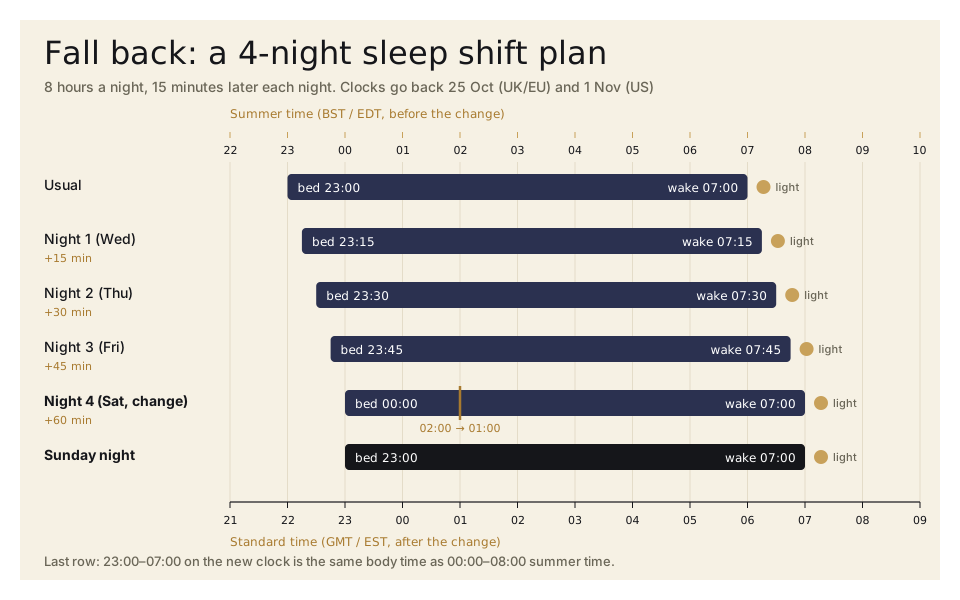
Four-night sleep shift plan: from Wednesday, bedtime and wake time move 15 minutes later each night until 00:00–08:00 summer time equals 23:00–07:00 standard time
Eight hours a night, 15 minutes later each night. Clocks go back at 2:00 am on 25 October (UK) and 1 November (US), so 11 pm–7 am on the new clock feels like midnight–8 am summer time.

Light: more in the evening, less at dawn

Evening light pushes your internal clock later; early-morning light pulls it earlier. So in the days before the change, get outside in the late afternoon while it is still bright, and keep normal room lighting in the evening rather than sitting in semi-darkness. If you wake at 5:30 am after the switch, do not reach straight for the brightest lamp: strong light at that hour reinforces the early wake-up.

Once you have adjusted, morning light becomes your ally again. Fifteen to thirty minutes of daylight in the first hour after waking helps keep a steady rhythm through the dark months, when a short walk before work may be your only real dose of daylight.

A wind-down routine that helps

Going to bed 15 minutes later is an invitation to scroll. Fill that time with something that tells your body the day is over:

  • Breathing. The 4-7-8 breathing exercise: in for 4 seconds, hold for 7, out for 8. The long exhale slows breathing down before sleep.
  • Sound. If street or neighbour noise keeps you up, a steady background helps, such as brown noise, or binaural beats for sleep on headphones.
  • Meditation. A guided sleep meditation with a body scan suits people whose minds replay the day.
  • Warm, then cool. A warm shower an hour or two before bed, and a cool bedroom of around 18 °C (65 °F).
Specific situations

How to help kids adjust to the time change

Toddlers and babies cannot read clocks: a child who wakes at 6:30 am will be up at 5:30 am after the switch. The 15-minute plan helps most here. From Wednesday, move bedtime, dinner and bath 15 minutes later each evening, let them play outside in the afternoon, and keep blackout curtains closed in the morning. In the US, the change falls on Halloween night, so a late night of trick-or-treating actually works in your favour if Sunday morning stays calm and dim. If you missed the window, shift bedtime by 15 to 20 minutes a day over three or four days after the change. Teenagers usually need the opposite: protect them from drifting too late at the weekend.

Dogs and cats

Pets live by routine: feeding, walks and your alarm. Move meals and walks 10 to 15 minutes later for a few days before the change. If you do not, expect a dog asking for breakfast an hour early for the first week. Avoid feeding the moment they nudge you, or the early start becomes the new habit.

Shift workers and night shifts

A night shift from Saturday into Sunday will be one hour longer on the clock. Nap in the afternoon before it, and wear sunglasses on the way home on Sunday morning so bright light does not block sleep. If you have any say in the rota, avoid stacking several night shifts in transition week. If you drive after a night shift and your eyes start closing, coffee is not the answer: pull over and rest.

If you live with insomnia anyway

For people who already struggle to sleep, transition week can add pressure. The key is not to "catch up" by lying in bed longer. If you are not asleep within about 20 minutes, get up, sit somewhere calm in low light, and return when you feel sleepy. Keep the same wake time every day, weekends included. If you are also looking at sleep products, the Mind University catalogue includes SleepWell, a product intended for sleep. If insomnia lasts longer than three months on at least three nights a week, see your doctor: chronic insomnia is treatable, and cognitive behavioural therapy for insomnia (CBT-I) is commonly offered.

What to avoid

  • Sleeping in on Sunday. Lying in until 9:00 am new time makes Sunday night harder. Get up at your usual time.
  • Late naps. If you need one, keep it to 20 minutes and before 3:00 pm.
  • Afternoon coffee. Caffeine lingers for hours; in transition week, have the last cup by 2:00 pm.
  • A nightcap. Alcohol may help you nod off but fragments the second half of the night and encourages the early waking that autumn already brings.
  • Screens in bed. Bright, engaging content late in the evening pushes sleep later and keeps the mind busy.
  • Long drives on Sunday if you slept badly, and big decisions made on a short night.

Will the clock changes ever end?

United States

Federal law lets states stay on standard time year-round, as Hawaii and most of Arizona do, but not adopt daylight saving time permanently. The Sunshine Protection Act would make daylight saving time permanent nationwide. As TIME reported on 7 October 2026, the House passed it with bipartisan support in July 2026, and President Trump has urged Congress to act, but the Senate has not yet voted and some senators remain opposed. Notably, sleep scientists want the opposite: the AASM favours permanent standard time, arguing that permanent daylight saving time would leave winter mornings dark and less aligned with the body clock.

United Kingdom and the EU

The European Commission proposed ending seasonal clock changes in 2018, and the European Parliament backed it in March 2019 by 410 votes to 192. The Council of the EU, however, still has no common position; its own page says no final decision has been taken and no timeline set. Spain revived the push in October 2025, and in May 2026 Estonia's public broadcaster ERR reported that the Baltic states agree on permanent summer time but want to move together with Finland, which prefers permanent winter time. The Commission has ordered a new impact study, expected by the end of 2026. The UK sets its own clock rules and is not bound by any EU decision. For now, clocks will go forward again on 28 March 2027 in the UK and EU, and on 14 March 2027 in the US.

Some people also blame the moon for restless nights. If you suspect a pattern, note it in a sleep diary along with today's moon phase and see after a few months whether the link holds up for you.

FAQ

When does daylight saving time end in 2026?

In the US, on Sunday 1 November 2026 at 2:00 am local time, when clocks go back to 1:00 am. In the UK and the EU, British Summer Time and European summer time end a week earlier, on Sunday 25 October 2026.

Do we gain or lose an hour in the fall?

On the clock you gain an hour: 2:00 am becomes 1:00 am. In terms of sleep, research suggests most people do not actually sleep an extra hour that night, and early risers may lose some sleep over the following week.

How long does it take to adjust to the time change?

For most adults the autumn change is easier than the spring one, and sleep timing settles within a few days. Children, early risers and shift workers may need up to a week, which is why the gradual 15-minute plan helps.

How can I fall asleep faster after the clocks go back?

Dim the lights an hour before bed, do a few rounds of 4-7-8 breathing, and use a steady sound or a sleep meditation. If you are still awake after about 20 minutes, get up and come back when you feel sleepy.

Is the end of daylight saving time linked to depression?

A large Danish study found an 11% rise in hospital contacts for depressive episodes after the autumn change, fading over about ten weeks. It is an association, not proof of cause, but it is a reason to protect daylight and routine in November.

Which states do not change their clocks?

Hawaii and most of Arizona stay on standard time all year (the Navajo Nation in Arizona does observe daylight saving time). US territories such as Puerto Rico and Guam also do not change.

Sources

  1. 15 U.S. Code § 260a. Advancement of time or changeover dates. https://www.law.cornell.edu/uscode/text/15/260a
  2. GOV.UK. When do the clocks change? https://www.gov.uk/when-do-the-clocks-change
  3. Directive 2000/84/EC of the European Parliament and of the Council of 19 January 2001 on summer-time arrangements. https://eur-lex.europa.eu/legal-content/EN/TXT/?uri=CELEX:32000L0084
  4. Rishi, M. A., et al. (2020). Daylight saving time: an American Academy of Sleep Medicine position statement. Journal of Clinical Sleep Medicine, 16(10), 1781–1784. https://pubmed.ncbi.nlm.nih.gov/32844740/
  5. Rishi, M. A., et al. (2024). Permanent standard time is the optimal choice for health and safety: an American Academy of Sleep Medicine position statement. Journal of Clinical Sleep Medicine, 20(1), 121–125. https://pubmed.ncbi.nlm.nih.gov/37904574/
  6. Kantermann, T., Juda, M., Merrow, M., & Roenneberg, T. (2007). The human circadian clock's seasonal adjustment is disrupted by daylight saving time. Current Biology, 17(22), 1996–2000. https://pubmed.ncbi.nlm.nih.gov/17964164/
  7. Harrison, Y. (2013). The impact of daylight saving time on sleep and related behaviours. Sleep Medicine Reviews, 17(4), 285–292. https://pubmed.ncbi.nlm.nih.gov/23477947/
  8. Fritz, J., VoPham, T., Wright, K. P., & Vetter, C. (2020). A chronobiological evaluation of the acute effects of daylight saving time on traffic accident risk. Current Biology, 30(4), 729–735. https://pubmed.ncbi.nlm.nih.gov/32008905/
  9. Manfredini, R., et al. (2019). Daylight saving time and acute myocardial infarction: a meta-analysis. Journal of Clinical Medicine, 8(3), 404. https://pubmed.ncbi.nlm.nih.gov/30909587/
  10. Hansen, B. T., et al. (2017). Daylight savings time transitions and the incidence rate of unipolar depressive episodes. Epidemiology, 28(3), 346–353. https://pubmed.ncbi.nlm.nih.gov/27775953/
  11. Lee, C. (2026, October 7). Most Americans want to stop changing the clocks. Here's why senators are hesitating. TIME. https://time.com/article/2026/10/07/senate-permanent-daylight-saving-time-sunshine-protection-act/
  12. Council of the European Union. Seasonal clock changes in the EU. https://www.consilium.europa.eu/en/policies/seasonal-time-changes/
  13. ERR News. (2026, May 29). Baltic decision on permanent summer time stalls over Finland's preference. https://news.err.ee/1610041702/baltic-decision-on-permanent-summer-time-stalls-over-finland-s-preference
Go deeper
From the shop on this topic
Comments (0)
Mind University
About the author
Mind University
Žinių platforma

Mind University – lietuviška žinių platforma, vienijanti geriausius mentorius, tyrėjus ir praktikus asmeninio augimo, sveikatos, istorijos ir dvasingumo srityse. Kursai, knygos ir seminarai, padedantys gyvenimą pakeisti iš esmės.

59 articles →

Comments (0)

No comments yet. Be the first!

Only logged-in users can comment. Register — and you'll be able to share your thoughts on this article.

Register
Journal

What you should know, before others do

Weekly insights. One article. One practice. No noise.

When Does Daylight Saving Time End? 2026 Dates, Sleep Plan — Mind University