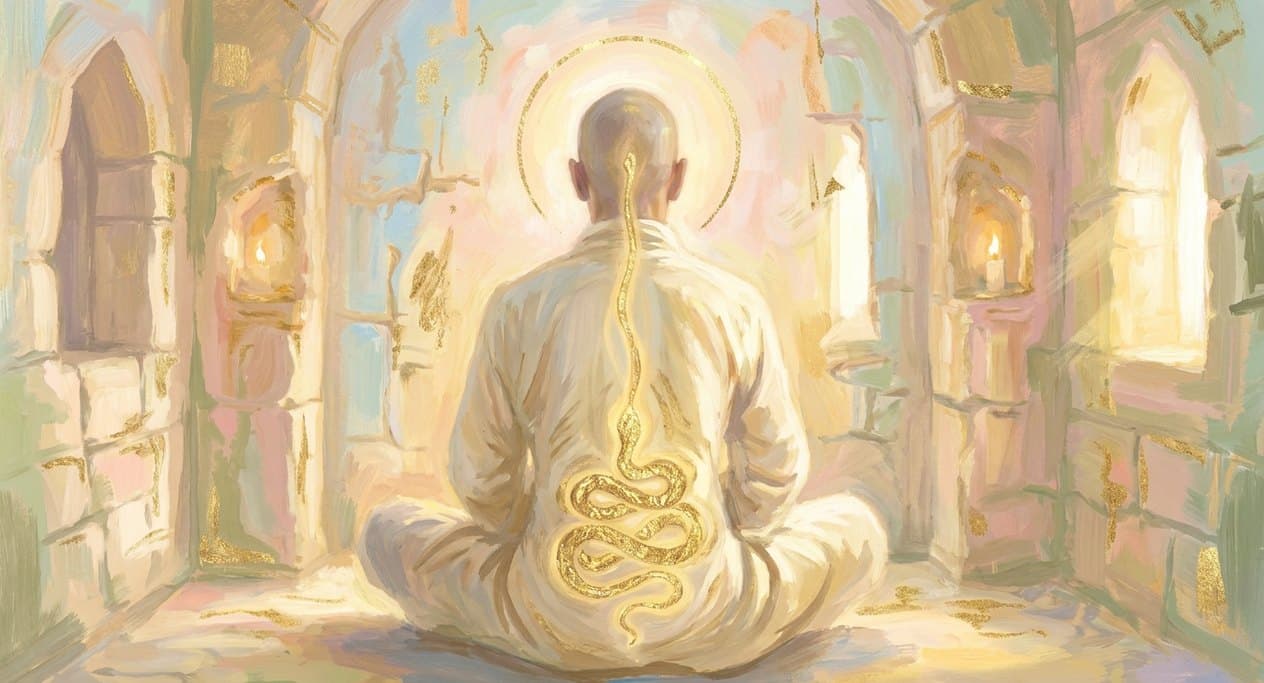
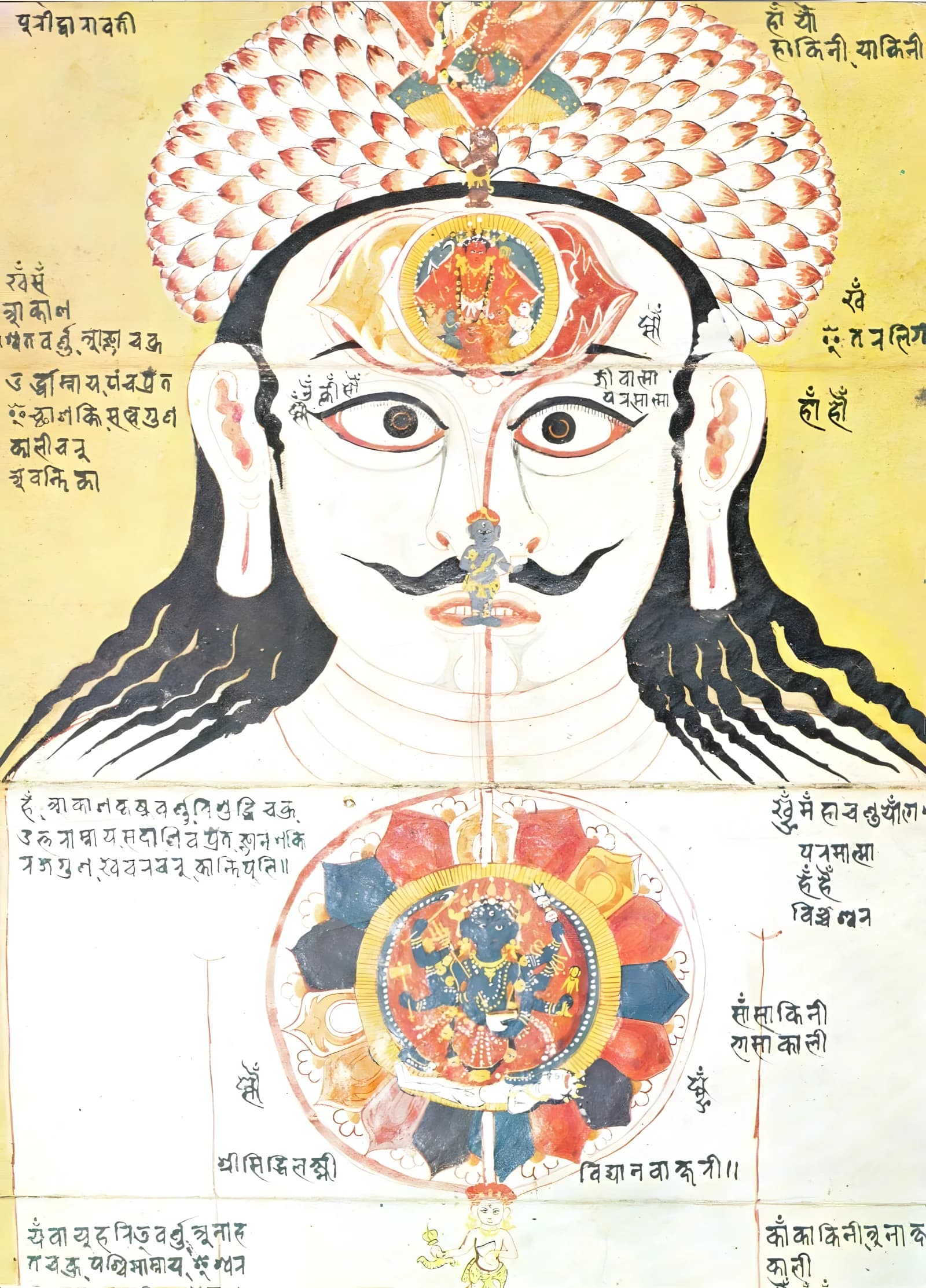
Kundalini (Sanskrit kuṇḍalinī, “the coiled one”) is, in the tantric and yogic traditions, the divine life force that lies asleep at the base of the spine, curled like a serpent. Once awakened it rises through the central channel and the chakras to the crown, where, the texts say, Shakti unites with Shiva and a person tastes liberation.
Key facts
The word “kundalini” comes from the Sanskrit kuṇḍala, “ring, coil”, and means “the coiled one”.
According to the tantric texts, kundalini sleeps in the root chakra, coiled three and a half times.
The Ṣaṭ-cakra-nirūpaṇa was written in 1577 by the Bengali tantric Pūrṇānanda; Arthur Avalon translated it in The Serpent Power (1919).
The fifteenth-century Haṭha Yoga Pradīpikā calls kundalini the support of all yoga practices.
Gopi Krishna described his 1937 kundalini experience in Kundalini: The Evolutionary Energy in Man (1967).
Kundalini Yoga as a group practice was popularised in the West by Yogi Bhajan, who founded 3HO in 1969.
Contents
What is kundalini?
The word “kundalini” comes from the Sanskrit kuṇḍala, “ring, coil”. Kuṇḍalinī literally means “the coiled one”. In the tantric and yogic traditions it is the name of the divine life force that lies asleep at the base of the spine, curled up like a serpent. When it awakens, the texts say, it rises through an inner channel along the spine, passes through the energy centres known as chakras and, at the crown of the head, merges with pure consciousness.
In the tradition, kundalini is not “energy” in the modern sense, like electricity or calories. It is a goddess: Shakti, the cosmic creative power that brought the world into being and hides that same power in every human being. Her journey upward is a journey home. Shakti travels to her consort Shiva, and their union is what the yogis call liberation.
Today people talk about kundalini on three levels. The first is the old tantric and hatha yoga texts, which map the subtle body and describe the practices. The second is the twentieth-century teachers who brought kundalini to the West and wrote about their own experiences. The third is modern Kundalini Yoga, with its breathwork, mantras and gong, which you can now find in yoga studios in most cities.
Kundalini in Tantra and Shaktism
The teaching on kundalini was born in the Tantras, the Indian tradition that sees the body not as an obstacle but as a temple and a vehicle of liberation. Shaktism, which worships the Goddess as the highest reality, sees kundalini as her presence in the human being. In Kashmir Shaivism, whose greatest teacher was the tenth and eleventh-century philosopher Abhinavagupta, kundalini is described as the power of consciousness itself, which can contract and sleep or unfold and rise.
One of the most important texts is the Ṣaṭ-cakra-nirūpaṇa (“Description of the Six Chakras”), written in 1577 by the Bengali tantric Pūrṇānanda. It describes each chakra in detail: the number of its lotus petals, its colour, its seed syllable, its deity and its element. Western readers met this text in 1919, when Sir John Woodroffe, writing as Arthur Avalon, published a translation with commentary in The Serpent Power. It remains one of the most quoted books on kundalini to this day.
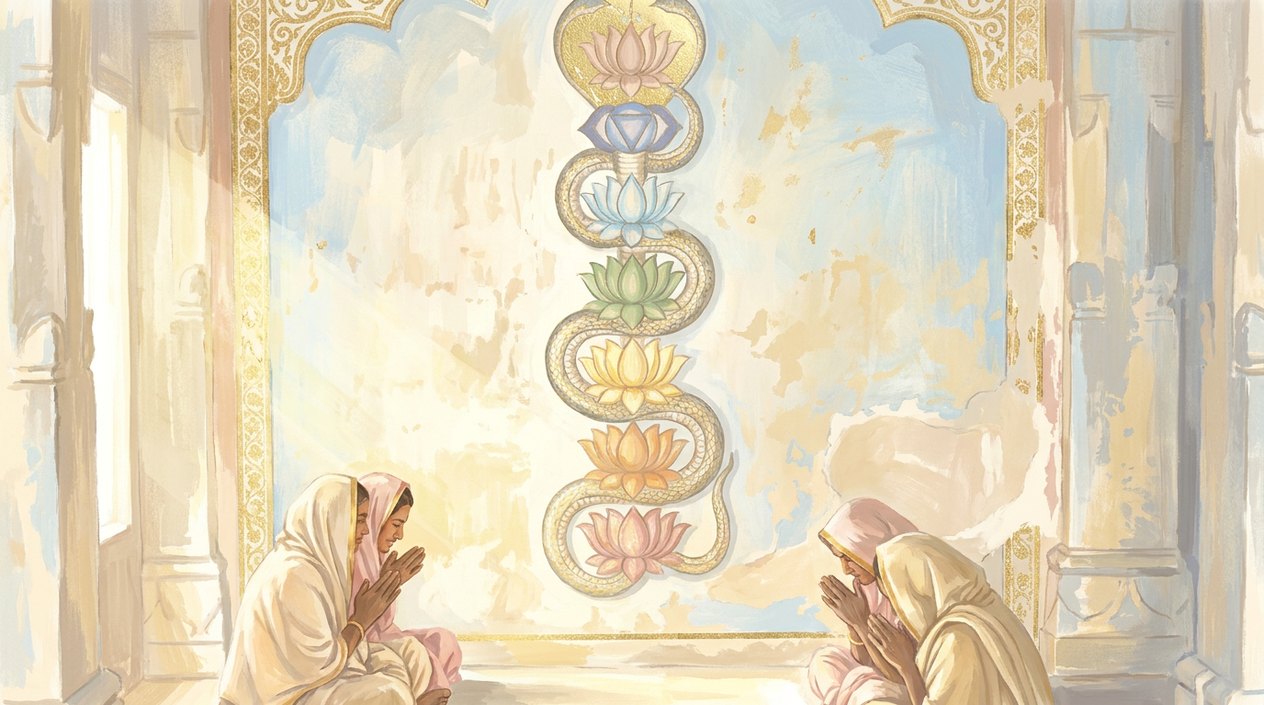
In temple art kundalini appears as a serpent rising through a column of lotuses, the chakras.
In the texts kundalini sleeps at the centre of mūlādhāra, the root chakra, coiled three and a half times around Shiva's emblem (the svayambhu linga), her mouth closing the entrance to the central channel. The three and a half coils carry their own meaning. The three coils are often read as the three qualities of nature (guṇas) or the three states of consciousness, waking, dreaming and deep sleep, and the half coil as what lies beyond them.
The subtle body: nadis, chakras and knots
To understand how kundalini “rises”, you need the traditional map of the subtle body. The hatha yoga texts speak of 72,000 energy channels (nāḍīs) through which the life force, prāṇa, flows. Three of them matter most.
Ida: the lunar channel
Begins on the left side and ends at the left nostril.
Linked with coolness, calm, the moon and the feminine principle.
Pingala: the solar channel
Begins on the right side and ends at the right nostril.
Linked with heat, action, the sun and the masculine principle.
Sushumna: the central channel
Runs through the middle of the spine from the root chakra to the crown.
According to the texts, this is the path the awakened kundalini takes once the currents of ida and pingala merge.
The chakras sit along the sushumna. The Ṣaṭ-cakra-nirūpaṇa describes six chakras and a seventh centre at the crown, the thousand-petalled lotus. We look at each chakra in depth in our article Chakras: do they exist?, so here is just a short table tracing the path of kundalini.
Centre
Location
Petals and element
On the path of kundalini
Mūlādhāra
Perineum, base of the spine
4, earth
Kundalini sleeps here; awakening starts with stability and grounding
Svādhiṣṭhāna
Below the navel
6, water
Creative and emotional power opens up
Maṇipūra
At the navel
10, fire
Will and inner heat; many practitioners feel warmth here
Anāhata
Centre of the chest
12, air
Love and compassion open, and the inner sound (nāda) is heard
Viśuddha
Throat
16, ether
Truth, speech and the power of mantra
Ājñā
Between the eyebrows
2, mind
The so-called third eye: visions and clear seeing
Sahasrāra
Crown of the head
1,000
Shakti unites with Shiva and the sense of separateness dissolves
The tradition also speaks of three knots (granthis) that block the way. Brahma's knot at the root is tied to attachment to the body and to safety, Vishnu's knot at the heart to attachment to feelings and people, and Rudra's knot between the eyebrows to attachment to one's name, knowledge and powers. Teachers say each knot loosens not through force but through mature letting go of what it is made of.
Kundalini in the hatha yoga texts
Hatha yoga, which most people today know as a system of postures, began as the art of awakening kundalini. Svātmārāma's fifteenth-century Haṭha Yoga Pradīpikā opens its third chapter by saying that just as the lord of serpents supports the whole earth, kundalini is the support of all yoga practices. When the sleeping kundalini awakens through the grace of the guru, the text continues, all the lotuses and knots are pierced.
The texts name specific tools for “waking” kundalini:
Bandhas (locks). Mula bandha (the root lock), uddiyana bandha (drawing the belly in and up) and jalandhara bandha (the chin lock) steer the flow of prana into the central channel. All three together are called mahā bandha, the great lock.
Mudras. The Haṭha Yoga Pradīpikā lists ten mudras, among them mahā mudrā, khecarī and śakti cālana, “stirring the Shakti”, which is meant for kundalini itself.
Pranayama. Breath retention (kumbhaka) and especially bhastrikā, “bellows breath”, of which the text says it awakens kundalini quickly.
Nada yoga. Listening to the inner sounds, which, the texts say, gradually carry the practitioner into deep meditation.
Other hatha yoga texts, such as the Gheraṇḍa Saṃhitā and the Śiva Saṃhitā, describe similar practices. All of them stress two things: the practice is to be done under a teacher, and only after the body and mind have been prepared by long, patient work.
How the traditions describe awakening
In the teachers' accounts, kundalini awakening is not a one-off event but a process that may take years. It comes with signs the tradition calls kriyās, the spontaneous movements of the awakened force.
Heat and currents. Warmth at the base of the spine or along it, tingling, a sense of current flowing through the body.
Spontaneous movements. Trembling, swaying, postures or mudras the body takes on by itself, breath that pauses on its own.
Inner light and sound. Visions of light with the eyes closed, the sounds of bells, flute, humming bees or thunder described in the nada yoga texts.
Strong feelings. Tears, bursts of joy, a sudden flood of love, and sometimes a wave of old memories.
Changed perception. A temporary loss of the boundaries of time and body, the experience of oneness with everything.
A story from the tradition
Sri Ramakrishna, the nineteenth-century Bengali mystic, told his disciples that kundalini does not always rise the same way. Sometimes it moves like an ant, slowly and with a tingling; sometimes like a fish darting through water; sometimes it leaps like a monkey from branch to branch, hops like a bird, or winds like a snake. When it reaches the head, he said, a person can no longer speak of it, because the one who would speak has simply vanished.
The teachers who brought kundalini to the West
In the twentieth century kundalini moved out of closed tantric circles and became a worldwide subject. Each of these teachers added something different: one a translation of the texts, another a personal account, a third a system of practice.
John Woodroffe (Arthur Avalon)
A British judge in Calcutta who translated tantric texts together with Indian collaborators.
The Serpent Power (1919) became the main English-language source on kundalini.
Swami Sivananda
Founder of the Divine Life Society in Rishikesh and author of Kundalini Yoga (1935).
Insisted that kundalini practice must go hand in hand with an ethical life, service and devotion.
Gopi Krishna
A Kashmiri civil servant whose kundalini awakened suddenly during long meditation in 1937, bringing years of both bliss and severe difficulty.
He described his experience in Kundalini: The Evolutionary Energy in Man (1967), which became a classic.
Swami Muktananda
A Siddha Yoga teacher who made shaktipat, the awakening of kundalini through the guru's grace, known around the world.
He described his spiritual path in his autobiography Play of Consciousness.
Swami Satyananda Saraswati
Founder of the Bihar School of Yoga and a disciple of Sivananda.
In Kundalini Tantra (1984) he combined tantric practice with systematic exercises for each chakra.
Yogi Bhajan
A teacher who arrived in the United States in 1968, founded 3HO in 1969 and popularised Kundalini Yoga as a group practice.
His students still practise in white, with mantras and the gong; a 2020 investigation into his conduct towards students led the community to rethink how the teaching is passed on.
The idea of kundalini also shaped Western thinkers. In 1932 in Zurich, Carl Gustav Jung gave a seminar on Kundalini Yoga in which he read the chakras as stages of a person's spiritual growth; the notes were published in 1996 as The Psychology of Kundalini Yoga.
A similar force in other traditions
The word “kundalini” is Indian, but other cultures describe a similar experience: a power that rises along the spine and transforms consciousness.
Tradition
Name
How it is described
Tibetan Buddhism
Tummo (Skt. caṇḍālī)
The yoga of inner fire, one of the Six Yogas of Naropa: a fire is kindled below the navel and rises through the central channel
Taoism
Microcosmic orbit
A current of qi rises up the channel along the back to the crown and descends down the front, forming a circle
The San of the Kalahari
N/um
During healing dances a “boiling” power rises from the base of the spine to the head, and the healer enters an altered state
Kashmir Shaivism
Ūrdhva kuṇḍalinī
Rising kundalini as an expansion of consciousness leading to the state of Shiva
In Boiling Energy (1982) the anthropologist Richard Katz described how San healers of the Kalahari feel, during all-night dances, a power climbing the spine, hot and painful, until it “bursts” and allows them to heal. Many researchers have noted how strikingly close this is to the yoga texts.
Kundalini Yoga today
Many people first meet kundalini in a yoga studio, in a Kundalini Yoga class in the tradition of Yogi Bhajan. It is quite different from posture-based yoga: a class is built from kriyas, set sequences that combine movement, breath, mantra and the focus of attention.
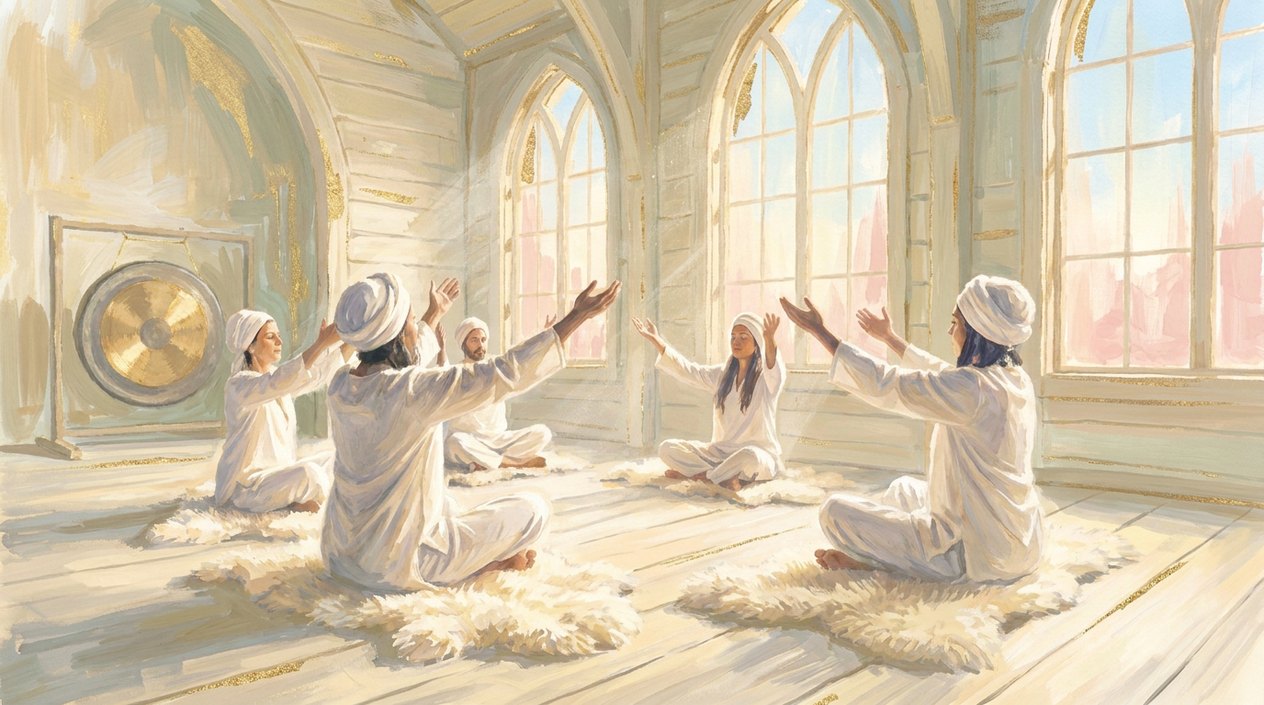
Modern Kundalini Yoga is practised in white, combining breath, mantra and the sound of the gong.
Breath of Fire. Rapid, rhythmic breathing through the nose, with the belly pushing each exhale. The tradition treats it as the main tool for waking kundalini.
Mantras. Classes open with the Adi Mantra, Ong Namo Guru Dev Namo, and the most repeated mantra is Sat Nam, “Truth is my name”.
Sat Kriya. One of the best-known kriyas: sitting on the heels with arms raised overhead, you chant “Sat Nam” while pulling in the navel point.
Gong relaxation. At the end of class students lie down while the teacher plays the gong, a sound treated as cleansing and integrating.
White clothing. According to the tradition, white expands the aura and helps hold attention.
In classical Tantra and hatha yoga, waking kundalini is the summit of a long path, while Kundalini Yoga classes offer the exercises to everyone from the very first lesson. Both views agree that kundalini is not a workout but a spiritual path.
Kundalini practice: where to begin
Every teacher repeats the same thing: kundalini is not a force you “raise”. It wakes on its own when the body, breath and mind are ready. That is why the traditional path starts not with intense techniques but with the foundations.
A daily rhythm. Regular sleep, moderate food and a short practice every day at the same time. The hatha yoga texts give this more attention than any single technique.
Grounding. Feet on the ground, walking, calm standing postures. Mūlādhāra is kundalini's home, so stability comes first.
Calm breathing. Slow belly breathing and alternate nostril breathing (nāḍī śodhana), which the texts say purifies ida and pingala.
Attention on the spine. Sitting with a straight back, move your attention slowly from the base of the spine to the crown and back down, pausing for a few breaths at each centre.
Mantra and silence. A few rounds of your chosen mantra, then a few minutes of silence in which you simply notice what is happening in the body.
A timer that shows the inhale and the exhale makes it easier to keep a steady breathing rhythm.
The tradition advises learning the intense techniques, such as bhastrika, long breath holds and mula bandha with kumbhaka, only with an experienced teacher. Teachers compare it to a river: if the water is released before the channels are cleared, it floods the fields instead of watering them. That is why Swami Sivananda always tied kundalini practice to an ethical life, service and devotion.
When the awakening is too strong
The tradition knows the hard side of kundalini well. Gopi Krishna wrote about months of burning heat, sleeplessness and fear before he learned to restore his balance. Yoga teachers call such states not a punishment but a sign that the force woke faster than the body was ready for.
What the tradition suggests in that case:
Stop the intense practices. Put rapid breathing, breath holds and long meditations aside until things settle.
Ground yourself. Walk barefoot, work with your hands, spend time in nature, eat warm and filling food.
Cool down. Gopi Krishna described how shifting his attention to the cooling ida brought relief; many teachers suggest calm breathing through the left nostril.
Find a teacher. In the tradition, this is exactly the stage for which you need someone who has walked the path.
When to seek help
If after practice you have not slept for more than a few days, feel strong anxiety or panic, can no longer tell what is real, or have thoughts of harming yourself, do not wait for it to “pass on its own”. Talk to someone close to you and see a doctor. In the US and Canada you can call or text 988; in the UK and Ireland, Samaritans are on 116 123. If a life is in danger, call your local emergency number.
Kundalini, karma and destiny
Many schools link the path of kundalini with karma. According to the tradition, the knots in the sushumna are impressions (saṃskāras) gathered from past actions and lives, and the awakened kundalini burns them away little by little. That is why old feelings and memories surfacing during an awakening are seen not as a failure but as purification. When kundalini reaches the crown, the texts say, the wheel of birth and death, samsara, is broken too.
Kundalini is often linked with the aura as well. Kundalini Yoga teachers say regular practice widens and brightens it, and clairvoyants describe the aura of an awakened person as more radiant, especially around the head. Some teachers read the halo of Christian art and the light around the Buddha's head as signs of an awakened kundalini.
How kundalini differs from related concepts
Concept
Essence
Link with kundalini
Prana
The life force flowing through the nadis
Prana feeds the body every day; kundalini is its sleeping source, which changes consciousness when it wakes
Chakras
Energy centres along the spine
The stations kundalini passes through as it rises
Shakti
The divine creative power
Kundalini is Shakti in the human body
Shaktipat
Transmission of spiritual power
A way of waking kundalini through the teacher's grace
Samadhi
The deepest meditative state of oneness
The goal of kundalini's journey, reached at the crown
Self-knowledge guide Ema Sakalauskaitė writes about how to recognise the so-called signs of kundalini awakening, and when intense experiences call for more care for yourself.
Frequently asked questions
What is kundalini in simple terms?
According to the tantric and yogic traditions, kundalini is the sleeping source of the divine life force in every person, pictured as a serpent coiled at the base of the spine. When it wakes it rises along the spine through the chakras and transforms consciousness.
What are the signs of kundalini awakening?
The traditions mention heat or currents along the spine, spontaneous movements and trembling (kriyas), visions of inner light and inner sounds, strong emotions and an experience of oneness. Teachers stress that awakening is a process that can take years.
How do you awaken kundalini?
The hatha yoga texts name bandhas (locks), mudras, pranayama and mantras, while Shaktism adds shaktipat, transmission from a teacher. Every tradition advises starting with a daily rhythm, grounding and calm breathing, and learning intense techniques only with an experienced teacher.
Can a kundalini awakening be dangerous?
The tradition also describes hard awakenings: heat, sleeplessness, fear. Teachers then advise stopping intense practices, grounding and finding an experienced teacher, and if you cannot sleep for more than a few days or feel strong anxiety, seeing a doctor.
What is the difference between kundalini and the chakras?
The chakras are energy centres along the spine, while kundalini is the force that, once awake, rises through them along the central channel from the root chakra to the crown.
What is Kundalini Yoga?
Kundalini Yoga is the practice popularised by Yogi Bhajan, in which kriyas combine movement, Breath of Fire, mantras such as Sat Nam and the sound of the gong. It differs from classical Tantra, where waking kundalini is the summit of a long path.
Why is kundalini shown as a serpent?
A serpent lies coiled at rest and can uncoil in an instant, so in Indian traditions it stands for a power that sleeps and wakes. A snake also sheds its skin, which made it a sign of renewal and transformation.
Sources
Svātmārāma, Haṭha Yoga Pradīpikā, 15th century, chapters II–III
Pūrṇānanda, Ṣaṭ-cakra-nirūpaṇa, 1577
A. Avalon (J. Woodroffe), The Serpent Power, Luzac & Co., 1919
Swami Sivananda, Kundalini Yoga, 1935
Gopi Krishna, Kundalini: The Evolutionary Energy in Man, 1967
Swami Satyananda Saraswati, Kundalini Tantra, Bihar School of Yoga, 1984
C. G. Jung, The Psychology of Kundalini Yoga, ed. S. Shamdasani, Princeton University Press, 1996
R. Katz, Boiling Energy: Community Healing Among the Kalahari Kung, Harvard University Press, 1982